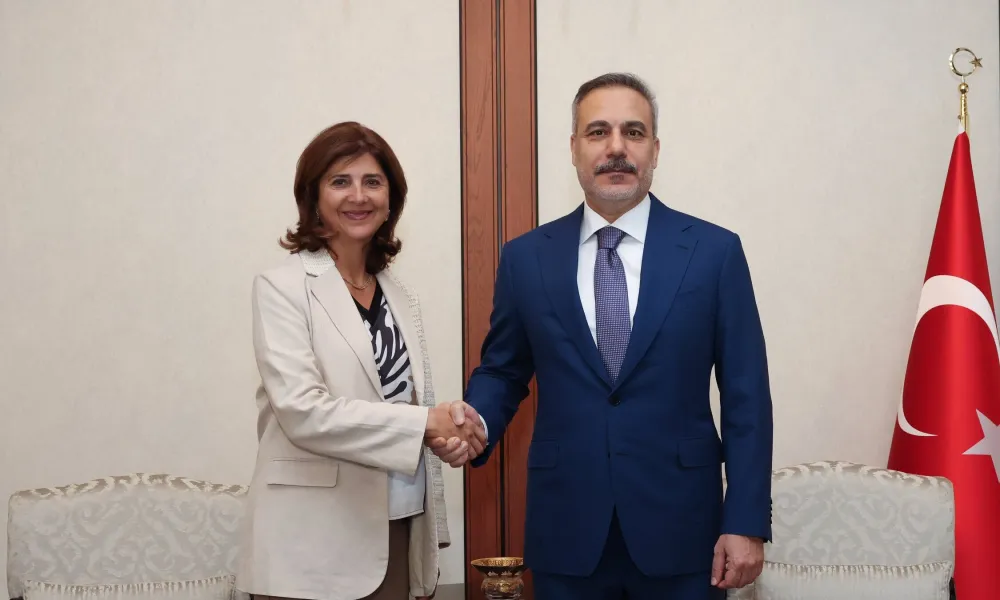

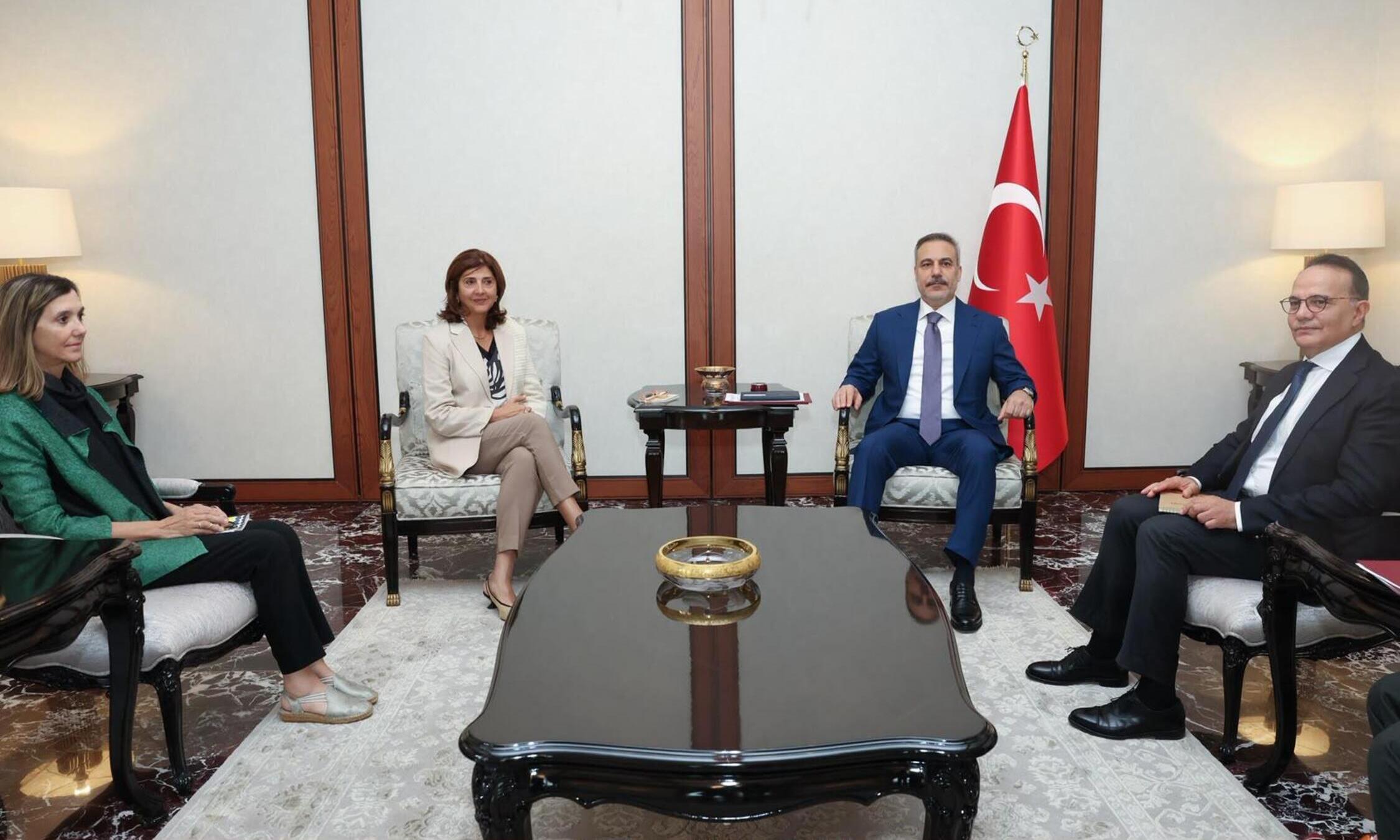
UN Personal Envoy María Ángela Holguín met with Turkish Foreign Minister Hakan Fidan on Friday afternoon in Ankara to discuss the Cyprus issue ahead of UN Secretary-General António Guterres’ visit to Cyprus on Monday.
The Ankara meeting is considered a key step in the effort to build momentum towards the UN convening an enlarged 5+1 meeting that could kickstart formal negotiations, nine years after the collapse of Crans-Montana.
Holguín went to the Turkish capital after holding discussions with European Commission President Ursula von der Leyen and her Special Representative for Cyprus Raffaele Fitto in Brussels on Wednesday.
The UN envoy returns to Cyprus on Saturday where she will brief the two leaders separately before Guterres’ arrival.
EU and UN aligning on Ankara
According to multiple sources, Holguín’s Brussels meetings went well and were considered “positive”. Given the increasing effort to tie EU-Turkey relations with progress on the Cyprus problem, it is understood the UN envoy would have met Fidan fully aware of what Brussels can offer Ankara as an incentive to move forward on Cyprus.
Turkey reportedly wishes to see progress on negotiations for an upgraded customs union with the EU, closer participation in the EU’s defence funding mechanism SAFE, and visa liberalisation.
Nicosia also wants to use EU-Turkey relations as leverage to secure Ankara’s positive approach to the peace effort. What remains to be seen is what exactly the EU is willing to offer and for what in exchange? Is acquiescence to go to a 5+1 meeting enough or must the sides also push ahead and agree to launch negotiations? If so, on what basis and with what milestones?
Then there is the question of what the Turkish Cypriots want, including the long-standing claim for the three Ds: direct trade, direct flights and direct contact. On launching peace talks, Turkish Cypriot leader Tufan Erhürman recently said in an interview he wants to see confidence-building measures and agreement on methodology first. As for the talks, he dismissed the notion of starting from where they were interrupted since they had already ended in failure at that point.
The Greek Cypriot side has long argued for talks to start from where they left off in Crans-Montana. What does this mean in practice? Does this include the Guterres Framework, and more specifically, the UNSG’s reference to security and guarantees? According to sources, it might do. The Greek Cypriot side also wants confirmation of the three singles (sovereignty, international personality and citizenship) and four EU fundamental freedoms (free movement of goods, services, capital and persons) though at what point in the process is unclear.
Nicosia also wants any parallel progress in EU-Turkey relations to be phased and reversible, depending on Turkey’s role in the peace effort. But what happens if the talks start and collapse and neither Ankara nor the Turkish Cypriots are considered responsible?
Shifting sands
In a sign of the rapid developments taking shape and shifting sands, semi-government news agency CNA reported on Friday afternoon that while the UN and EU see room for progress on the Cyprus issue, the Greek Cypriot side is conveying to both that Ankara’s position and messages to date do not reflect that.
CNA cites sources pointing to the recent NAVTEX issued by Turkey to conduct surveys in the waters between Mersin and the north for which there are plans to build a two-way natural gas pipeline by 2028. They also referred to efforts by Turkey’s foreign minister to delink progress on EU-Turkey relations from progress on the Cyprus problem.
Ankara’s position
The Turkish Foreign Ministry posted a laconic statement on social media on Friday afternoon, simply saying Foreign Minister Hakan Fidan met with the UN envoy in Ankara.
According to ministry sources, Fidan reiterated Turkey’s long-standing positions during an exchange of views with Holguín ahead of Guterres’ upcoming visit to the island.
The sources said Fidan told Holguín Turkey believes the most realistic solution to the Cyprus issue lies in the coexistence of the island’s two states side by side. He also stressed that, on the basis of the realities on the island, approaches that fail to recognise the inherent rights of the Turkish Cypriot people to sovereign equality and equal international status would not contribute to efforts to reach a settlement.
Busy days ahead
According to Director of the President’s Press Office Victoras Papadopoulos, President Nikos Christodoulides will fly to Athens on Saturday morning to meet with Greek Prime Minister Kyriacos Mitsotakis at the Maximos Mansion at 11.30am before returning to Cyprus the same day. The two will have a tete-a-tete before expanded talks with their respective officials, including Foreign Minister Constantinos Kombos, European Affairs Deputy Minister Marilena Raouna and negotiator Menelaos Menelaou.
The aim of the lightning visit is to discuss the latest developments on the Cyprus issue and coordinate steps ahead of Guterres’ visit. The issue of EU-Turkey relations is likely to play a significant role in the dialogue between Athens and Nicosia.
Guterres’ last stand
Meanwhile, the UNSG arrives on Monday, holds separate talks with the two leaders and a joint dinner on Tuesday, followed by a trilateral on Wednesday. The pressing question now is will he announce the convening of a new 5+1 in Geneva for the end of August? Or will more work need to be done before going to New York in September for an enlarged meeting? If convened, will formal talks be launched before Guterres’ term ends in December or will efforts to end the island’s division be thrown into a black hole?
National Council ‘united’ for now
Christodoulides briefed the National Council on Friday on the evolving developments on the Cyprus issue ahead of Guterres’ visit.
In a joint Communiqué, the National Council welcomed Guterres’ upcoming visit, which showed “tangible proof of his personal commitment to efforts aimed at resolving the Cyprus issue”.
The advisory body also welcomed the appointment of Fitto as EU Special Representative. Notwithstanding the long-standing positions of the political parties, the Council expressed support for the President’s efforts to resume negotiations with a view to achieving a comprehensive settlement.
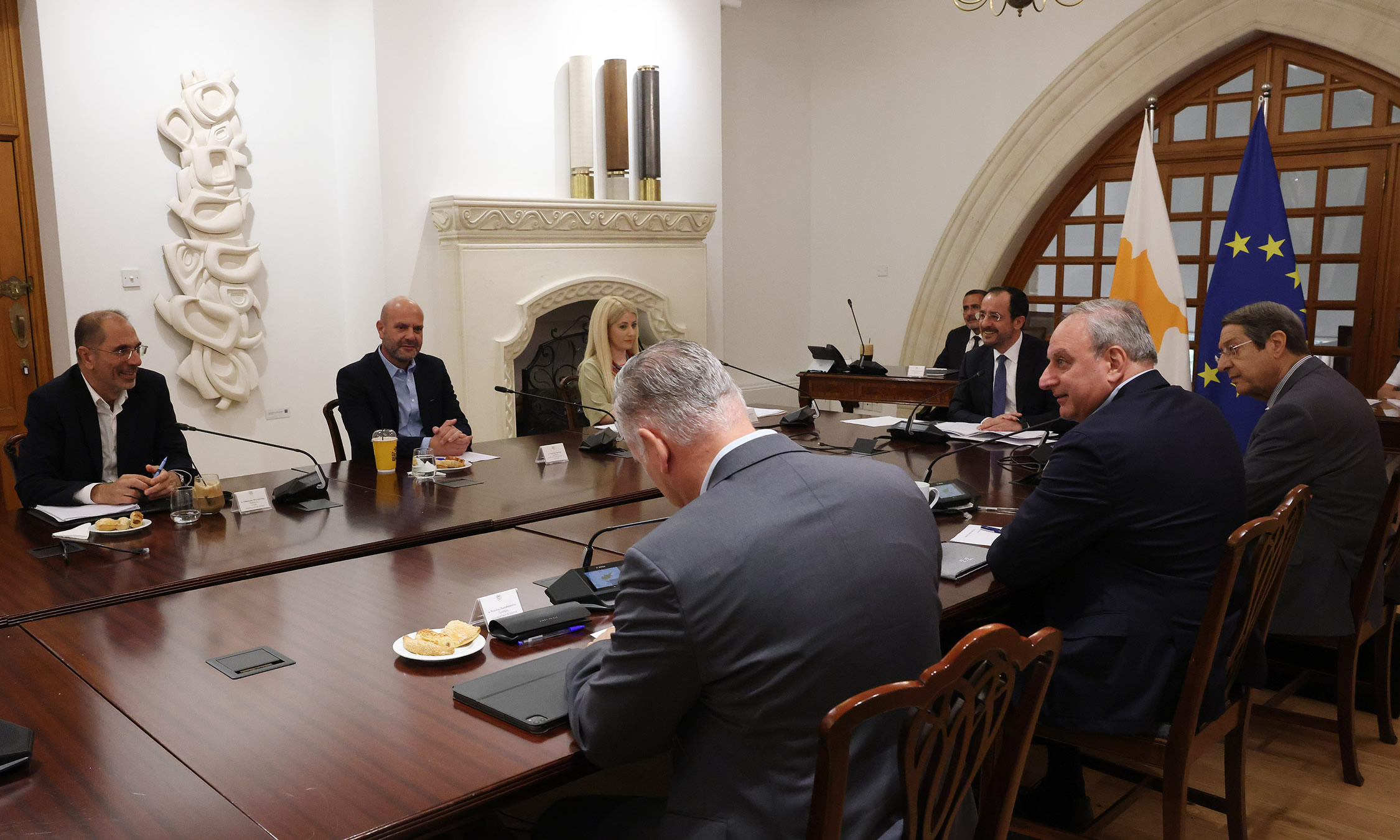
Speaking after the meeting, Government Spokesperson Konstantinos Letymbiotis said these were “critical moments” that required unity and a shared awareness of historical responsibility, elements that he said were present during the meeting.
He said: “We have chosen the path of a solution and we hope, and are determined, to follow it to the end,” adding that he hoped to see a corresponding approach from the other side.
After the meeting, DISY leader Annita Demetriou highlighted the importance of preserving the body of work achieved to date in the negotiating process, while expressing support for the UNSG’s initiative. AKEL’s Stefanos Stefanou stressed the need to preserve past convergences and make use of the Guterres Framework tabled in Crans-Montana. DIKO leader Nicholas Papadopoulos welcomed the EU’s more active involvement while ELAM leader Christos Christou reiterated his party’s rejection of a bizonal, bicommunal federation. ALMA’s Odysseas Michaelides welcomed the momentum but warned against failure leading to the island’s permanent partition. Direct Democracy sent party member Mike Spanos to the meeting. No party announcement was issued.
Minister of Foreign Affairs @HakanFidan received María Angela Holguín Cuéllar, Personal Envoy of the UN Secretary-General on Cyprus, in Ankara. pic.twitter.com/9gal4he7nF
— Turkish MFA (@MFATurkiye) July 24, 2026