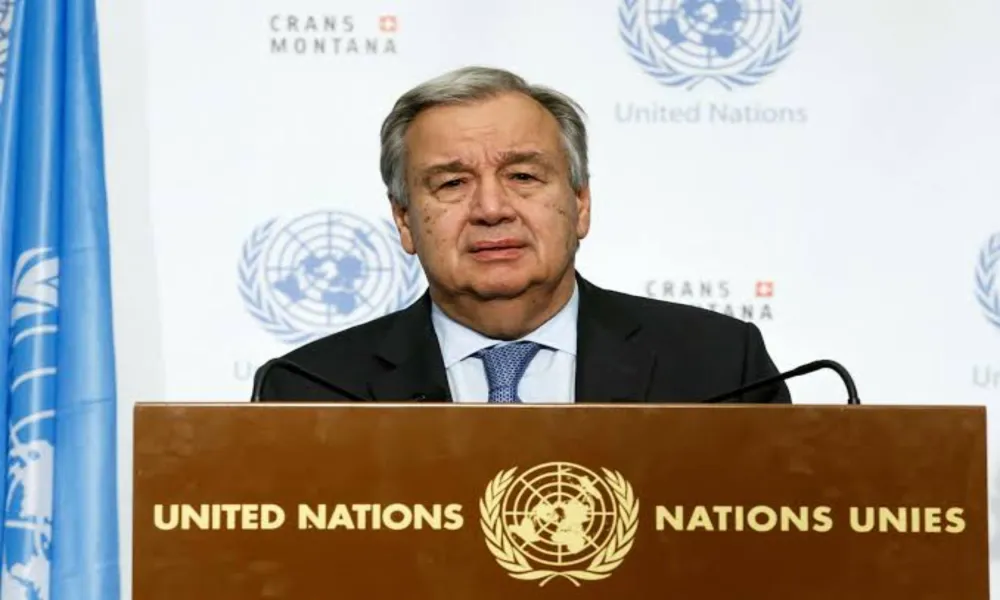

The most accurate assessment is that by the time of the Crans-Montana conference, an exceptionally extensive body of negotiating acquis had been created, but not a completed agreement.
UN Secretary-General António Guterres assessed that the essence of a comprehensive settlement was "virtually there" and that a strategic agreement was emerging.
However, because the overall package was never finalised, none of the convergences acquired independent binding force under the principle that "nothing is agreed until everything is agreed."
What exactly was the Downer document?
The document entitled "Convergences – 2008-2012", dated 30 April 2013, compiled the results of negotiations conducted mainly between Demetris Christofias and Mehmet Ali Talat, and subsequently between Christofias and Derviş Eroğlu.
The document divided the material into two categories:
Section 1: Convergences, including joint convergence papers.
Section 2: Agreements in principle, common understandings, conditional or dependent convergences, and issues where differences were considered bridgeable.
Issues on which no convergence existed were not included.
Consequently, the document did not constitute a comprehensive agreement, nor did all recorded points carry the same political weight.
The convergences of 2008-2012
Federal executive power
The following points were recorded:
- The President and Vice President would come from different constituent states.
- The presidency would be elected directly by citizens.
- The presidential term would be six years.
- The President could not be removed through a vote of no confidence.
- There would be a Council of Ministers with an agreed Greek Cypriot-Turkish Cypriot ratio.
- Ministers would be appointed jointly by the President and Vice President.
- The Council of Ministers would seek consensus, with majority decisions requiring positive votes from both communities.
The six-year term and the 4:2 formula for exercising the presidency remained a conditional convergence linked to the broader package on external relations, defence and security.
Federal parliament
Convergences included:
- A bicameral legislature consisting of a Senate and House of Representatives.
- Equal Greek Cypriot and Turkish Cypriot representation in the Senate.
- Proportional representation in the House, with a minimum one-quarter representation for each constituent state.
- Legislation requiring approval by both chambers.
- Special majorities on specified matters.
- An "alarm bell" mechanism allowing a community to suspend legislation deemed harmful to its interests.
- Referral of such disputes to the Supreme Federal Court.
Judicial authority and independent institutions
Broad convergence was achieved regarding:
- A Supreme Federal Court with equal Greek Cypriot and Turkish Cypriot participation.
- Resolution of disputes between the federal government and constituent states.
- Federal criminal courts.
- A Federal Public Service and Public Service Commission.
- Independent officials such as an Auditor General and Deputy Auditor General from different communities.
- Mechanisms for resolving institutional deadlocks.
Federal competencies
Federal authority would include:
- Foreign relations and international treaties.
- Relations with the European Union.
- Defence policy.
- Citizenship, migration, asylum and deportations.
- Counter-terrorism and organised crime.
- The Central Bank, monetary policy and financial supervision.
- The federal budget, indirect taxation, customs and trade policy.
- Telecommunications, civil aviation and airspace.
- Territorial waters, the continental shelf and the exclusive economic zone.
- Federal policing and justice.
The basic principle was that Cyprus would speak with one voice internationally, while constituent states would participate in policymaking whenever their own competences were affected.
Property
Full convergences on property were limited and largely technical.
It was agreed that:
- Public property, other than federal property, would belong to the constituent state where it was located.
- A register of federal property would be established.
- Expropriated property would require compensation.
- A donor conference and compensation funding mechanism could be created.
- Development of affected properties would begin primarily with vacant properties.
- Common categories of affected property were identified.
Bridgeable issues included:
- Restitution, exchange and compensation.
- Criteria for remedies.
- Caps on restitution.
- Compensation for loss of use.
- Valuation methods.
- A Property Commission and Property Court.
- Application procedures.
- Relocation and alternative housing.
These did not yet amount to a complete property regime.
The European Union
Extensive convergences existed concerning:
- A Federal Ministry for European Affairs.
- A Permanent Representation to the EU.
- Federal responsibility for EU affairs.
- Coordination mechanisms for common Cypriot positions.
- Participation of constituent states when their competences were affected.
- Application of the acquis communautaire throughout Cyprus.
- Transitional arrangements and EU support measures.
- Representation in EU institutions.
By 2017, most EU-related issues were considered resolved.
The economy
Convergences covered almost the entire economic architecture:
- A Federal Ministry of Finance.
- Common fiscal and macroeconomic policy.
- A Central Bank and common currency.
- Financial sector supervision.
- A federal budget and public debt management.
- Revenue-sharing arrangements.
- Management of EU funds.
- Free movement of goods, services and capital.
- Competition and state-aid rules.
- Labour, pensions and healthcare arrangements.
- Economic convergence policies.
In 2017, Guterres described the economy chapter as the closest to completion.
Citizenship, residence and migration
It was agreed that:
- Citizens of the Republic of Cyprus before December 1963 and their descendants would become citizens of a reunited Cyprus.
- Additional persons from both sides would obtain citizenship at the implementation of a settlement.
- Citizenship, migration and asylum would be federal competences.
- Citizens could establish permanent residence in the other constituent state under agreed restrictions.
- Such restrictions would not affect movement, employment or economic activity.
- There would be a single federal citizenship alongside an internal citizenship linked primarily to political rights within constituent states.
No final number of settlers or new citizens was ever agreed.
By 2017, the chapter was regarded as almost complete.
Internal and external security
Internal security
Significant convergences included:
- A Federal Police with equal Greek Cypriot and Turkish Cypriot representation.
- A Joint Investigative Authority with equal representation.
- A chief and deputy chief from different communities.
- Cooperation between federal and constituent-state police forces.
- Separate policing jurisdictions for each constituent state.
- An overall policing ratio of approximately 60:40 between the two constituent states.
External security and guarantees
Convergence was minimal.
The only substantive common position was the demilitarisation of:
- The National Guard.
- The Turkish Cypriot Security Force.
- Community reserve forces.
There was no convergence on:
- Greek and Turkish troop levels.
- The Treaty of Guarantee.
- The Treaty of Alliance.
- Intervention rights.
- The overall external security framework.
Territory
The Downer document states explicitly that no full convergence existed on territorial issues.
There was agreement only in principle that:
- Territorial adjustments would take place.
- Maps and percentages would be discussed during the final stage.
- Turkish Cypriots affected by territorial adjustments would be rehoused.
- Relocation, funding and transition mechanisms would be established.
No agreed territorial percentage, common map or agreement on Morphou existed.
The Joint Declaration of 11 February 2014
The Anastasiades-Eroğlu Joint Declaration reaffirmed:
- A bizonal, bicommunal federation with political equality.
- One sovereignty.
- One international legal personality.
- One Cypriot citizenship.
- Two constituent states of equal status.
- Federal constitutional supremacy.
- Residual powers belonging to constituent states.
- No union, partition, secession or unilateral change of status.
- Separate simultaneous referendums.
- No arbitration.
- The principle that nothing is agreed until everything is agreed.
The new Anastasiades-Akıncı convergences, 2015-2017
The process launched in May 2015 produced more than 565 joint documents and substantial progress across all chapters.
Property agreement of 27 July 2015
The two leaders agreed that:
- Individual property rights would be respected.
- Different methods of exercising those rights would exist.
- Both displaced owners and current users would have legal interests.
- Remedies would include compensation, exchange and restitution.
- Agreed criteria would govern the remedies.
- A Property Commission and Property Court would be established.
- Principles of fairness and avoidance of unjust enrichment would apply.
Territory: Mont Pèlerin and Geneva
At Mont Pèlerin in November 2016, the leaders agreed on percentage ranges for territorial adjustment.
In Geneva in January 2017, the two sides exchanged maps for the first time. The maps were examined by experts and deposited in a UN vault but never became a common map.
Security: The Geneva parameters
At the Geneva Conference on 12 January 2017, the sides agreed that:
- The security of one community could not come at the expense of the other.
- Historic fears on both sides had to be addressed.
- A modern security system was required.
No agreement was reached on the content of that system.
Where convergences stood at Crans-Montana
On 30 June 2017, Guterres presented a six-point framework covering:
- Political equality and effective participation.
- Federal executive power and rotating presidency.
- Property.
- Territory.
- Equal treatment of Greek and Turkish nationals.
- Security, guarantees and troops.
The framework was not a signed agreement but a proposal for an overall compromise.
Governance and effective participation
By the end of the conference:
- The operation of key federal institutions had largely been agreed.
- Federal competences were substantially defined.
- Effective Turkish Cypriot participation was largely resolved.
- Near-complete agreement had been reached on the executive branch.
The rotating presidency came very close to agreement but was never finalised.
Equal treatment of Turkish nationals
Differences had narrowed mainly to freedom of movement issues and practical implementation details rather than matters of principle.
Property: Two regimes
Agreement in principle was reached on two different regimes:
- Areas remaining under Turkish Cypriot administration would lean towards protecting current users.
- Areas returning under Greek Cypriot administration would lean towards protecting displaced owners.
Precise criteria and implementation arrangements remained unresolved.
Territory
According to Guterres, territorial adjustment was "within reach".
However, no agreement was reached on:
- A final common map.
- A final territorial boundary.
- A complete list of affected areas.
- The final status of Morphou.
- Timetables for returns and transfer of administration.
Security and guarantees
Crans-Montana marked a significant shift away from the 1960 security system.
Guterres proposed that:
- The existing guarantees system, particularly the unilateral right of intervention, was unsustainable.
- A new security architecture was required.
- A credible monitoring mechanism had to be established.
- Guarantor powers could play a role in implementation without retaining unilateral intervention rights.
No final agreement was reached on:
- The future of the Treaties of Guarantee and Alliance.
- The structure of the new security framework.
- The withdrawal of troops.
- The number of troops that might remain temporarily.
- Review clauses or final withdrawal dates.
The issue of troops was to be referred to the prime ministers of Greece, Turkey and the United Kingdom, but the meeting never took place because the strategic package was never completed.