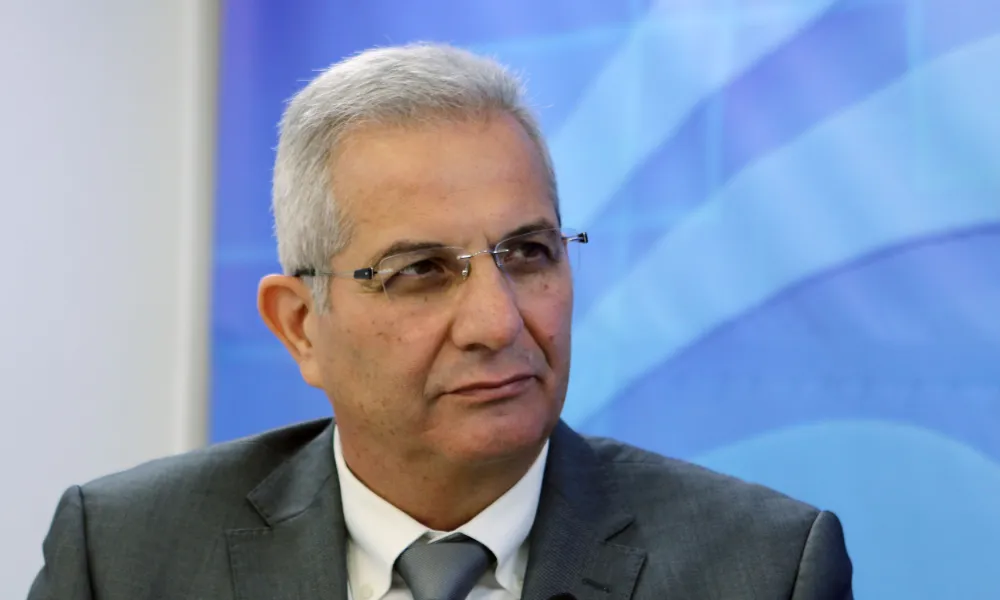

Former AKEL Secretary-General Andros Kyprianou has criticised President Nikos Christodoulides’ strategy on the Cyprus issue, arguing that the Greek Cypriot side’s actions must match its stated commitment to restarting negotiations.
Speaking on Morning Briefing on Politis 107.6 and 97.6, Kyprianou said Christodoulides should have focused from the beginning of his presidency on developing a strategy capable of persuading Turkey to move away from its current position.
Criticism of Christodoulides’ strategy
Kyprianou argued that while the president repeatedly declares his readiness to participate in trilateral or multilateral talks, some of his actions have the opposite effect by pushing the two communities further apart rather than rebuilding trust.
“He is following an erratic strategy. One part of it, the rhetoric, says ‘I am ready at any moment to start negotiations’, but in substance this strategy does exactly the opposite,” he said.
Kyprianou stressed that he was not advocating concessions on matters of principle. Instead, he said the objective should be to create the conditions and incentives necessary to encourage Turkey to move away from its existing demands.
Incentives through natural gas and EU-Turkey relations
Presenting AKEL’s proposal for breaking the deadlock, Kyprianou suggested offering incentives to the Turkish Cypriot community and Turkey linked to energy and Ankara’s relations with the European Union.
He proposed that, if agreement is reached on the substance of the Guterres Framework, Turkish Cypriots could participate in decisions concerning natural gas through the committee responsible for handling energy-related matters.
“If we agree on the Guterres Framework, yes. Then I believe, to a very large extent, there will be no turning back. We will have resolved the substance of the Cyprus problem,” he said.
Regarding Turkey, Kyprianou said that if Ankara cooperates towards a settlement based on the agreed framework, discussions could then take place over natural gas.
These could include a possible commercial agreement following a settlement and consideration of the most suitable route for transporting Cypriot natural gas to the European Union.
He added that, provided the Cyprus issue is resolved within the agreed framework, the Republic of Cyprus could also refrain from obstructing improvements in EU-Turkey relations.
Return to Crans-Montana
On the substance of negotiations, Kyprianou said the Greek Cypriot side should reaffirm its commitment to the agreed basis of a bizonal, bicommunal federation and declare its readiness to resume negotiations from the point at which they ended at Crans-Montana.
He also proposed submitting bridging proposals and making clear that, if the Turkish side cooperates within the agreed framework, the negotiating process would be pursued through to its conclusion.
Call for political parties to work together
The former AKEL leader also called on political parties to jointly discuss ways of encouraging the Turkish side to move away from its position in favour of a two-state solution.
He stressed that AKEL did not claim its own proposal was infallible and said other political forces should contribute ideas on how the current impasse could be overcome.
‘Actions must be aligned with words’
Kyprianou concluded by calling for consistency between the Greek Cypriot side’s public statements and its actions.
“Our actions must be aligned with our words. Our rhetoric cannot point in one direction while our actions point in another,” he said.
He also criticised political decisions that, in his view, are designed primarily to satisfy domestic electoral audiences rather than create the conditions necessary for progress on the Cyprus issue.