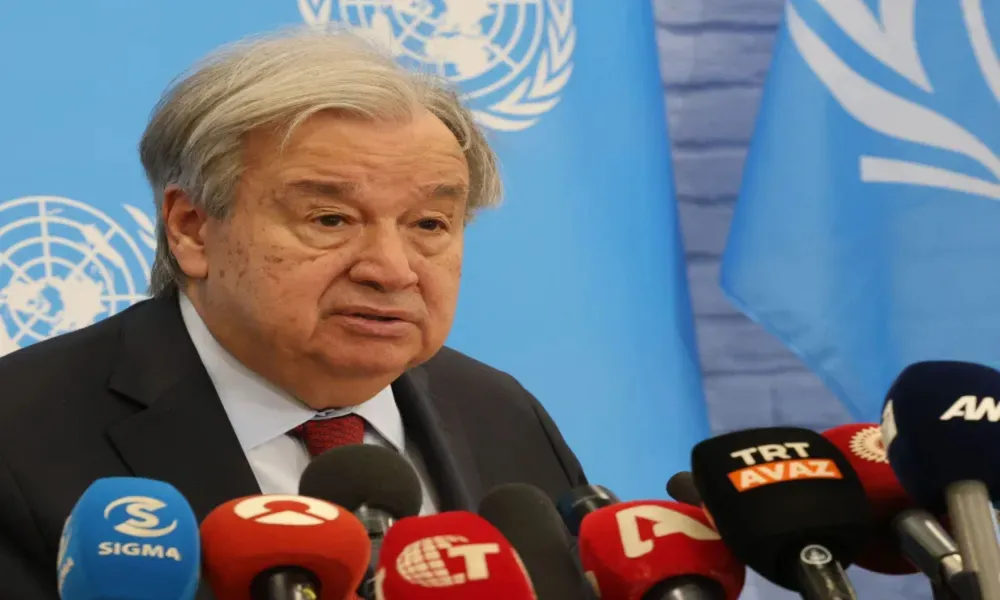

Turkish Cypriot leader Tufan Erhürman has referred back a "law" passed by the "parliament" in the north with the votes of the "governing coalition" parties, the National Unity Party (UBP) and the Democratic Party (DP), together with the settlers' Rebirth Party (YDP), which would abolish the mixed, cross-list voting system ahead of the double "elections" scheduled for 6 December.
UBP leader and "prime minister" Ünal Üstel said this amounted to a serious inconsistency on Erhürman's part, since as leader of the Republican Turkish Party (CTP) he had previously said cross-list voting contributed nothing to the political system.
"Mr Erhürman's attempt to protect a system he himself called wrong yesterday is a political, not a legal, choice," he said. If, he added, "there is any doubt about the constitutionality of the law, it can be sent to the 'constitutional court' for an opinion."
Referring the "law" back for political rather than "constitutional" reasons, he continued, is incompatible with the respect owed to the will of the "parliament." He added that there is no provision in the "constitution" stating that "electoral laws" cannot be changed a year before "elections," and that there are clear recent examples of this happening. "No one should be looking for legal cover for what is a political decision," he said.
Üstel also said that "abolishing cross-list voting does not abolish the voter's right to choose, that exists within the parties." The aim of the change, he said, is "to reduce invalid votes, simplify the electoral system and ensure the will of the people is reflected more accurately at the ballot box." The "presidency," he continued, cannot take part in the pre-election calculations of any political party.
People's Party (HP) leader Kudret Özersay noted that Erhürman, while a "member of parliament" for CTP in October 2017, voted "yes" for an amendment to the "electoral law" made shortly before the elections held in early January 2018.
In a social media post, Özersay added that CTP had not opposed abolishing mixed voting itself, but had voted against the change on the grounds that it was wrong to alter "laws" so close to "elections," recalling that the 2017 change was also made two and a half months before the "parliamentary elections."
Erhürman responds
Following the criticism, the Turkish Cypriot leader returned to the issue in a social media post, repeating that he does not believe it is right to amend "electoral legislation" shortly before "elections," and that he was fulfilling his duty as "president" to warn of the irregularities this could create in future if it set a precedent.
On "the principle of a democratic state and the right to vote and stand for election," he pointed, as he put it, to the Venice Commission, a significant international body on the subject.
Responding to Özersay, without naming him, he said the claim that fundamental changes were made to electoral legislation in 2017 shortly before the elections, which he too voted for, was incorrect, since the date on which fundamental changes were made to electoral legislation was 2016. The changes made in 2017, he said, were technical adjustments related to implementing the 2016 changes.
Responding to Üstel, again without naming him, Erhürman wrote that the claim the "president acted politically rather than legally" was likely the result of incomplete information about the powers granted to the president under the "constitution."
At a time when everyone is talking about standards, meritocracy and oversight, he continued, it is unthinkable for the "presidency" to avoid its duties of "constitutional oversight" when it comes to "constitutional standards."
If the "parliament" accepts the "law" as it stands, he added, the "presidency" will sign and publish it, but that does not prevent him from carrying out his duties and issuing a warning.
Source: Cyprus News Agency (CNA)