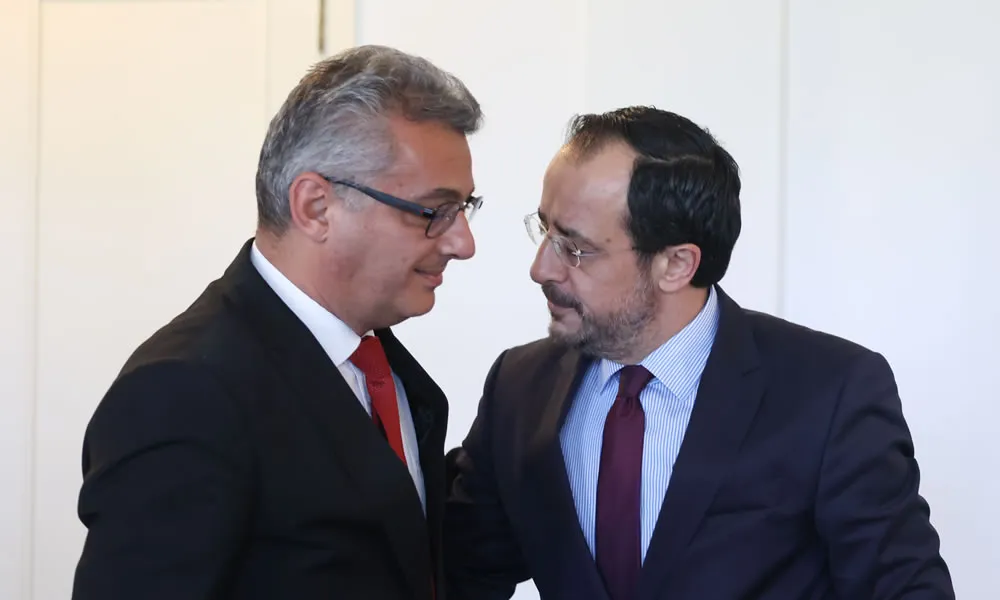

UN Secretary-General’s special representative for Cyprus María Ángela Holguín’s September 26 message provides the clearest authoritative account of the Cyprus diplomacy conducted during the General Assembly’s high-level week. It cuts through the competing narratives and identifies what the United Nations considers necessary for further progress.
Holguín met Turkish Cypriot leader Tufan Erhürman and Greek Cypriot leader Nikos Christodoulides separately and accompanied Guterres during his bilateral meetings with them. Together with UN Under-Secretary-General Rosemary DiCarlo, she also met Turkish Cypriot representative Mehmet Dânâ and Greek Cypriot negotiator Menelaos Menelaou to review confidence-building measures the sides had agreed to develop.
Her formulation was careful. She did not say that every measure had been finalised. Agreement to “develop” them suggests political acceptance of the areas of cooperation, but not necessarily of every proposal or implementation mechanism.
Erhürman’s account is consistent with that distinction. He said the Turkish Cypriot side accepts six of Guterres’s seven measures. The proposal on new crossing points has not been accepted in its present form but has not been rejected and remains open to negotiation.
A Trilateral That Was Never Scheduled
Holguín also clarified the controversy surrounding the trilateral meeting that did not take place. She confirmed that no such meeting had initially been planned. Christodoulides proposed one during the week, but Erhürman did not consider it appropriate “at this moment.”
This contradicts claims that Erhürman rejected a previously scheduled UN meeting. But it also confirms that when Christodoulides proposed an improvised encounter, the Turkish Cypriot leader chose not to participate.
Christodoulides presented his initiative as evidence of political will. He submitted 19 proposals covering confidence-building measures, methodology and substance, and argued that high-level contact could break the impasse.
Erhürman took the opposite view. He said a leaders’ meeting should endorse or unlock prepared progress, not disguise its absence. According to his account, the Greek Cypriot side had made no commitment to meaningful movement, while Holguín’s assessment of the preparatory discussions was not encouraging. Her public message did not repeat that assessment but stressed the need to implement confidence-building measures and create a conducive environment.
The disagreement reflects two diplomatic methods. Christodoulides sees a summit as a possible catalyst. Erhürman fears that an unprepared meeting would produce another photograph followed by another argument over responsibility for failure.
Guterres combines elements of both approaches. He remains prepared to convene another 5+1 meeting involving the two sides, Türkiye, Greece and Britain, but only after adequate preparation on confidence-building, methodology and substance. The UN has not abandoned high-level diplomacy. It has placed conditions on its usefulness.
The Seven-Point Test
Guterres’s seven areas cover new crossing points, demining, joint disaster response, cooperation against irregular migration, sports, citizenship problems affecting children of mixed marriages and the activation of a civil-society structure.
The crossings dispute remains the most visible obstacle. Competing formulations involve Haspolat-Mia Milia, Piroi-Athienou, Akıncılar-Lurucina and Erenköy-Kokkina. The Turkish Cypriot side opposes separating individual routes from a balanced package, while the Greek Cypriot side treats some proposals as parts of a single transport corridor.
Behind the technical arguments lies a political calculation. Roads affect movement, economic activity, local communities and perceptions of territorial control. Yet these questions remain far less difficult than federal competences, property, rotating leadership, security, guarantees and troops. If the sides cannot resolve crossings, prospects for agreement on the core settlement issues will appear remote.
Holguín said Guterres had reiterated the urgency of implementing confidence-building measures as evidence of the leaders’ capacity to cooperate. The decisive word is “implementation.” Declarations of readiness are no longer sufficient.
Erhürman wants the focus kept on Guterres’s seven areas rather than shifted to the Greek Cypriot side’s 19 proposals. His argument is that expanding the agenda enables agreed priorities to remain unresolved. The Greek Cypriot leadership counters that its proposals demonstrate initiative.
The danger is that proposal-making becomes a substitute for agreement. The UN should separate measures ready for implementation from those requiring technical negotiations and wider political ideas belonging in formal talks.
Convergences and Methodology
The most important substantive development may be Holguín’s confirmation that the UN has completed its review of previous convergences. The resulting material will be available when negotiations begin.
The exercise addresses whether a new process should start from zero, resume from 2017 or selectively retain earlier agreements. The Greek Cypriot side wants talks to continue from where they ended. The Turkish Cypriot side supports preserving convergences but insists that they be interpreted accurately and remain open to mutually agreed revision.
The review can reduce disputes over what was previously agreed, although it cannot eliminate disagreement over how those understandings should be interpreted or connected. Its core message is clear: a new process will not begin from a blank page.
Holguín also announced that the sides will be invited to submit proposals on negotiating methodology. This is potentially decisive because earlier processes failed not only over the final settlement but also over deadlines, sequencing, UN involvement and the consequences of another collapse.
The Turkish Cypriot side has four requirements: prior clarity on political equality and effective participation, including a rotating executive and at least one Turkish Cypriot affirmative vote; time-bound negotiations; preservation of convergences; and protection against returning unchanged to the status quo if talks fail for reasons not attributable to the Turkish Cypriot side.
The Greek Cypriot side accepts political equality, convergences and a results-oriented process in principle but rejects predetermined consequences that could be interpreted as automatic partition or recognition after failure.
Written methodology proposals should force both sides to explain how long negotiations should last, how deadlocks should be handled and what the UN should report if talks collapse. The emerging UN framework consequently has three tracks: confidence-building measures to test cooperation, convergences to protect previous progress and methodology to prevent another open-ended failure.
A Contest From the UN Rostrum
While the UN concentrated on process, Erdoğan and Christodoulides presented competing narratives of sovereignty and legitimacy.
Erdoğan reiterated Türkiye’s support for the sovereign equality and equal international status of the Turkish Cypriot side. He called for direct international contacts and an end to Turkish Cypriot isolation. Ankara’s argument is that the Greek Cypriot-led Republic of Cyprus cannot represent the entire island while treating Turkish Cypriots as a minority seeking entry into an existing state.
Christodoulides accused Türkiye of invoking sovereignty and the UN Charter elsewhere while violating both in Cyprus. He presented the conflict as one of invasion, occupation and attempted partition, defended a bizonal, bicommunal federation with political equality and called for talks to resume from 2017.
The speeches targeted international audiences rather than each other. Erdoğan challenged the proposition that international recognition should determine the political structure of a settlement. Christodoulides reinforced the established position that the recognised state must be reunited under Security Council parameters.
Public diplomacy therefore hardened the outer positions while UN diplomacy sought practical cooperation without immediately resolving the status dispute.
Türkiye and Greece also remained directly engaged. Erdoğan discussed Cyprus with Guterres while maintaining Ankara’s equal-status position. Greek Prime Minister Kyriakos Mitsotakis described Cyprus as a test of UN credibility, while Foreign Minister George Gerapetritis met Holguín and supported renewed negotiations within the established framework.
Britain’s Threefold Role
Christodoulides met British Prime Minister Andy Burnham and requested his contribution to Guterres’s effort. Britain is a guarantor power, permanent Security Council member and penholder for Cyprus resolutions. It also retains the sovereign base areas of Akrotiri and Dhekelia.
The Greek Cypriot side expects London to defend the federal framework and preserved negotiating record. Türkiye and the Turkish Cypriot side want Britain to address political equality and the imbalance created by recognition of only one side.
Britain could facilitate discreet discussion of effective participation, deadlines, safeguards and guarantees. No distinct British bridging initiative emerged publicly, however. London’s contribution will be judged by what it does before Holguín’s October visit, not by the number of meetings it attends.
Confidence-Building Versus Diplomatic Containment
The confidence-building message was undermined by a written request from the Republic of Cyprus mission asking foreign missions not to meet representatives of what it called the “secessionist” Turkish Cypriot entity.
The Greek Cypriot side wants to prevent diplomatic contacts from being portrayed as recognition. Politically, however, asking international actors not to hear Turkish Cypriot representatives reinforces the perception that the recognised government is monopolising diplomatic access. Contact does not constitute recognition.
Erhürman raised the matter with Guterres and said attempts had also been made to obstruct Dânâ’s contacts. Despite this, the Turkish Cypriot delegation met representatives including Russia and France, as well as the secretaries-general of the Organisation of Islamic Cooperation and the Organisation of Turkic States.
Erhürman also cited restrictions involving sports, festivals, a Barcelona youth camp, the Immovable Property Commission, buffer-zone contacts and European Parliament resolutions. These are Turkish Cypriot claims rather than agreed UN findings, but their political effect matters. Confidence cannot be built through new mechanisms while existing civic and diplomatic contacts are simultaneously restricted.
October’s Final Test
Turkish Cypriot media framed New York around inadequate preparation, acceptance of six measures and restrictions on international contacts. Greek Cypriot media emphasised Christodoulides’s proposals and Erhürman’s refusal to meet. Turkish coverage focused on equal status and isolation, while Greek reporting stressed occupation, federation and preserved convergences. International coverage regarded the unheld trilateral as evidence of continuing disagreement over both substance and process.
Holguín shifts the argument from who wanted the photograph to whether the sides can implement what they have already accepted. She will return to Cyprus in October and continue her facilitation until the end of December.
Her mission faces three tests: implement agreed measures, narrow the crossings dispute and obtain clear methodology proposals. Progress could justify a meaningful 2+1 or 5+1 meeting before Guterres leaves office. Another exchange of accusations would make such a gathering ceremonial.
The Greek Cypriot side must recognise that diplomatic containment is incompatible with confidence-building. The Turkish Cypriot side must show that preparation is a route to negotiations rather than a renewable reason to postpone them. Türkiye, Greece and Britain should help bridge differences over methodology rather than repeat established positions.
New York produced no breakthrough, but it provided a clearer map: seven measures, preserved convergences, written methodology proposals and an October deadline. The process lacks neither an agenda nor a mediator. What it still lacks is demonstrated cooperation.
The next photograph can wait. The opportunity to prove that a negotiated Cyprus settlement remains possible cannot.