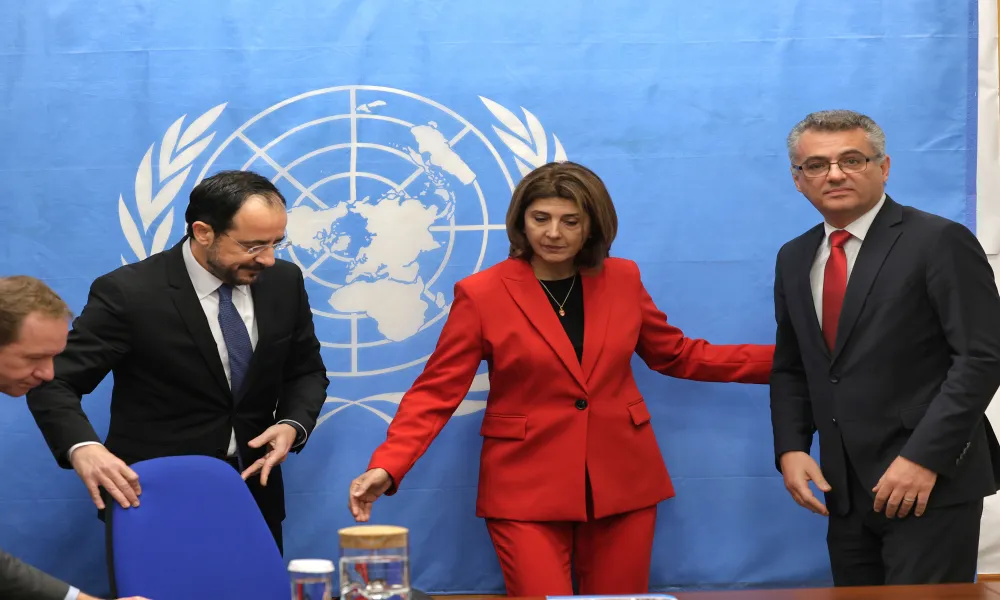

UN Secretary-General's Personal Envoy for Cyprus, María Ángela Holguín, has expressed hope that the planned 9 November trilateral meeting will encourage the island's two leaders to reach compromises on initiatives already discussed in their recent bilateral contacts.
In an interview published on Monday, Holguín said she hopes the meeting will help the leaders agree not only on confidence-building measures but also on the methodology for any future negotiating process.
"I hope the trilateral meeting during my visit will provide an incentive for the two leaders to reach a compromise on the initiatives they have discussed in their bilateral meetings," she said.
She added that practical cooperation, political will and Cypriot ownership of the process are essential conditions for achieving a settlement.
Direct dialogue welcome, but not enough
Holguín welcomed the meetings held between the two leaders in recent months, describing direct dialogue as useful.
However, she cautioned that such meetings alone do not demonstrate the political will required to change the current situation.
For that reason, she said she continues to urge both leaders to implement confidence-building measures that would demonstrate a genuine willingness to work together.
According to Holguín, the resumption of substantive negotiations depends on both sides.
No need for constant UN presence
Asked about criticism regarding her absence from Cyprus, Holguín said the purpose of bilateral meetings is to allow the two leaders to meet privately and discuss issues freely.
"There is no need for me to be present," she said.
Her role, she explained, is to facilitate communication and help the sides identify common ground.
She stressed that she is not part of the dialogue itself and does not participate directly in negotiations, meaning there is no need for her to be permanently based on the island.
"The Cypriots hold their future in their own hands," she said, expressing hope that both communities will focus on what unites them rather than on the painful experiences of the past.
No progress on confidence-building measures
Holguín said that, to her knowledge, recent meetings have not resulted in progress on crossing points, other confidence-building measures or agreement on a negotiating methodology.
She said both sides already know what is needed to move forward, where compromises might be found and what steps could create a more favourable environment for negotiations.
"The sides simply need to decide to begin negotiations and continue them until a final agreement is reached," she said.
"Very far and very close"
The UN envoy described the current state of the process as paradoxical.
"We are simultaneously very far and very close to an agreement," she said.
According to Holguín, the parties remain far from a deal because there is currently insufficient political will to engage seriously with the difficult issues that must be resolved in order to achieve a comprehensive settlement.
At the same time, she said they are close because both sides understand their interests and recognise that those interests could potentially be reconciled.
Political courage required
Holguín argued that changing the status quo after so many years is extremely difficult and will occur only when political leaders decide that coexistence in a united Cyprus matters more than short-term political calculations.
She warned that time may increase the pressure on Cyprus as regional and global developments continue to evolve.
"Perhaps one day the leaders will bridge this gap, engage meaningfully in the process, resolve the outstanding issues and adopt a long-term strategy that will transform the current model of coexistence and the deep division in Cyprus," she said.
She also stressed that any successful process requires the active participation of Cypriots themselves.
While neither side would achieve all of its objectives, both communities stand to benefit from a settlement, she said, pointing to potential political, economic and social gains.
Ultimately, Holguín concluded, the decision on whether the process moves forward rests with the leaders and, above all, with the people of Cyprus.
Source: CNA