More than 200 monuments across Cyprus have been preserved over the past 15 years through the work of the Bi-communal Technical Committee on Cultural Heritage, which has evolved into one of the most successful examples of cooperation between Greek Cypriots and Turkish Cypriots.
At a time when the Cyprus issue remains politically deadlocked, the committee continues to produce tangible results, restoring churches, mosques, monasteries, cemeteries and archaeological sites across the island.
The committee's Greek Cypriot co-chair, Sotos Ktoris, speaks about ongoing projects, the completion of the second phase of restoration works at Apostolos Andreas Monastery and the messages conveyed through the joint protection of cultural heritage.
Which monuments are currently undergoing conservation work, and what are your plans for the coming months?
At present, the Technical Committee on Cultural Heritage is implementing a programme of conservation works that includes churches, mosques and cemeteries throughout Cyprus.
Work is currently under way at Apostolos Andreas Monastery, the churches of Saint George in Vokolida, Panagia Faneromeni in Gastria, Saint Prokopios in Sygkrasi, Apostolos Varnavas in Engomi of Famagusta, Saint Irene and Saint George in Karavas, Saint Paraskevi in Palaeosofos, Saint John the Baptist in Kalopsida, Saint Demetrianos in Larnakas tis Lapithou, as well as the Church of Panagia Apsiinthiotissa and the adjacent school in Lefka.
At the same time, work is being carried out on the aqueducts of Lefka and at the mosque in Kilani, while restoration is expected to begin in the coming days at the mosques of Pyrga and Kato Arodes.
Our programme for the coming months includes a significant number of churches, mosques and other monuments that are either at the tender stage or in the process of architectural studies.
Apostolos Andreas in Final Stage
When will the restoration of Apostolos Andreas Monastery be completed? What stage have the works reached?
The works are now in their final stage and, provided no unforeseen issues arise, are expected to be completed in September.
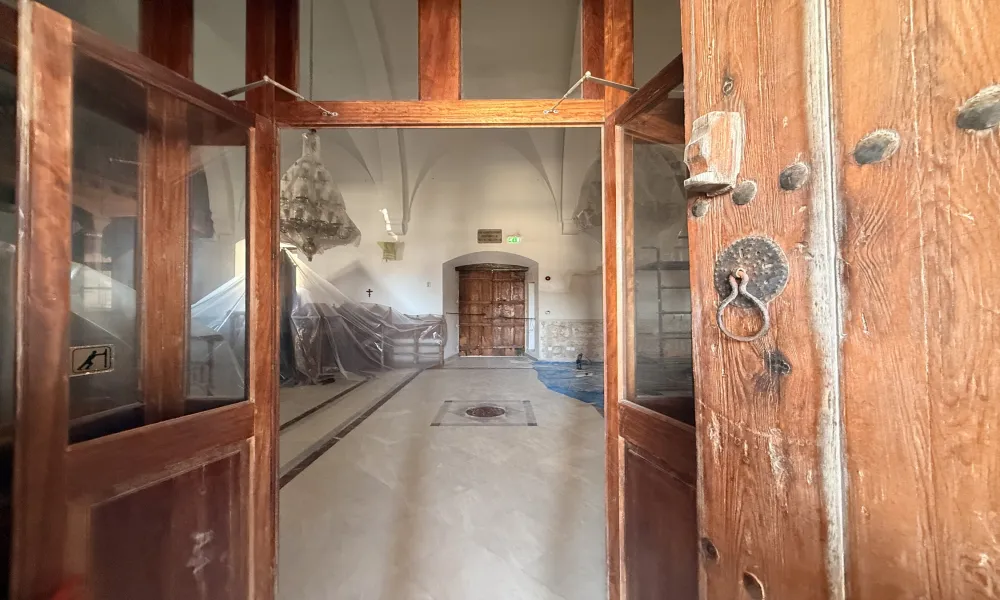
This is the second phase of the restoration of Apostolos Andreas Monastery and includes conservation of the medieval church located at the lower level of the complex towards the sea, together with access routes and the surrounding area, as well as the holy spring and access to it.
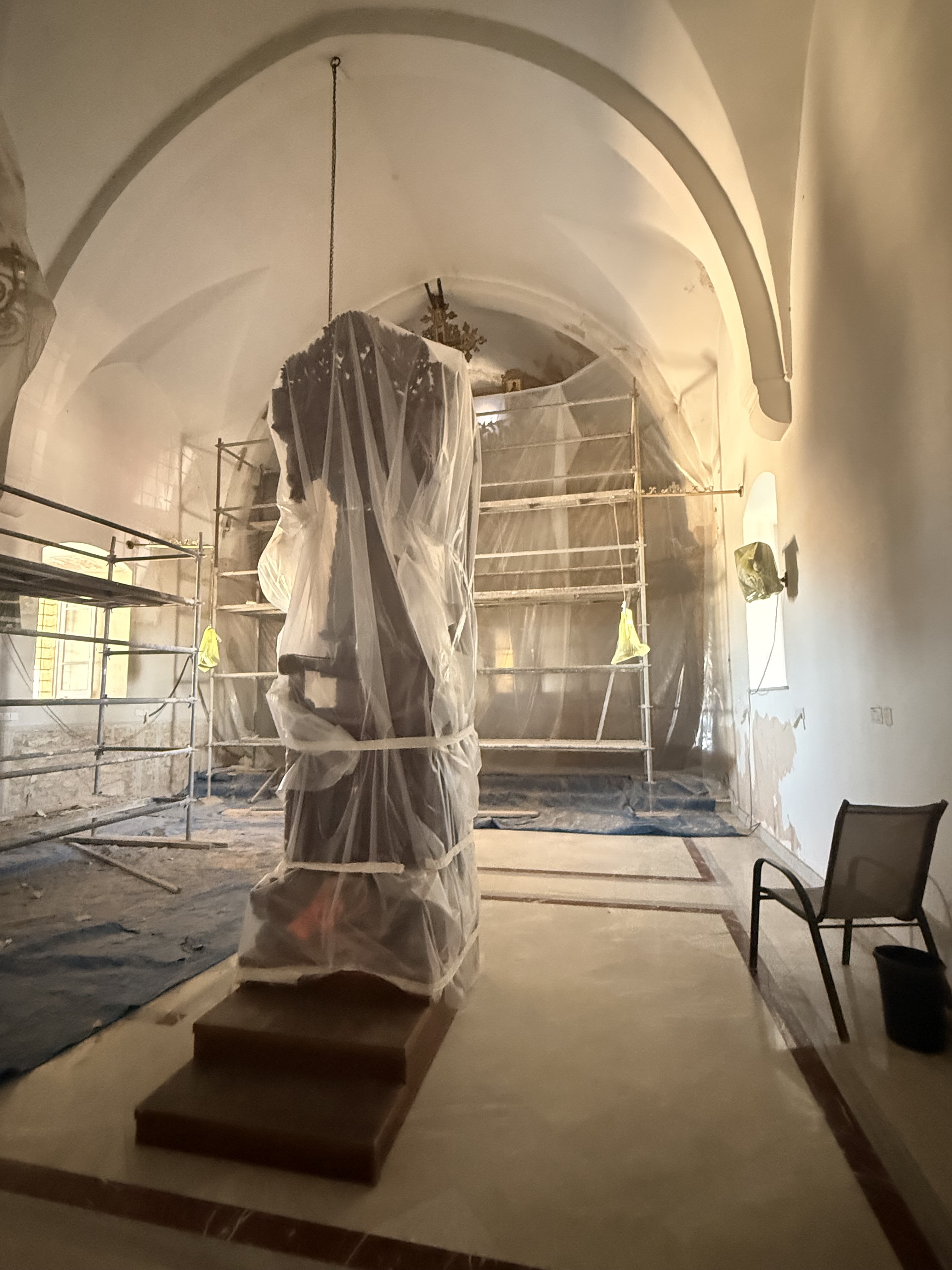
The project also includes restoration of the wing built in 1919 and designed by Theodoros Fotiadis, as well as conservation works and the return to operation of the octagonal water reservoir, believed to have been constructed in 1898, which stands at the centre of the complex.
In addition, maintenance and repair works are being carried out on parts of the complex restored during the first phase of the project.
The Committee's Role
Is the Technical Committee on Cultural Heritage one of the most successful examples of bicommunal cooperation? What is your assessment of its work today and what have been its most important achievements in recent years?
What makes the Technical Committee on Cultural Heritage stand out is that it functions as an example of practical and meaningful cooperation in an environment where the wounds of the past remain open and mistrust between the two communities continues to exist.
This becomes even more significant when one considers that for decades cultural heritage had become a field of political confrontation, with each community blaming the other for the destruction of monuments.
The committee opened a different path.
For the first time, Greek Cypriots and Turkish Cypriots chose to abandon confrontation and focus on saving monuments. They sat around the same table, discussed issues together, jointly established priorities and made decisions through consensus and mutual respect.
Over a period of approximately 15 years, the committee has contributed to the preservation of more than 200 monuments throughout Cyprus.
These include churches, monasteries, mosques, fortifications, aqueducts, archaeological sites and other monuments reflecting the island's centuries-long and multicultural history.
At the same time, a large-scale programme for the restoration and maintenance of Muslim and Christian cemeteries is under way in close cooperation with local communities.
Is there a balance between Greek Cypriot, Turkish Cypriot and other cultural heritage monuments included in the restoration programme?
The Technical Committee treats all monuments with the same care and respect and therefore seeks to ensure that its programme responds to the needs of the cultural heritage of all communities in Cyprus.
The selection and prioritisation of projects is a complex process that takes many factors into consideration, including the structural condition of each monument, its cultural, archaeological and religious value, its significance to the identity of Cyprus's communities, the readiness of the relevant studies and the availability of resources.
For us, every monument is an integral piece of Cyprus's cultural heritage.
Whether Greek Cypriot, Turkish Cypriot, Armenian, Maronite or Latin, our commitment remains the same: to protect and preserve them for future generations without distinction.
What messages are conveyed by the joint effort of Greek Cypriots and Turkish Cypriots to protect their shared cultural heritage?
The significance of this joint effort extends far beyond the preservation of monuments themselves.
For the past 15 years, Greek Cypriots and Turkish Cypriots have worked together every day based on a shared vision: that all monuments in Cyprus, regardless of their religious or ethnic identity, form an inseparable part of our common cultural heritage.
This experience has taught us that sincere dialogue, mutual respect, understanding of each community's sensitivities and a willingness to compromise can lead to meaningful cooperation even under the most difficult political circumstances.
At the same time, the committee's work has highlighted an undeniable historical reality about Cyprus that, after decades of division, has largely faded from collective memory, particularly among younger generations.
The history of this island is far more interconnected and multicultural than one-dimensional nationalist narratives often suggest.
The monuments we preserve are living testimonies to centuries of coexistence, interaction and a shared historical journey.
The strongest symbolism, however, lies in our daily work itself.
The same hands that restore churches and bell towers also restore mosques and minarets.
That image perhaps summarises the committee's message better than anything else.
What are your personal feelings after spending so much time in both the occupied and government-controlled areas as part of this journey?
My participation in the Technical Committee on Cultural Heritage has been a profound and unique experience.
It gave me the opportunity to get to know every corner of Cyprus and to meet people from both communities, Greek Cypriots and Turkish Cypriots, who share the same deep love for this place.
I met Turkish Cypriots who care about the restoration of churches and Greek Cypriots who show the same respect and interest in mosques.
What moves me most, however, is when we see people looking once again at their village church or mosque after it has been restored.
That is when we realise that we are not only saving monuments.
We are saving memories, but also a part of this country's soul.
Through these experiences, I have come to believe even more strongly that Cyprus's future should not remain hostage to the legacy of intercommunal conflict but should be built on the equally real, though less visible, historical experience of coexistence.
Today, I believe more strongly than ever that living together in a federal state within the European Union is the only option if we wish to overcome permanently the traumas and divisions of the past and ensure that Cyprus remains the common homeland of future generations of Greek Cypriots and Turkish Cypriots.
Do you believe the progress recorded by the technical committees over the years can serve as a model for confidence-building and positively influence the political level of negotiations?
It would be naive to claim that the work of the technical committees can, by itself, decisively influence the course of resolving the Cyprus issue.
The Cyprus problem remains a complex political issue with domestic and international dimensions, geopolitical implications and a heavy historical burden.
In addition, under current circumstances, the two communities continue to hold serious disagreements regarding both the desired form of a settlement and the methodology that could lead to the resumption of negotiations.
That does not mean, however, that the work of the technical committees lacks political significance.
Quite the opposite.
Their value lies in keeping channels of communication open, fostering cooperation and producing tangible results for people in both communities.
The technical committees cannot replace political negotiations, but they can help create the conditions that make a solution more achievable: building trust, developing a culture of cooperation and strengthening the belief that cooperation produces benefits for both communities.
And that is by no means insignificant.
Message to the Two Leaders
If you had the opportunity to send a message to the two leaders, based on your experience from working within the Technical Committee, what would it be?
If these years in the Technical Committee have taught me anything, it is that Greek Cypriots and Turkish Cypriots may live separately today, but they cannot, in the long run, survive if they continue to follow separate paths.
The security and long-term survival of Greek Cypriots depends on the survival of Turkish Cypriots as a community with a distinct political and demographic existence.
Otherwise, northern Cyprus will become irreversibly integrated into Turkey, with incalculable consequences for all Cypriots.
At the same time, the survival of Turkish Cypriots as a distinct community depends on coexistence with Greek Cypriots within a common European state, where they can safeguard their autonomy and identity free from dependency and hegemonic relationships.
The two leaders belong to a new generation that has the opportunity to move beyond the burdens of the past and chart a new course for Cyprus.
With vision, political courage and determination, they can seek the necessary convergences for a federal solution.
Time is not working in favour of reunification.
Every missed opportunity makes it more difficult and brings permanent partition closer.
Such a development would undermine the future of the whole of Cyprus and of both communities.
The cost of failure will be borne by future generations.