A nomadic comedian from Romania who travels the world telling jokes and a Swiss student of Bulgarian descent studying in Amsterdam with a camera in hand found themselves on a divided island and were intrigued by its story.
This could easily be the plot of a film, and yet, it is very real and, in the end, produced a spontaneous documentary.
What has been the everyday life of Cypriots for the past 52 years, appears simply strange to visitors: checkpoints, controls, competing jurisdictions and a line of barbed wire separating two communities that had once lived together.
A painful history filled with bloodshed and displacement still casts a shadow over every Cypriot today. Yet for outside observers, it simply raises questions and a peculiar feeling that is difficult to define.
Can comedy heal the wounds of the past? Are there more things that unite the two sides of the island than divide them? How much do we truly want the reunification of our country and its people? Do we really know our history, or have parts of it become obscured by time and propaganda?
The Cyprus problem did not begin in 1974, nor did it end then.
Deconstructing a myth
Two people who, at first glance, appear to have nothing in common have spent the past few years travelling the world, listening to stories, telling jokes, making videos about division and racism, and trying to “deconstruct the myth of national identity” that emerged in the nineteenth century with the decline of colonialism.
They are not conducting a campaign. They simply express what they believe through the alternative medium of political satire and stand-up comedy.
In a documentary unlike others produced so far, they manage to offer a different perspective on the Cyprus issue, both through comedy and through the testimonies of young people describing how they experience division today and what hopes they have for the future.
Politis spoke with the creators of the documentary series The Comedy Nomad, whose fifteenth episode is dedicated to Cyprus, its history and the present day, under the title The Good, the Bad and the Cyprus.
Victor Patrascan and Georges Degoumois describe how the idea developed and the emotions their visit to Cyprus inspired.
Victor Patrascan
“We've been making these videos for the last two years and this one was probably the most complicated so far,” Victor said while speaking from New Delhi, India, where he was performing.
As he explained, it was their longest episode to date and they wanted to give it greater depth.
Victor is a millennial comedian from Romania who has spent the last six years travelling from country to country, “telling jokes” wherever he is invited and has effectively toured much of the world.
This was the second time he had visited Cyprus but the first time he had travelled to the occupied areas.
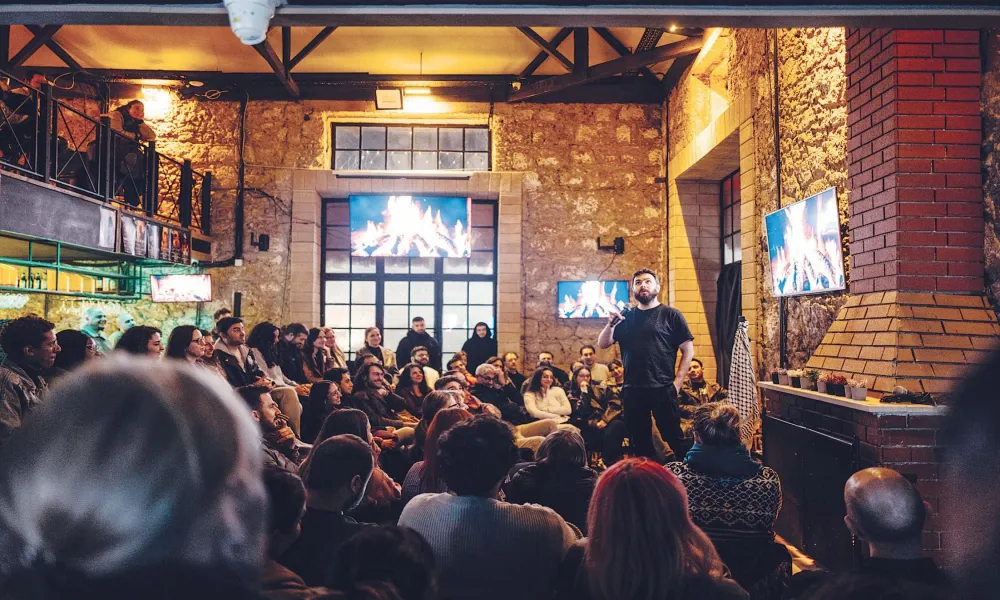
Accompanied by two local comedians, Giorgos Kyriacou and Hakan Çoban, he performed in Nicosia, Limassol and Famagusta.
“The division of the island moved us from the first visit and we wanted to document our experience on both sides.”
Cyprus' history certainly made an impression on Victor, but what has struck him most throughout his global travels are the similarities between people.
“People think their problems are unique and special, but once you start travelling you begin to see patterns,” he said.
“We could learn a lot from one another if we were willing to look beyond our borders.”
People in the same room
The documentary includes footage from Victor's performances as well as interviews with audience members after the shows.
“People want to talk about it. They're fed up with the situation and they want to share the way they see things,” he observed, noting that his audience generally knows what it is getting into and understands that some of his jokes are intentionally provocative.
Asked whether comedy can change the way we see things, he hesitated.
“I don't know if it has that kind of power,” he said, “but perhaps it can encourage people to reconsider certain stereotypes and prejudices. It certainly can't solve the actual problem.”
What he has realised is that divisions demonstrate how difficult it becomes to solve major political problems when people remain separated from one another.
“When we live separately and there is no interaction, we don't understand each other and we start making assumptions that may not be true.”
“What the show tries to do is at least bring people from both sides into the same room,” he explained.
It provides an opportunity, he added, to understand some basic things about one another.
An outsider's perspective
As a visitor, Victor found the situation strange.
“The atrocities of the past left such deep wounds,” he said, that generations later people are still trying to heal those wounds and make amends.
He also believes that the way history is taught plays an important role.
“Each side naturally talks about its own experiences and promotes its own narrative. What I wanted was to speak directly with people from both sides.”
He stresses that “the important thing is not to blame people for things they never did”.
Most of the people attending his shows, he notes, are young and politically aware, born decades after the war and conflict.
Older generations who experienced violence first-hand have grown tired, not because they want to forget what happened but because they genuinely want to see the situation resolved.
“It is human nature,” he said. “We get angry, we commit crimes and then we are punished. But after some time we have to learn how to function as a society and find a way to continue living together.”
Humour where you least expect it
Pure political satire is not particularly widespread in comedy.
Victor says his approach developed naturally through his travels and through the stories and realities he encountered in places such as Cyprus, Lebanon and the Balkans.
“In comedy you can talk about anything, so why not talk about the things that matter?”
Asked whether he hopes to change the way people think, he responded almost instinctively that his job is to make people laugh.
“What they do after that is up to them.”
The goal, he said, is to find humour where people least expect it.
“If that also changes somebody's perspective, that's wonderful.”
“I don't believe jokes can change the world. People can.”
Laughter, however, is healing and may help people realise that some divisions and conflicts look absurd when viewed from a distance.
Division and conflict
What has repeatedly struck him is the way every conflict believes itself to be unique.
He points to Indians, Greeks, Ukrainians, Romanians, Israelis, Palestinians, the peoples of the Balkans and others he has encountered.
“At the end of the day, everyone laughs at the same jokes.”
What amazes him is just how similar people are despite the kilometres that separate them.
Georges Degoumois
Georges Degoumois has a very different story.
Born in Switzerland to a family with Bulgarian roots, he is 24 years old and studies English Literature and Political Theory in Amsterdam.
He admits that before working with Victor he was not especially interested in politics, but he had always enjoyed documenting human stories through his camera.
Amsterdam is his base, but he spends most of his time travelling with Victor, filming performances and producing the documentaries.
As he explained to Politis, he researches the history of every place they visit, but the Cyprus episode was the only one that prompted him to delve deeper and include narration in order to provide fuller context.
Among the moments that stood out most was the interview with the Turkish Cypriot “mayor” of occupied Famagusta, as well as their visit to the ghost town of Varosha.
“What impressed me most is the fact that many young people have never travelled to the other side,” he said.
“I found that sad.”
Although he knew little about the Cyprus issue beforehand, he tried to approach both communities respectfully, using careful language to maintain balance and capture not only the divisions but also the elements that unite people.
Tillirkotissa as an anthem
One aspect of the documentary that deserves special mention is the way it goes beyond comedy.
A number of young people spoke to Georges' camera about how the current situation affects them, some emotionally and others in practical ways, particularly Turkish Cypriots, who remain largely isolated from the rest of the world.
Georges said his favourite moment comes in the final scene, when Victor asks what could serve as the island's anthem.
Members of the audience begin singing the bilingual traditional song Tillirkotissa/Dillirga, giving the documentary what he describes as “a beautiful note of unity”.
Stereotypes and divisions
As Georges explained, comedy often relies on stereotypes because comedians do not have the time to get to know their audiences in depth before making observations about them.
Victor takes this one step further by highlighting the fact that such stereotypes do not define who we are.
Their aim is to question nationalism, identity politics and the divisions people create between themselves.
For them, Cyprus became “the perfect case study”.
The project inevitably attracted criticism.
Georges described negative comments posted online, mainly over the fact that they performed in the occupied areas.
“I am sure that those who criticised it only watched the first few minutes of the video,” he said.
The black sheep and the white sheep
Colonialism and national identity are central themes in their work.
Georges argues that the concept of the nation-state contains a fundamental flaw.
“The idea assumes that for a country to belong to a certain people, it must have an overwhelming ethnic majority and set limits on the number of foreigners or people from different cultural backgrounds it can accept, so that its identity is not perceived as being threatened.”
Many of history's tragedies occurred because this idea was put into practice, he said.
He recalled a personal experience from Switzerland when he was 10 years old.
A far-right party launched an anti-immigration campaign featuring a poster depicting a white sheep kicking a black sheep beyond the country's borders.
“Fortunately, it was rejected,” he said.
What he takes away most from his visit to Cyprus is how willing people were to share their pain.
“Everyone can explain the suffering experienced by their own community.”
“The difficult part is recognising that the other side suffered as well.”
Victor Patrascan will return to Cyprus in January for a new series of performances.