
In Israel, Gadi Eisenkot has taken steps towards forming a minority government, with the Arab parties tolerating it from outside the coalition. Such a development could mark the end of Benjamin Netanyahu's political hegemony. At the same time, it could mark the end of the illusions surrounding his rhetoric on the Cyprus problem.
A minority government
A minority government under former general Gadi Eisenkot is one of the main scenarios. Negotiations are entering a critical phase, as the initial mandate given to him by President Isaac Herzog expires on Sunday 6 December. The possible accession of an ultra-Orthodox party with seven seats would bring the coalition to 55 seats. It would also make things easier for those in the Eisenkot camp who reject the participation of an Arab party in government. The two Arab factions, with 19 seats in total, retain a decisive role in the confidence vote.
The division
Netanyahu cultivates division in Israeli society. At the opening of the new Knesset, he accused members of the two Arab factions of supporting terrorism and seeking the destruction of Israel. The atrocities against thousands of civilians in Gaza and the escalating violence of settlers in the West Bank have stigmatised Israel internationally. On 8 September, twelve countries, among them eight EU member states, announced that they were considering trade sanctions on settlement products.
Netanyahu is dragging the country from war to war, tying his political survival to the continuation of conflict and endangering the entire Middle East. In the US, President Donald Trump openly supported Netanyahu, while AIPAC and its affiliated Super PAC, United Democracy Project, were highly active in repaying Trump's support for Netanyahu. But the Democrats won the midterm elections by a landslide. The war with Iran and the high cost of living weighed heavily in the vote against the Republicans. In addition, in several districts, elected Democrats sent a strong message against these organisations' attempt to steer the country's policy.
Silence and alignment
Only in Cyprus do President Nikos Christodoulides and a section of the political establishment fail to see the negative impact of Netanyahu's policy on the international stage, and fall in line with him. Nicosia did not co-sign the joint statement of the twelve countries on restrictions on trade with the settlements. It is one of many examples of Nicosia's choice not to upset Netanyahu.
Netanyahu has dominated political life in Israel for almost two decades. His hardline policy dates back to the Rabin-Peres era. Like the rabid Hamas through its actions, he has undermined the prospect of resolving the Palestinian question. The historic right-wing Likud party and hardline parties oppose the creation of an independent Palestinian state alongside Israel.
But in last October's elections, Netanyahu lost significant ground and no longer has a parliamentary majority. An exit from successive wars and Israel's security remain the goals, and Israel needs international support and moral rehabilitation more than ever. The parties opposing Netanyahu, led by Eisenkot, want to put their own house in order and safeguard the institutions that placed Netanyahu under the microscope for corruption. That is why they have submitted proposals to reverse the judicial reform and to set up a state commission of inquiry into 7 October, so that his responsibilities are brought to light.
The "hexagon"
One of the weapons Netanyahu used to rein in public opinion before the elections was sharp rhetoric against Turkey. To Iran's "radical Shia axis" he added the "radical Sunni axis" of the Muslim Brotherhood, and then named Turkey. Israel's intense regional rivalry with Turkey in Syria after the fall of Assad gave a plausible basis to Netanyahu's rhetoric about axes and alliances in the Middle East. In February, he presented a "hexagon of alliances" and included Greece and Cyprus in it. It was the eve of the war with Iran, and his government was at risk of collapse.
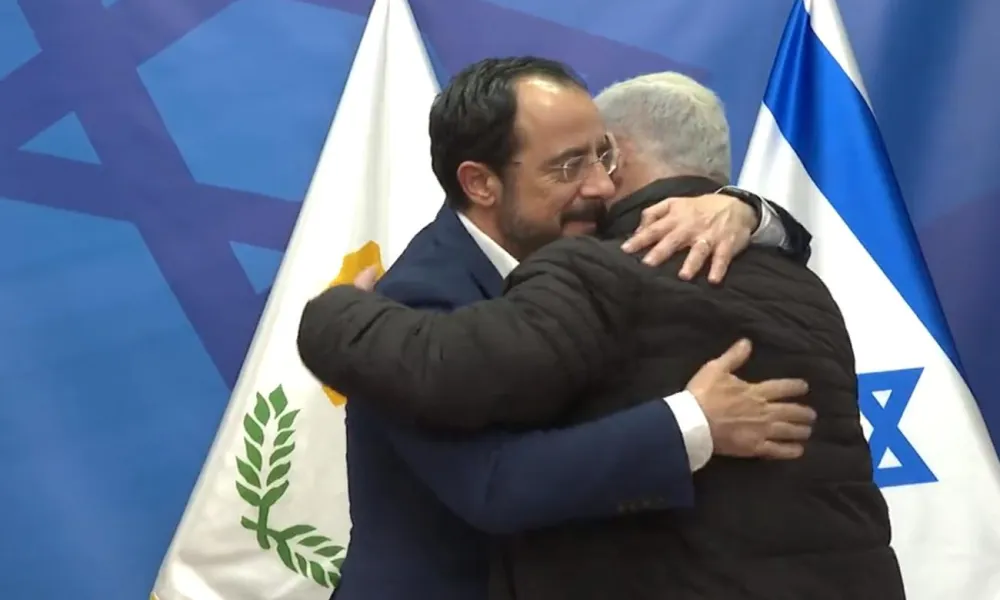
Cyprus never publicly distanced itself from this announcement. Meanwhile, it showcases the National Guard's military equipment and its strategic cooperation with Israel ever more openly. Christodoulides seeks privileged relations with the AIPAC leadership in order to reach Washington. In the House, six MPs from DIKO, DISY and ELAM formed a caucus with one of the hardline Israeli lobbies, the Israel Allies Foundation. A host of commentators appear in the media, further strengthening the impression of a Cyprus-Israel military alliance.
The fake news circulating on a remarkable number of Greek-language websites presents Israel as ready to crush Turkey militarily. It glosses over the deterrent role played by the US in relations between its two strategic allies, as well as the deep trade and energy ties between Israel and Turkey. "Experts" of every kind identify Greece and Cyprus with Israel's policy, but do not explain exactly what the reciprocity is and whose interests are being served.
The Guterres warning
At a critical moment for the effort to revive negotiations, UN Secretary-General António Guterres called on the parties concerned in July to contribute constructively, pointing out how volatile the regional environment is. Answering a question in Nicosia on 29 July, Guterres was more than clear. As long as the Cyprus problem remains unresolved, he said, Cyprus becomes "much more vulnerable to the risks we see today in a region that is, to a large extent, on fire". Guterres reminded Cypriots that a solution would provide security for the island and have a significant stabilising effect on the region. Guterres's term is coming to an end, and his effort has proved fruitless once again, for the same reasons it has remained fruitless for ten years.
The policy of stagnation
The timing of the development of Cyprus-Israel strategic relations is no coincidence. The Greek Cypriot leadership walked away from Crans-Montana in July 2017 without foreseeing when and how it would return to the table. It turned to regional cooperation and to trilateral and multilateral meetings with Greece, with Benjamin Netanyahu's Israel as its key partner. It announced grand plans, spectacular investments by corporate giants and the transformation of Cyprus into an energy hub for the region. All of it proved futile, serving only to sustain stagnation.
Yet Cyprus consigned to the dustbin the Guterres package, which on security issues included the most advanced Greek Cypriot positions:
- the end of Turkey's unilateral right of intervention;
- the withdrawal of Turkish troops;
- the replacement of the Treaty of Guarantee with a new security treaty;
- the deployment of a multinational UN force to implement the solution.
Today, Christodoulides promotes regional cooperation with Benjamin Netanyahu's Israel for communication purposes. But Netanyahu may be sidelined. A new Israeli leadership with different priorities is likely to distance itself from his rhetoric and make more rational choices in Israel's foreign policy.