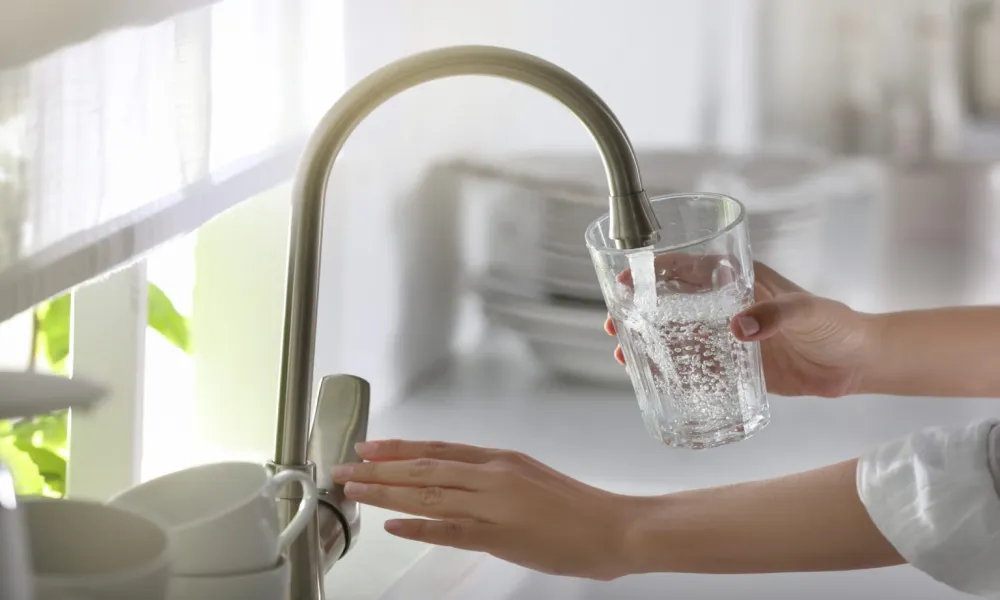

A discovery that won the 2025 Nobel Prize in Chemistry is now driving a new commercial race to produce drinking water straight from the atmosphere. According to a report by US network CNBC, two companies, California-based Atocoand UK-based Ahbstra, are developing machines that harvest moisture from the air. Both are aimed at households, businesses and communities facing water scarcity.
How metal-organic frameworks capture water
The technology relies on metal-organic frameworks (MOFs). For developing these materials, Omar Yaghi of the University of California, Berkeley, Susumu Kitagawa of Kyoto University and Richard Robson of the University of Melbourne shared the 2025 Nobel Prize in Chemistry.
MOFs are highly porous materials that can selectively capture water molecules from the air. When the material is heated, the molecules are released and condensed, producing liquid water.
Conventional atmospheric water harvesters work best in humid air. MOFs, by contrast, can operate even in very dry environments.
First customers in the Balearic Islands
Ahbstra unveiled its machine, the ARK, in Barcelona on 30 July. The company says it can produce up to 500 litres of drinking water a day. CNBC reports that each unit costs £150,000.
According to CNBC, Ahbstra has already pre-sold ten machines in Spain's Balearic Islands, where water scarcity is severe. The company says the first units are due to be installed by early 2027. Ahbstra was founded by Hashem Arouzi, who has said the idea came after the wells on his property in Ibiza ran dry.
The first buyers include owners of luxury homes and a restaurateur, who plans to use the water for bottling and for making coffee.
The company aims to cut the price of its machines by 50% within the next 12 to 18 months, with the longer-term goal of bringing them into ordinary homes.
Atoco systems of up to 4,000 litres a day
Atoco, the company founded by Nobel laureate Omar Yaghi, is developing two types of water harvesting systems:
- Off-grid units powered by thermal energy, designed to produce about 1,000 litres of water a day.
- Grid-connected installations, with a projected capacity of up to 4,000 litres a day.
Atoco says actual output will depend on the climate at each site. The units could serve remote communities, hospitals, industrial facilities and areas hit by natural disasters.
Data centres as a key market
One of the largest potential markets is data centres, whose water needs are growing with the expansion of artificial intelligence.
Atoco's technology uses the waste heat given off by servers to harvest water from the air. In this way, the company aims to deal with two problems at once: excess heat, and the facilities' rising demand for water.
How well this works at large industrial scale has yet to be proven.
Cost and energy remain barriers
The technology shows promise, but the high cost of the machines and their energy requirements remain major obstacles to wide commercial use.
Harvesting water from the atmosphere could supplement existing water supply methods, especially in areas facing severe shortages.
The companies' challenge now is to make the technology affordable, so that it is not limited to large businesses and wealthy households.
With information from CNBC, the Financial Times, Bloomberg and Euronews