The elections on 24 May will not be decided solely by who is leading in the polls. They will also be determined by who succeeds in mobilising their supporters, limiting losses and, most importantly, persuading those who remain undecided or are not entirely certain of their choice.
The first part of Noverna’s fourth poll for Politis functions as an X-ray of these dynamics, illustrating not only party preferences across social groups but also how fluid or fixed the political landscape remains just days before polling stations open.
The second part of the poll, including party percentages and voting intention, will be published in Saturday’s edition.
Among men, AKEL leads with 19%, narrowly ahead of DISY at 18%, while Immediate Democracy reaches a notable 12%.
Movement between parties
The first major finding regarding voter behaviour in Cyprus is that despite the intensity of the election campaign, the contest remains open across key segments of the electorate.
The major party voter pools still exist, but voter movement has not frozen, something reflected in the relatively low levels of party cohesion.
The election may not be decided within traditional party bases but in the “softer” voting zones, where doubt, temporary influences and uncertainty over final choices remain dominant.
Among women, the picture favours the centre-right party. DISY leads with 16%, AKEL follows with 13%, while ALMA appears strengthened with 9%.
Age groups and voter audiences
The age breakdown confirms that each party speaks to a different audience.
AKEL records a clear advantage among older age groups, reaching 21% among voters aged 55-64 and also among those over 65. By contrast, support among younger voters aged 18-34 stands at 11%.
DISY shows a different profile. Its strongest performance comes among voters aged 45-54, where it reaches 25%, while also maintaining a significant presence among the 35-44 age group with 16%.
ELAM records its strongest appeal among younger voters, reaching 16% among those aged 18-34.
Immediate Democracy records 15% among voters aged 35-44 and 12% among those aged 18-34, while showing significantly lower figures among older age groups.
The female vote challenge
One of the most revealing findings concerns the gap between male and female voters.
Among men, AKEL leads with 19%, slightly ahead of DISY with 18%, while Immediate Democracy reaches 12%.
Among women, the picture changes. DISY leads with 16%, AKEL follows with 13%, while ALMA records 9%.
The most important finding, however, concerns indecision. Among women, the proportion of blank votes, undecided voters or refusal to answer reaches 28%, almost double the 15% recorded among men.
This suggests the largest remaining electoral reserve lies among female voters.
Immediate Democracy emerges as the leading party in Paphos with 15%, followed by AKEL with 14% and DISY with 13%, creating a picture of fragmentation and increased fluidity.
Districts with distinct political identities
The geography of voting remains equally important.
In Nicosia, DISY leads with 19%, followed by AKEL with 13%.
In Limassol, the picture is similar, with DISY at 18% and AKEL at 15%.
Larnaca appears more favourable for AKEL, where the party reaches 24%, its strongest regional performance.
Paphos records one of the most interesting findings, with Immediate Democracy at 15%, AKEL at 14% and DISY at 13%.
In Famagusta, the race appears even more open, with AKEL at 15%, and DISY and ELAM both at 14%.
The truly loyal and the vulnerable
One indicator revealing the real strength of each party is voter certainty.
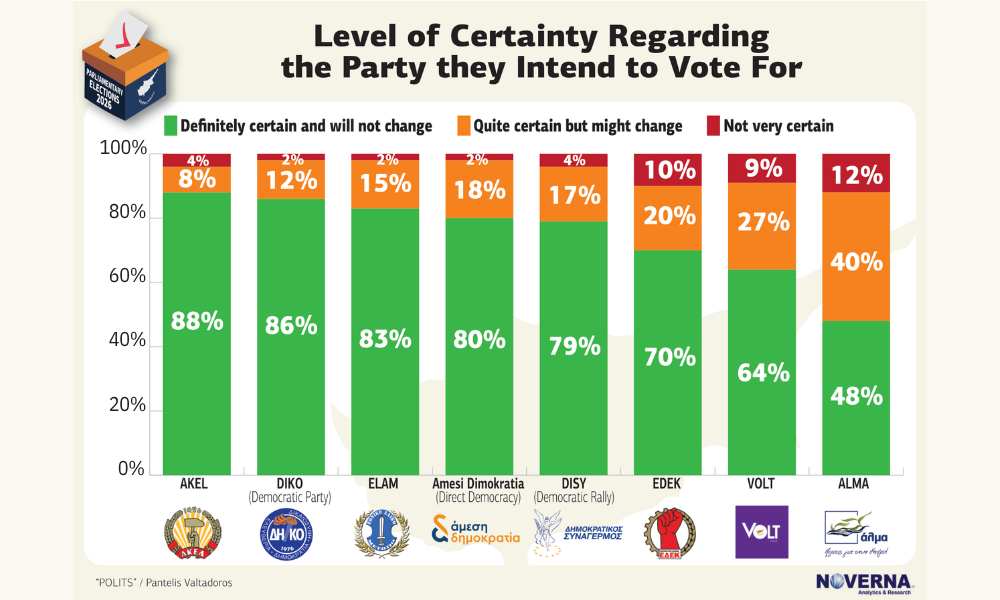
AKEL records the highest party cohesion, with 88% saying they are completely certain of their vote.
DIKO follows with 86%, ELAM with 83%, Immediate Democracy with 80% and DISY with 79%.
At the opposite end stands ALMA.
Only 48% of ALMA voters say they are absolutely certain, while 40% describe themselves as reasonably confident but still open to changing their minds.
Undecided voters and hidden losses
The composition of undecided voters also matters.
Among undecided voters:
- 17% voted DISY in 2021
- 16% voted AKEL
- 9% voted DIKO
- 19% voted for another party
- 16% either did not vote or cast a blank ballot
The findings suggest uncertainty is not concentrated within one political camp.
Campaign with limited reach
One of the more concerning findings for campaign teams is that only 22% of respondents said they had seen or heard something over the past two weeks that made them view a party more positively.
A total of 78% answered negatively.
Immediate Democracy appears to be the exception, with 36% of its supporters saying recent messages or appearances positively influenced them.
AKEL follows with 20%, while ALMA and ELAM stand at 17%.
What could still change
In the final days of the campaign, what could still shift voting behaviour?
Candidate appearances in television debates appear to have the strongest influence, with 13% saying these could affect their vote significantly.
Social media shows a more limited but still measurable impact, especially among more fluid voter groups.
By contrast, the opinions of relatives and friends appear to carry minimal influence, with only 4% saying they could significantly affect their vote.
Only 48% of ALMA voters say they are absolutely certain they will vote for the party, while 40% say they are fairly confident but open to changing their minds. This makes ALMA perhaps the most vulnerable political movement to late shifts.
The overall picture
Noverna’s fourth poll does not simply show who is ahead. Those figures will be published in tomorrow’s edition.
Instead, it presents a political landscape where party cores remain intact but late shifts are still possible.
AKEL has the most disciplined voter base.
DISY remains strong among working-age voters.
ELAM maintains a solid audience.
Immediate Democracy appears to have momentum.
ALMA shows potential, but also significant uncertainty.
The central question remains whether the final days of campaigning will substantially change the landscape, or whether the ballot box will simply confirm trends already formed.
For now, the answer remains open.
Methodology
Conducted by: NOVERNA Analytics & Research, member of SEDEAK and ESOMAR, on behalf of Politis.
Sample and methodology: 1,014 interviews with a representative sample of voters in the government-controlled areas of Cyprus through random sampling.
Interview method: Structured questionnaire with CATI telephone interviews.
Margin of error: +/- 2.7% at a 95% confidence level.
Fieldwork dates: 1–12 May 2026.
Read tomorrow: Voting intention and party cohesion figures.