Cyprus’ Finance Minister Makis Keravnos said on Friday that cohesion policy has been the European Union’s main investment policy for more than four decades and a cornerstone of the Single Market.
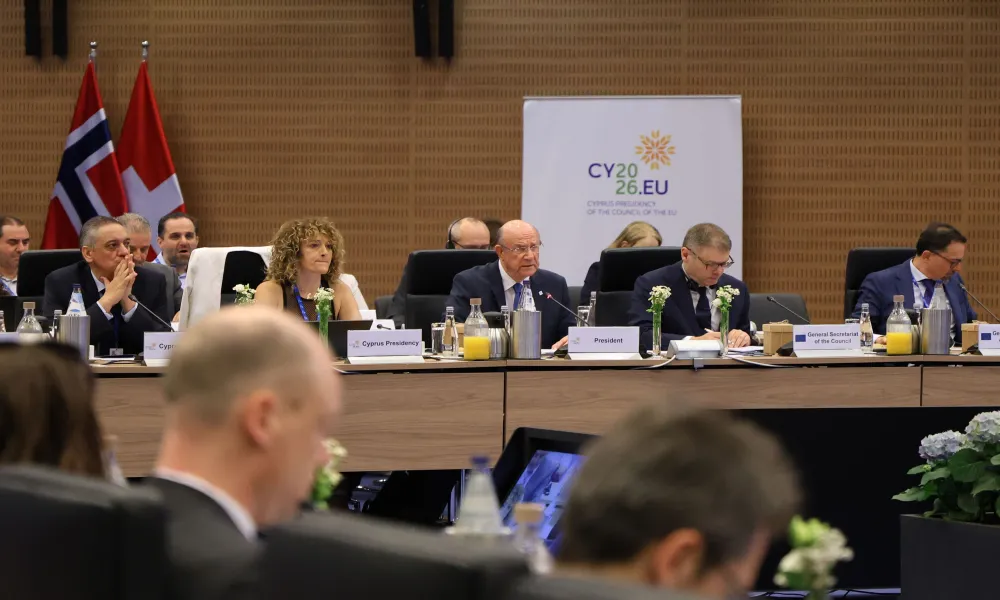
Keravnos was speaking as he chaired the first session of the informal meeting of ministers responsible for cohesion policy, held at the Filoxenia Conference Centre in Nicosia as part of the Cyprus Presidency of the Council of the European Union.
During the session, ministers were due to discuss the role of cohesion policy in providing incentives, development prospects and employment opportunities that allow European citizens to remain, prosper and build their future in their home countries and regions.
Keravnos said cohesion policy had played a decisive role in modernising infrastructure, supporting small and medium-sized enterprises, strengthening research and innovation, promoting digitalisation and connectivity, and reinforcing social cohesion across Europe.
He added that the policy had also acted as a stabilising factor during periods of crisis and as a driver of long-term convergence and growth.
“Yesterday we visited the CYENS Centre of Excellence and had the opportunity to see first-hand how cohesion policies support cities, research and innovation, while also contributing, together with other EU policies, to competitiveness and sustainable growth,” Keravnos said.
He noted that since joining the European Union, Cyprus had drawn significant benefits and added value from cohesion policy in almost every area of economic activity, contributing to economic growth, job creation and the country’s overall progress.
“Cohesion policy remains a key priority of the Cyprus Presidency,” Keravnos said, adding that significant efforts were being made to advance discussions and achieve progress on the legislative package concerning national and regional partnership plans.
“I am particularly pleased that all the key actors in cohesion policy are here today, and I look forward to a meaningful and constructive discussion,” he said.
Earlier, upon his arrival at the Filoxenia Conference Centre, Keravnos said ministers would discuss and exchange views on the “right to stay” strategy, describing it as an especially important issue.
“We will discuss how every European citizen can live, work and remain in their homeland,” he said, adding that this was particularly important for Cyprus, where, as he noted, “Cypriot European citizens do not have the right to remain in their homeland because of the Turkish invasion and occupation.”
Keravnos said ministers would also discuss an islands strategy during the second session, another important issue within the framework of cohesion policy.
He said ministers would exchange views and examine the specific characteristics of island member states, which face difficulties because of their distance from mainland Europe.
“They face problems related to transport costs, energy costs and competitiveness issues,” he said.
A press conference was scheduled to follow the first session, with the participation of Keravnos and European Commission Executive Vice-President for Cohesion and Reforms Raffaele Fitto.
Source: CNA