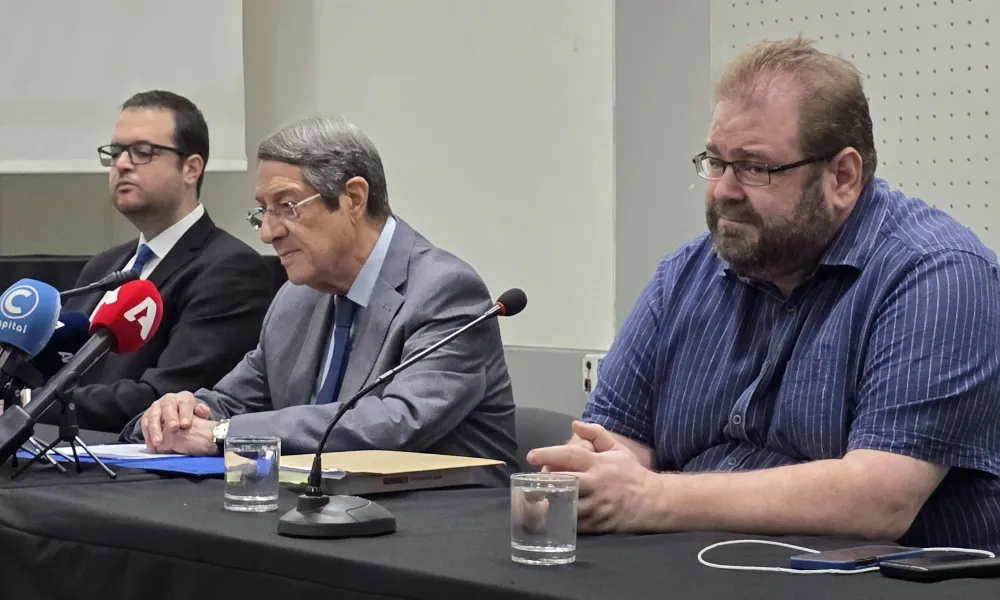
For an hour and a half, former President of the Republic Nikos Anastasiades spoke at the press conference he organised to respond to the findings of the Anti-Corruption Authority's investigation, but on the substance of the significant issues and the potential criminal offences identified, he gave no answers. Yesterday's appearance by Nikos Anastasiades, flanked by lawyers Theodoros Oikonomou and Achilleas Aimilianidis, was consumed more by responses directed at Makarios Drousiotis and references to his book Kratos Mafia (State Mafia), than by the substance of the findings of the inspection officers who compiled the report for the Anti-Corruption Authority. And this is because the references in the Authority's report were not limited solely to the content of Makarios Drousiotis's book. With regard to the answers he gave concerning the investigation's findings, what one can say is that at the very least... they are being examined. It is also being strongly commented upon that a significant portion of Nikos Anastasiades's remarks constitute an attempt to nullify the Anti-Corruption Authority's investigation.
From the totality of the former President of the Republic's positions, it emerges that, employing the favoured tactic he used to apply frequently and repeatedly, he artfully chose to refer to other matters, perhaps related ones, while not a single word was heard, at the very least, regarding political responsibility, given that he had rejected the question of potential criminal liability from the very first day the report on State Mafia was announced. He spent considerable time on legal explanations regarding the difference between the balance of probabilities method for the commission of criminal offences cited in the Authority's report, and the criminal procedure by which an offence must be proven beyond reasonable doubt in court.
Something else that is being strongly commented upon, primarily in legal circles, is that yesterday's statement by Nikos Anastasiades was entirely mistaken from the moment he did not have in hand the full text of the Authority's findings, only the 67-page summary note that was made public. In the full text, which reportedly runs to around 3,000 pages, there may be additional elements which, for different reasons and in view of the impending criminal investigation, were not mentioned in the Authority's announcement or were mentioned only in passing without detail. Yesterday's public intervention by Nikos Anastasiades does not affect in any way the next procedural steps that must be taken. He is now under investigation for specific criminal offences, and it falls to the criminal investigation that will be conducted to determine whether and which individuals will ultimately be brought before justice, and for which criminal offences they may be charged.
With the answers he gave following the conclusion of his initial statement, Nikos Anastasiades placed himself at the disposal of justice, also clarifying the matter that had been discussed in recent days regarding his immunity. Asked to comment on whether a question of immunity arises, he stated characteristically that "I do not consider there to be a question of immunity, but even if there were, I would of course renounce it."
The five chapters
In his initial statement of 15 pages and 5,200 words, Nikos Anastasiades addressed five chapters and the allegations levelled against him, expressing the view that whether they are claims in Makarios Drousiotis's book or findings in the Anti-Corruption Authority's report, they are refuted by what he himself argues.
Regarding the allegation of an agreement with Russian oligarch Rybolovlev to amend legislation in his favour, Mr Anastasiades said the allegation "collapsed since it was voted on almost unanimously by Parliament, with only two dissenting votes, following the support of the entirety of the organised state — the Government, the Central Bank, the Banking Association, the Cyprus Bar Association, SELK, KEVE, STEP, the then Attorney General, and all those invited to express views on the relevant Bill."
On the arrest of Rybolovlev's daughter, he noted that at no point in M. Drousiotis's book or the Authority's Report is there any reference to any direct or indirect action by the former President towards any authority or body suggesting knowledge of or involvement in the arrest.
Regarding the inspection officers' finding, on the basis of the balance of probabilities, that there was an agreement between the former President and Rybolovlev to cover the cost of a private flight for the former President from Brussels to Athens on 21 March 2014, Mr Anastasiades stated that the Anti-Corruption Authority's finding that the former President may have committed the offence of "trading in influence" by accepting an undue advantage "is overturned and collapses, since the alleged undue advantage is not connected to the arrest of Rybolovlev's daughter but — by false allegation — to the execution of a new plan that was 'agreed' at a later stage."
On the Focus case, he stated that the then Attorney General announced in 2016 that the evidence did not point to the commission of any criminal offences, since at the material time undeclared funding to political parties did not constitute a criminal offence. He also noted that "the defamatory allegation" that he had misappropriated a total of €550,000 intended for DISY was dismissed as "false and unfounded" by the inspection officers. Nevertheless, the officers concluded that a potential commission of the offence of abuse of power arises, because Mr Anastasiades met with and communicated by telephone with the then Attorney General, Kostas Clerides, expressing strong displeasure at the course of the investigation and requesting the termination of inquiries. "It is truly unprecedented and also lamentable that the inspection officers should reach findings attributing a potential felony to the former President without giving him the right to be heard," he noted.
The former President also commented on the matter of a transaction of €250,000 from Laiki Bank in 2011 in his favour, reportedly intended as financial support for his election campaign, which is alleged to have been misleadingly presented as a fee or commission, and on the allegation that Nikos Anastasiades abused the influence he was able to exert over other persons as a seller of influence. The former President argued that this allegation too was never placed before him and he was not given the opportunity to be heard.
On the 2019 publications by the Organised Crime and Corruption Reporting Project (OCCRP) and the 2021 International Consortium of Investigative Journalists (ICIJ), which linked the firm "Nikos Chr. Anastasiades & Associates" to the laundering of millions of dollars belonging to Alexander Abramov through a network of shell companies that operated from 2006 to 2013, and to his personal interventions in the naturalisation of Alexander Abramov and Leonid Lebedev, he said that "there is absolutely no evidence that the law firm and/or its associates violated any law or committed any offence." On the property in Dromolaxia, and what is stated in the Authority's report, Nikos Anastasiades again maintained that on this specific matter too he was not heard during his appearance before the investigating officers.
'Lack of will'
At another point in his statement, having rejected the findings of the Anti-Corruption Authority, Nikos Anastasiades clarified that he does not attribute bad faith to the officers or Members of the Authority, "but I do charge them with a lack of the requisite strong will to resist populism, the prevailing atmosphere created by the people's judges, the character assassins, and malicious internet users."