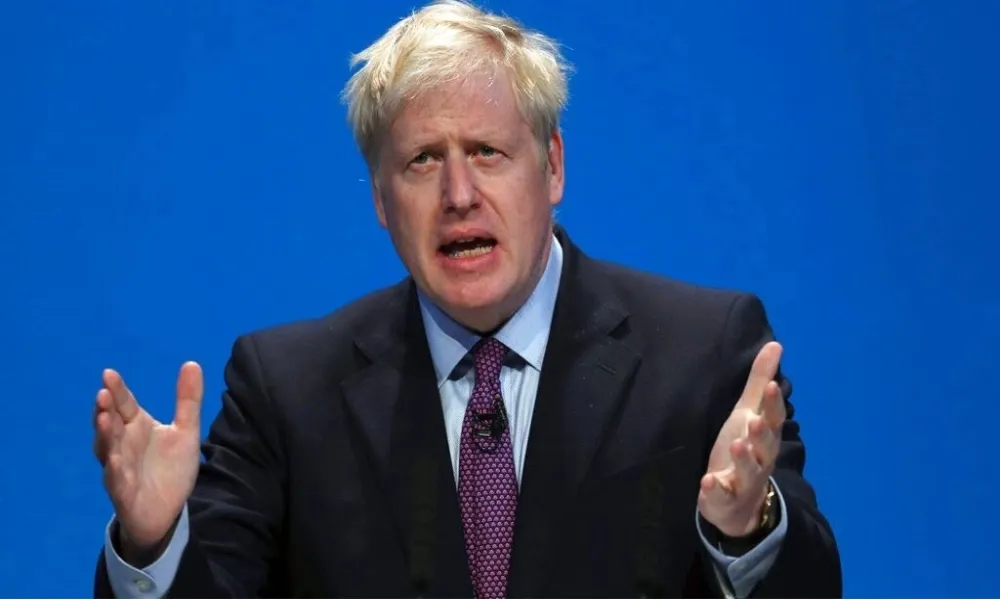

A Russian unmanned aircraft struck a train near the Ukraine-Poland border, minutes after former British Prime Minister Boris Johnson and senior European security officials had passed through the same location.
No injuries were reported from the strike on the train's engine in Yahodyn. Ukrainian authorities said all passengers had already evacuated the carriage.
Johnson and other European national security advisers, including Britain's Jonathan Powell, were travelling on the same rail line in a different train, returning from a conference in Kyiv.
Ukraine’s future is in the West as a free independent sovereign country. We need to hear this loud and clear from Western leaders. pic.twitter.com/nuJ1fFwRVl
— Boris Johnson (@BorisJohnson) September 14, 2026
Disputed target
Moscow said it had targeted "railway infrastructure" in western Ukraine. However, Ukraine's state railway company, Ukrzaliznytsia, said it was "highly likely that the drone's actual target was the diplomatic train."
"A frightening incident"
Former CIA director David Petraeus, who was on another train at the Yahodyn station at the time of the strike, described the incident as "frightening."
Speaking to The New York Times, Petraeus said it was the act of "a truly barbaric leader" attempting to terrorise Ukrainian civilians.
In a statement, Ukrzaliznytsia clarified that the diplomatic train "departed earlier than scheduled due to a change in the timetable... because of ongoing threats of Russian strikes."
Both Ukrainian and Polish authorities confirmed that the Russian drone struck just 2 kilometres from the Polish border.
"A blind attack"
Former Swedish Prime Minister Carl Bildt, who also attended the Kyiv conference, told the BBC that passengers on his train were instructed to prepare for evacuation before finally being allowed to continue their journey.
"On the train I was on, we were told to prepare for evacuation as soon as the train stopped. A few minutes later, we were informed the danger had passed and we could continue," he said.
That train arrived safely at the Dorohusk border station in Poland. Some reports suggested Bildt was travelling on the same train as Johnson, though the former British prime minister did not confirm the details.
In a post on X, Johnson wrote: "I don't know what twisted logic drove Putin to blow up a stationary Ukrainian train engine at the Polish border this morning." He added that it was "the kind of blind and senseless attacks Ukrainians experience daily, even on the civilian rail network," and called on Kyiv's allies to urgently provide Ukraine with "the air defence they need."
I don’t know what warped logic drove Putin to blow up a stationary Ukrainian locomotive on the Polish border this morning. What we can say for sure is that this is the kind of random and senseless attack Ukrainians are enduring every day - even on civilian railways. So far Putin…
— Boris Johnson (@BorisJohnson) September 13, 2026
Calls grow for stronger Ukrainian air defence
Ukraine has repeatedly appealed to its allies, particularly the United States, for more interceptor systems to counter daily Russian attacks, which increasingly involve ballistic missiles and jet-powered drones.
Ukrainian Foreign Minister Andrii Sybiha said the "barbaric strikes" at the Ukraine-Poland border in Yahodyn amounted to "Putin's terrorism knocking directly on the door of the EU and NATO," renewing calls for tougher sanctions against Moscow.
"Putin must understand that his barbarity will be met with a decisive response that will raise the cost of the war for him to unacceptable levels. That is the only way to stop it," he said.
In Poland, Prime Minister Donald Tusk convened an emergency meeting to assess developments. "The escalation of Russian actions is becoming a reality, and the attacks are drawing ever closer to our borders," he said.
Johnson and the other European officials were returning from the Yalta European Strategy conference in Kyiv, an annual gathering of leaders and experts from politics, business, security and media.
Russia appears to be escalating its operations against Ukraine, increasingly targeting trains, rail depots, fuel stations and border crossings.
Source: BBC