
As households try to cut costs while keeping their homes at least reasonably warm (at today’s prices, comfort has become a luxury), the goal is not simply to reduce the hours the heating is on. It is to find the option that delivers the most heat at the lowest possible cost. According to the scenario we examined, a household can pay anywhere from €99 to €396 a month, depending on the heating system it uses.
Politis ran the numbers and compared the cost of six heating options, based on this year’s and last year’s prices. The scenario is as follows. We take a 100 square metre home with average insulation, aiming for an indoor temperature of 20 to 21 degrees Celsius. We assume that, for one winter month, the home needs 1,200 kilowatt hours of useful heat, meaning the heat that must be delivered to the indoor spaces to maintain that temperature. This is a hypothetical example, not the official average consumption of Cypriot homes. The calculations cover the running cost of each system for this specific heating need. Note that the upfront investment differs for each technology.
Heat pump: €99 a month
The cheapest option to run appears to be the heat pump. Assuming it achieves a coefficient of performance of 4, it needs to consume 300 kilowatt hours of electricity to deliver 1,200 kilowatt hours of heat.
At this year’s price of 33 cents per kilowatt hour, the monthly cost comes to €99. At last year’s price of 28 cents, it would have been €84. For the same use, the household will therefore pay €15, or 18%, more.
Air conditioners: €120 a month
Inverter air conditioners come second. The calculation uses a coefficient of performance of 3.3, which means that producing 1,200 kilowatt hours of heat requires 364 kilowatt hours of electricity. This year’s cost is estimated at €120, against €102 last year. That is an extra €18 a month, or 17.5% more.
Heating the whole home this way assumes there are air conditioners in every room. If a single unit is used for the living room, the cost may be lower, but it will not necessarily meet the heating needs of the entire home.
Heating oil: €225 a month
The cost is higher for households with oil-fired heating. A boiler with 85% efficiency needs 141 litres of heating oil to deliver the 1,200 kilowatt hours in our example. The calculation is based on an energy content of 10 kilowatt hours per litre.
At €1.59 a litre, the monthly cost comes to €225. At last year’s price of €0.99, the same amount of fuel would have cost €140. This means that a household keeping the same level of consumption will pay €85 more, around 61% more than last year.
LPG heater: €208 a month
In the case of LPG, for the same heating need and assuming 90% of the fuel’s energy is used, the amount required is 104 kilos of LPG, or just over ten 10kg cylinders. At this year’s price of €20 per cylinder, the cost is estimated at €208, against €177 at last year’s price of €17. The consumer will see an increase of €31 (17.5%).
Electric heaters: €396 a month
The most expensive option in the comparison is electric resistance heaters, such as oil-filled radiators, convector heaters, fan heaters and electric heating panels. These appliances convert almost all of the electricity they use into heat. At 33 cents per kilowatt hour, the cost comes to €396, against €336 last year. The increase reaches €60 a month, or 18%.
To understand the scale of the cost, consider a single 2,000-watt electric heater. If it runs for eight hours a day for 30 days, it consumes 480 kilowatt hours. At this year’s electricity price, that means €158 a month, against €134 last year. And that is for just one heater. If a household uses two or three, the cost rises steeply.
Firewood: up more than 40%
For firewood, the calculation is more complex, as the cost depends on the quantity, the calorific value of the wood and the efficiency of the fireplace or stove. At €199 per cubic metre of olive wood, buying 1.25 cubic metres would cost €249. At last year’s prices, the same purchase would have cost €175. That is €74 more, or 42% more expensive.
These figures reflect the cost of buying the wood and cannot be equated with producing the 1,200 kilowatt hours of heat in our example. To make the calculation comparable, the weight, moisture content and energy yield of the wood would need to be known, along with the efficiency of the fireplace.
Why efficiency makes the difference
The outcome of the comparison comes down to the efficiency of each heating system, explains Savvas Vlachos, director of the Cyprus Energy Agency. Oil and LPG boilers have efficiencies of around 90%, while air conditioners and heat pumps can achieve 400% to 500%. In practice, an air conditioner can deliver four or five units of heat for every unit of electricity it consumes, depending on conditions.
Check the SCOP
Mr Vlachos explains that consumers should look at the seasonal coefficient of performance (SCOP) shown on the energy label of air conditioners. A rating of 4.3 means that, over the season, the unit delivers 4.3 units of heat for every unit of electricity. This explains why air conditioners and heat pumps are cheaper to run, even though they use electricity, the price of which has risen.
He points out that air conditioners are also heat pumps. However, they cost less to buy and install than a central heat pump system. For households with both oil-fired central heating and modern air conditioners, he suggests making greater use of the air conditioners, especially in the rooms used every day.
Electric heaters
Mechanical engineer Kyriakos Athienitis stresses that each system has different upfront and running costs, so there is no single solution for every household. A heat pump combined with underfloor heating can operate efficiently at low water temperatures, providing economical heating. However, installing it requires a much higher investment. An electric heater, by contrast, costs less and needs no plant room, pipework or fuel storage. But when it runs for many hours, its running cost can exceed that of other options.
Mr Athienitis notes that electric heaters are not always a poor choice. In a small flat, for example, or for heating a single room for a limited time, they can be a practical solution with a low purchase price. The picture changes when the whole home is heated for several hours, as the running cost then rises noticeably.
Mr Vlachos is more cautious about electric resistance heaters. As he explains, claims of energy savings do not change the fact that their efficiency remains close to 100%, unlike air conditioners, which deliver several times more heat per kilowatt hour.
Insulation makes the difference
The differences in our example do not mean that every Cypriot home uses the same amount of energy. The condition of the home affects the bill. Kyriakos Athienitis explains that, depending on the insulation work carried out, savings can reach 50%. According to Mr Athienitis, replacing windows and doors alone can save 15% of energy.
Beyond consumption, poor insulation is also linked to damp and mould. As another expert, who wished to remain anonymous, explains, when the outdoor temperature is low and the walls are not insulated, the inside surfaces become cold. When warm air carrying water vapour comes into contact with them, condensation can form. Insulation keeps the inside walls warmer, reducing this risk. Mr Athienitis adds that ventilation also plays a role in tackling damp. He recommends airing the home, especially bathrooms, and avoiding drying wet laundry indoors.
Thermostat at 21 degrees
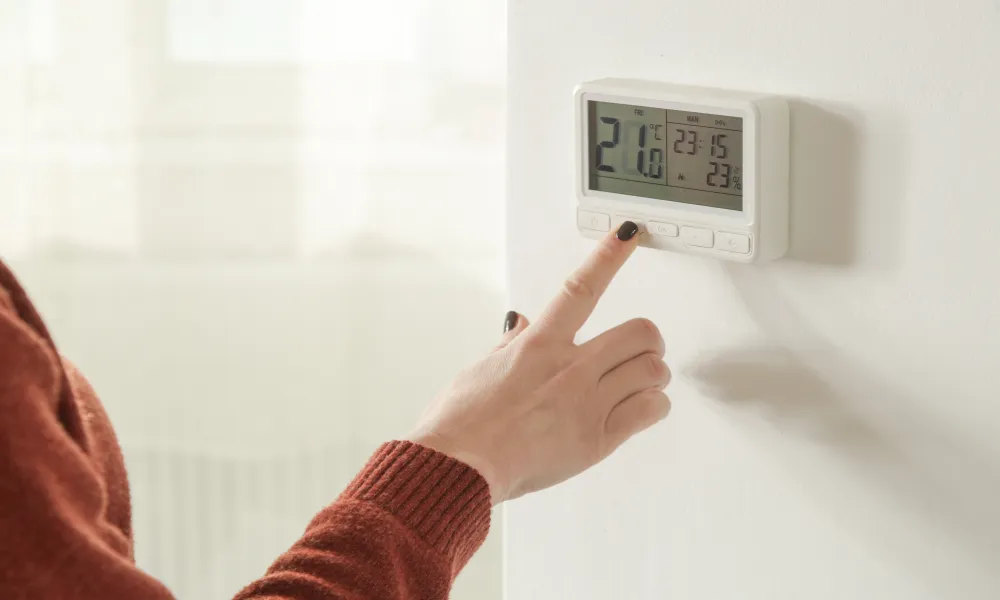
The thermostat setting also affects energy consumption. Depending on conditions, each additional degree can increase energy needs by 10%. The difference between a home kept at 20 degrees and one at 24 can be significant. Savvas Vlachos recommends around 21 degrees Celsius for everyday living spaces. Rooms used less often, such as hallways and storerooms, can be kept at 18 degrees. He also advises opening windows and curtains on sunny winter days, letting the sun warm the indoor spaces and reducing the need for heating.
Energy-efficient fireplaces
For households that burn wood, Savvas Vlachos points out that the efficiency of the fireplace or stove makes the difference. An open fireplace has an efficiency of 20% to 25%, while a closed, energy-efficient fireplace insert can exceed 70% to 80%. With pellet stoves, efficiency can approach 90%.