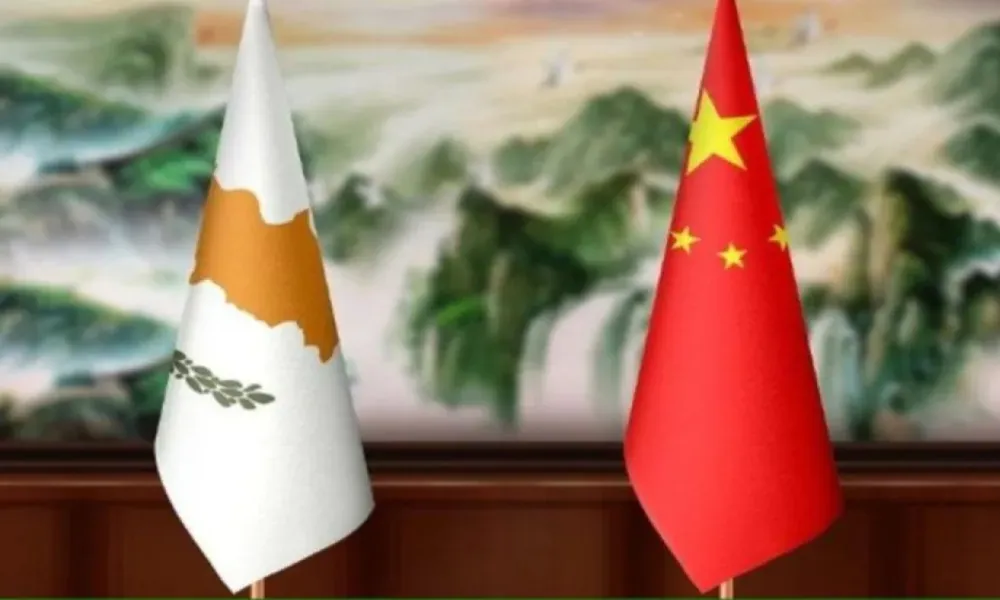



Bilateral trade between Cyprus and China reached $1.44 billion in 2025, an annual increase of 26%, according to figures presented by China’s Ambassador to Cyprus, Yang Yundong. The figures were announced at the Cyprus–China Cooperation and Entrepreneurship Forum, held on Tuesday at the Cyprus Chamber of Commerce and Industry (CCCI) in Nicosia.
The forum highlighted prospects for further developing the two countries’ economic ties, with a focus on investment, shipping, tourism, new technologies, green energy, and cooperation between local authorities and businesses.
Yang said China was Cyprus’s fourth-largest trading partner in 2025 and the third-largest country of origin for its imports. He added that Cypriot products, including halloumi, zivania and juices, were gaining a presence in the Chinese market.
The ambassador also said there was considerable scope for cooperation in shipping, tourism, green development and the digital economy. He underlined that Cyprus could serve as a bridge between China and the European Union.
Yang said the forum was part of events marking the 55th anniversary of diplomatic relations between Cyprus and China. He also stressed that cooperation between local authorities was an important pillar of bilateral ties and recalled the establishment of the China–Cyprus Alliance of Sister Cities in September 2023, an initiative aimed at developing meaningful cooperation between cities and local communities.
He also referred to the prospects of the Chinese economy and the opportunities for foreign businesses created by the development of artificial intelligence, robotics and other innovative sectors.
CCCI: Seeking lasting business partnerships
The importance of turning bilateral relations into concrete business partnerships was highlighted by CCCI President Stavros Stavrou. His speech was read by the Chamber’s Director General, Filokypros Rousounides.
Mr Stavrou said Cyprus could serve as an entry point for Chinese businesses into the EU single market, making use of its location at the crossroads of Europe, Asia and Africa, its human resources and professional services, as well as its legal and regulatory framework.
China, he noted, is an important market and an international centre for technology, innovation, production and investment, offering opportunities for Cypriot businesses.
He placed particular emphasis on the participation of businesses, municipal authorities and regional organisations in the forum, saying that local-level cooperation could create direct commercial opportunities. As an example, he referred to a cooperation agreement in the tourism sector scheduled to be signed by Cyprus’s Top Kinisis and China’s Zhejiang Overseas (Ningbo) International Travel Service Co., Ltd.
The CCCI president said the forum’s value would be measured by the partnerships that emerge after it concludes. He assured participants that the Chamber would continue to support links between Cypriot and Chinese businesses.
Nicosia aims for 80% energy autonomy
Nicosia Mayor Charalambos Prountzos outlined specific areas for cooperation with Chinese cities and businesses, focusing on green energy, smart-city infrastructure and research.
Prountzos said the municipality was promoting a project to achieve 80% energy autonomy renewable energy sources. The plan includes a photovoltaic installation with a capacity of 11 megawatts and energy-storage capabilities.
According to the mayor, two related studies funded by the EU have been completed and the project is under way. He said the initiative could offer scope for cooperation with Chinese cities and businesses with expertise in renewable energy.
He also announced that an agreement was scheduled to be signed on Friday, under the auspices of the Ministry of Education in Beijing, with the aim of connecting academic and research centres in Nicosia with corresponding organisations in Chinese cities.
In outlining the capital’s advantages, he referred to its six universities, six centres of excellence and approximately 50,000 students, as well as its potential to attract international businesses and specialised talent.
Nicosia’s smart-city infrastructure includes its own fibre-optic network, sensors, smart lighting, waste-management systems and the Novoville platform for communication with residents. The mayor said this infrastructure offered opportunities to work with Chinese companies to upgrade and make use of it.
He added that Nicosia had competitive costs for setting up businesses and housing, a strong university and research presence, and economic activity that did not depend on tourism seasonality.
Municipal cooperation for smart and sustainable cities
Andreas Vyras, President of the Union of Cyprus Municipalities and Mayor of Larnaca, spoke about strengthening cooperation between local authorities in Cyprus and China.
Vyras said China could be an important partner for Cyprus in technological development and modernisation, while Cyprus could offer access to the European market and the wider Middle East region.
Despite the difference in scale between the two countries, he said, local authorities faced common challenges relating to the provision of quality services to citizens, the development of smart cities, waste management, urban planning and sustainable urban development.
He recalled that a 26-member delegation from Cyprus’s local government had made a study visit to China in 2025 as part of a programme on modern urban development and management. The visit gave participants the opportunity to learn about technological development and urban-planning practices, as well as ways to combine economic progress with the preservation of historical heritage.
The Union of Municipalities president said Cyprus’s local authorities were ready to support new partnerships emerging from the forum, for the benefit of businesses and local communities.
Technology contributes more than €4 billion to the economy
Invest Cyprus Director General Marios Tannousis discussed Cyprus’s investment potential and the country’s economic trajectory, highlighting sectors attracting growing international interest.
He said the information and communications technology sector had become a key driver of the Cypriot economy. Its annual contribution exceeds €4 billion and amounts to approximately 15% to 16% of GDP.
Tannousis noted that Cyprus was recording an increase in foreign direct investment from different geographical regions. According to the figures he cited, the country ranks among the world’s top ten for foreign direct investment per capita.
Shipping, education, financial services and tourism were also performing positively, he said. He particularly highlighted the potential for Chinese businesses to use Cyprus as a regional base for activities in the European Union, the Middle East and North Africa.
In his view, the country’s geographical position, together with its EU regulatory framework and legal system, creates conditions for investment and commercial activity. He also referred to prospects for cooperation in financial technology, noting that Cyprus’s innovation ecosystem and supervisory mechanisms could support the development of new business activities.
More than 200 members in the Cyprus–China Business Association
The President of the Cyprus–China Business Association, Theodoros Parperis, spoke about the potential to expand trade and investment ties between the two countries.
He said Cyprus offered advantages to Chinese businesses wishing to expand into the European Union and the wider region, thanks to its geographical position, legal and tax environment, and growing professional and digital services sectors.
The association has more than 200 members and develops business contacts through missions, conferences and networking events in Cyprus and China, he said. He added that the association was preparing a new initiative in China and expressed the expectation that it would be implemented soon.
In conclusion, Parperis stressed that strengthening bilateral cooperation required making use of existing opportunities and turning them into tangible business results.
Source: CNA