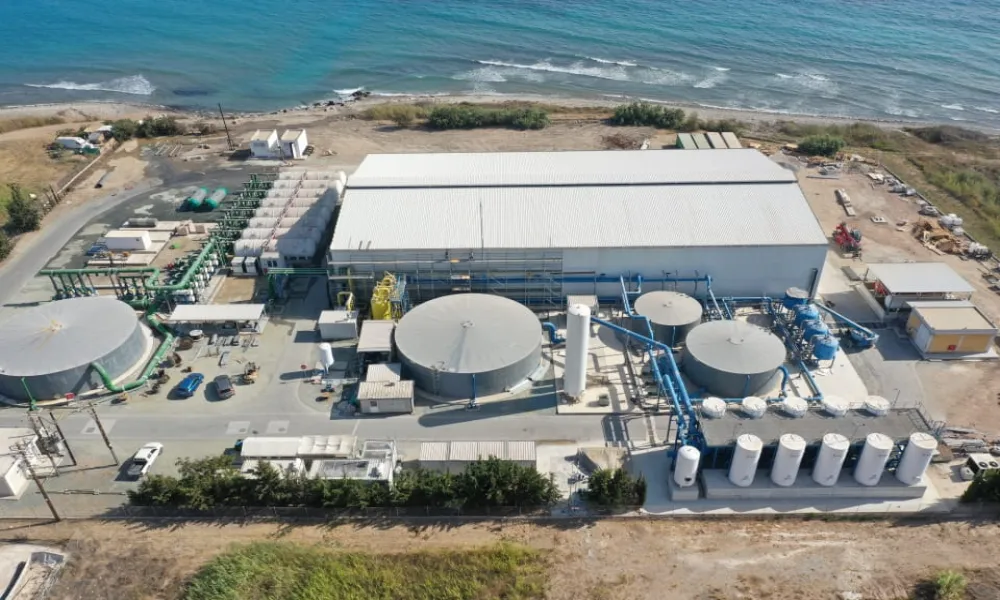

Permanent and mobile desalination units are expected to underpin Cyprus’ water security strategy through to 2028, with four new plants planned to ensure full coverage of drinking water needs and the gradual release of dam reserves for agriculture.
According to three-year scenarios prepared by the Water Development Department, which include four new units at Dhekelia, Vasiliko, Mazotos and Germasogeia, desalination is expected to contribute about 83 million cubic metres to the Southern Conveyor Project in 2026 and 8.2 million cubic metres to the Paphos Major Irrigation Project. For 2027 and 2028, the corresponding contribution is projected to rise to 105.1 million and 8.9 million cubic metres respectively.
Key assumptions for water security
To secure these volumes, the Water Development Department says it has adopted a set of critical assumptions relating to specific desalination plants that are considered vital to medium-term planning.
At the Dhekelia desalination plant, the existing contract with the operator, providing for 19.7 million cubic metres annually, expires in 2027. The department has already initiated negotiations to extend the current agreement. Under the Southern Conveyor Project scenario, annual output is expected to remain at the same level in 2026, 2027 and 2028. Any failure to conclude the negotiations positively could create significant deficits in the project’s water balance for 2027 and 2028, the department warns.
For the mobile desalination unit at Vasiliko, annual quantities of 3.3 million cubic metres have been factored in for 2027 and 2028, on the assumption that the unit will become operational in January 2027. Any delay in completing installation and integration would lead to corresponding shortfalls in 2027. The department notes that responsibility for completing the installation rests solely with the Cyprus Electricity Authority, as the implementing authority.
At the Mazotos desalination plant, annual quantities of 13.1 million cubic metres have been included for 2027 and 2028, based on the assumption that the unit will enter operation in January 2027. The department cautions that any delay in installation, the start of full operation or a possible cancellation or redesign, as occurred with the mobile unit at Ayia Napa, would result in significant deficits in the quantities incorporated into the water balance, particularly in 2027. It should be noted that a group of residents and environmental organisations oppose the Mazotos project, citing the risk of damaging a beach of pristine natural beauty and a rich marine ecosystem with protected habitats.
For the floating desalination unit at Germasogeia, annual quantities of 6.6 million cubic metres have been included for 2027 and 2028, based on the assessment that the unit will become operational in January 2027. The department notes that the project is still at the tender document preparation stage and is considered high risk, albeit necessary, for technical and or financial reasons. Any delay in installation, certification or full operational integration would lead to immediate deviations from projected volumes and deficits in 2027.
Four new units in 2027
A mobile desalination unit at Garyllis in Limassol is expected to become operational within days, adding an additional 10,000 cubic metres of water to the supply system. This will be the fourth unit to enter full operation, following the mobile unit at Moni with a capacity of about 15,000 cubic metres per day, which came online in July 2025, the mobile unit at Potima in Kissonerga with a capacity of 12,000 cubic metres per day, also integrated in July 2025, and the unit at Limassol Port with a capacity of 10,000 cubic metres per day, which became operational last month.
With the addition of the Israeli-owned unit at Garyllis, the number of desalination plants rises to nine. A tenth, mobile unit with a capacity of 15,000 cubic metres per day, is expected to become operational in Episkopi, Limassol, in September.
Bridge projects
These projects form part of the Water Development Department’s medium-term planning to ensure full coverage of drinking water needs from desalinated water by 2027, while preserving dam reserves for irrigation. As reported by Politis, this year, following a decision by the Advisory Water Management Committee, the agricultural sector will receive zero quantities for seasonal crops in areas served by the Southern Conveyor Project, particularly potato farming in free Famagusta, and the Paphos Major Irrigation Project. Significant volumes of dam water have been earmarked instead for increased drinking water demand.
The decision has prompted strong reactions from farming organisations, which are calling for last-minute changes before the agriculture minister submits the final proposal to the cabinet. By contrast, for domestic water supply, the 10% cut imposed on water boards is being lifted and additional allocations of between 5% and 16% are being granted.
At present, permanent and mobile desalination units cover about 80% of drinking water needs supplied through government water systems. These are considered bridge projects until two new permanent desalination plants are installed, one at Dhekelia with a capacity of 80,000 cubic metres per day to replace the existing unit, and another at Episkopi, Limassol, with a capacity of 60,000 cubic metres per day.
Department issues warning
However, to complete the medium-term plan by 2027, which would allow adequate coverage of agricultural needs, the Water Development Department says four additional desalination projects must be implemented at Dhekelia, Vasiliko, Mazotos and Germasogeia.
“Any delay, partial operation or failure to complete even one of the above desalination plants will create significant and difficult-to-manage deficits, which would have to be covered by dam reserves, with serious impacts on the water balance,” the department warns in a special note submitted to the Advisory Water Management Committee on water allocation scenarios for 2026–2028. “Such a development would undermine medium-term planning, increase uncertainty and substantially limit available management tools, raising the risk of stricter restrictions on domestic supply and irrigation in the coming years.”
Increases through 2028
In preparing three-year allocation scenarios, the department has assumed the full and uninterrupted operation of all existing desalination plants at up to 100% of their contractual capacity throughout the reference period. This assumption, it stresses, is a core component of the water balance and a critical precondition for ensuring adequate drinking water supply, particularly under prolonged drought conditions and increased demand.
Specifically, total desalination output is estimated to contribute about 83 million cubic metres to the Southern Conveyor Project and 8.2 million cubic metres to the Paphos Major Irrigation Project in 2026. For 2027 and 2028, the corresponding contribution is projected to rise to 105.1 million cubic metres for the Southern Conveyor Project and 8.9 million cubic metres for Paphos, in line with the planned integration of the four new desalination plants outlined above.