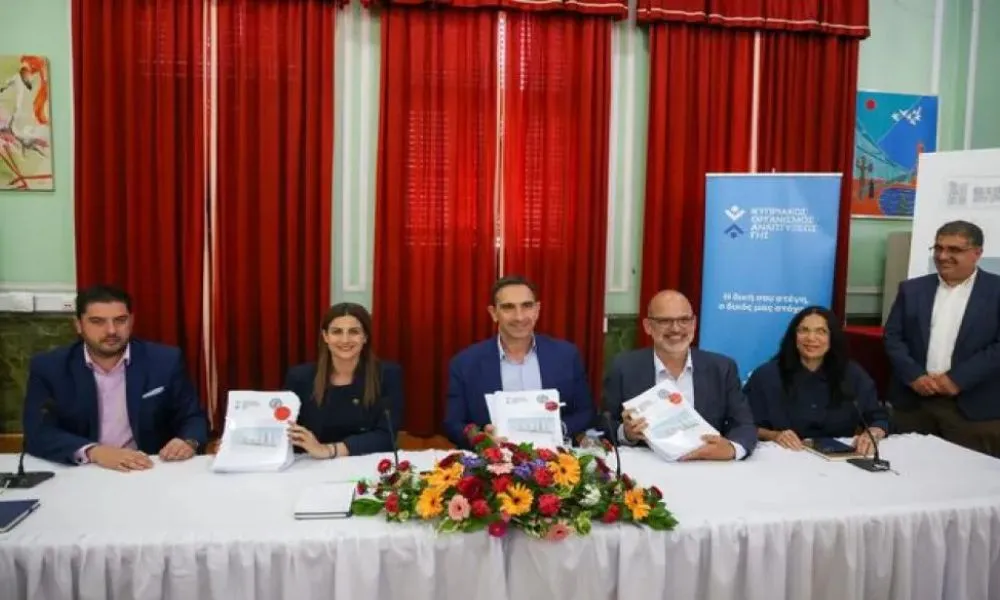

Several open issues remain between the Municipality of Limassol and the Cyprus Land Development Corporation (CLDC) regarding the implementation of their major joint project to create hundreds of new apartments in Limassol, which will be used for affordable housing and made available through an 'affordable rent' scheme. Although, after a decade of discussions and announcements, the project has finally started with one apartment block of 36 units (with four more blocks to begin within 12 months, bringing the total to 138) in Agios Nikolaos, there is still a long way to go before reaching the original target of 600 apartments. However, new realities – both in Limassol in 2026 and in the way CLDC funds projects – appear to be creating obstacles to the smooth continuation of the programme. In particular, concerns are emerging about continuing the project in Agios Ioannis, as well as differing approaches regarding the second – and most important – plot in Agios Nikolaos. At a theoretical level, these concerns relate to phases B1–B2 and Phase C, involving 180 and 280 apartments respectively.
Willing to continue, but…
First of all, it should be clarified that both sides are willing to continue the project, as they understand the magnitude of Limassol’s housing problem and the social impact it has on the city. The Municipality of Limassol continues to view it as its duty to contribute by providing land, while the CLDC believes it must focus on Limassol while also continuing with the 'affordable rent' model as a sound practice for providing housing units. Beyond that, the fact that ten years have passed since the initial announcement has created problems that could not have been foreseen from the outset.
Agios Ioannis ‘too expensive’
Phases B1 and B2 of the project concerned municipal plots in Agios Ioannis, specifically on Goethe Street. These plots currently host some very old municipal social housing, which is to be demolished. The original planning for this location provided for 180 housing units.
However, the Municipality of Limassol now appears to be raising concerns over the high value of the land, given that it is now adjacent to major developments in the city (very close to the coastal road). Essentially, the value of the land today is almost equivalent to construction costs, a development that would radically alter the balance of the land‑for‑build exchange (possibly even a 50‑50 split), whereas in Agios Nikolaos it currently stands at around 68% (CLDC) and 32% (municipality). The CLDC has prepared construction designs and applied for a planning permit for Phase B1 (87 units), which was forwarded by the District Local Government Organisation to the Municipality of Limassol for comments and stalled there, as municipal consent is required for significant modifications related to green spaces and road layout, which would need to be reduced. Both sides acknowledge that it is too early to reach a final agreement on the exchange, since this will depend on construction tenders that will determine actual costs; however, as time passes, land values continue to rise.
For this reason, Interior Minister Constantinos Ioannou sent a written letter to the Mayor of Limassol at the end of April, asking whether anything had changed on the municipality’s side. He noted that “it has been brought to my attention that reservations are being expressed on your part… and that alternative options outside the urban core, on the outskirts of the municipality, are being considered.” The minister’s letter also underlined the importance of the project to his ministry and requested clarification of the municipality’s position.
‘Yes’ from the municipal council
The issue was brought before the Limassol municipal council, which unanimously decided that it is positive for the project to continue, provided that the land‑for‑build process is carried out properly and fairly, effectively resulting in a much higher ownership share for the municipality. At the same time, the discussion reopened on whether guarantees should be sought from the state to ensure that beneficiaries fulfil their obligations to the municipality, as significant arrears have already been observed in cases where municipal apartments have been allocated to beneficiaries. The Mayor of Limassol also raised the need to clarify that the project concerns affordable housing rather than social housing, and that if the intention is for it to be the latter, alternative solutions would need to be found, along with new housing models inspired by examples from abroad.
Architectural competitions
A particularly crucial issue – one that could change the course of the project – is the unanimous decision of the Limassol municipal council to request that all subsequent stages of the project be carried out through architectural competitions. Until now, the architectural designs were prepared internally by the CLDC, a practice opposed by the municipality. This requirement is intended to apply immediately to the remaining development ratio of the Agios Ioannis plot. In addition, the municipality considers this a 'red line' for the third and largest phase of the project in Agios Nikolaos, involving 280 housing units.
The municipality is also asking for the incorporation of New European Bauhaus principles in the project’s design, through participatory processes and the determination of uses by the residents themselves. In support of this, it cites the recent government decision to launch architectural competitions for 500 housing units across Cyprus, although in that case the competition concerns only the concept and not the entire project. These proposals will be forwarded immediately to the CLDC and the Ministry of Interior, who will need to take a position, although initial indications suggest reservations, as this approach would significantly increase implementation costs.
Ready with proposals
Meanwhile, the Municipality of Limassol is not limiting itself to the large 600‑unit project and is putting other ideas on the table, either for affordable or social housing in the city. Specifically, the municipality says it is ready to make available a large municipal plot located within the administrative boundaries of the Municipality of Polemidia, where a major new residential complex could be developed, potentially including a four‑digit number of housing units, along with additional complementary uses. There is also discussion about submitting a request to the Council of Ministers for the transfer of unused development rights held by the Municipality of Limassol from other plots, such as the municipality’s 'prime asset,' the Enaerios plot, in order to increase buildable area on other plots and allow for the construction of more housing units.