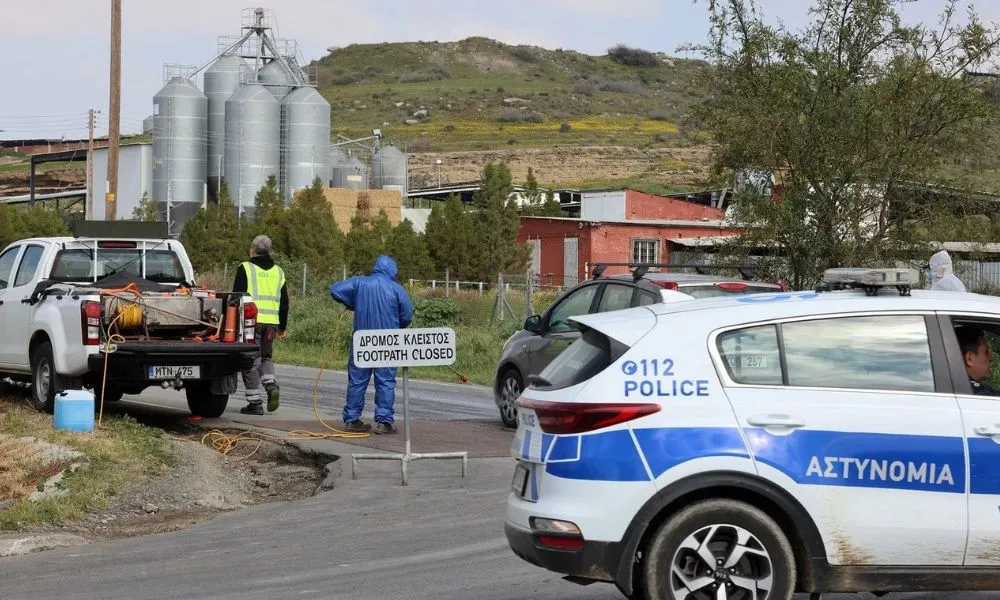

With a delay of approximately three months, the government has decided on more active involvement and mass presence of the army and police in the fight against foot‑and‑mouth disease, as well as an increase in fines of up to €250,000. Unlike during the Covid period, the monitoring of livestock farmers regarding compliance with biosecurity measures had until now been largely inadequate, both for illegal animal transport across the Green Line and within the free areas, particularly from infected zones to 'clean' areas, with the result that the virus has spread unchecked from Larnaca to Nicosia and Limassol.
“Better late than never for the tightening of measures,” commented yesterday on Politis 107.6, the President of the Pancyprian Farmers’ Union (PEK), Christos Papapetrou, noting that until now “we were chasing the virus” and confirming reports carried in our coverage about violations of decrees by a portion of livestock farmers, allowing the virus to remain uncontrolled.
Following successive meetings held yesterday at the Presidential Palace under President Christodoulides, initially with the Veterinary Services and the scientific team and subsequently with agricultural organisations and the group 'Voice of the Livestock Farmers,' Agriculture Minister Maria Panayiotou announced the implementation of a package of ten measures, stressing that effective management of the situation requires cooperation from all involved stakeholders and producers.
First, it was decided to immediately complete the culling of infected animals, something that, she stressed, can be carried out very quickly over the coming days.
Second, while the virus is still spreading due to movement and incomplete implementation of biosecurity measures, including mass gatherings, both detection methods will be used, namely PCR (molecular testing) and ELISA (enzyme‑linked immunosorbent assay). Subsequently, the Minister noted, the method will be evaluated depending on the results by the epidemiological team.
Third, the nationwide mass vaccination campaign continues and will be completed rapidly. To date, vaccination of the second dose stands at 84% for cattle, 78% for sheep and goats and 41% for pigs.
Fourth, fines are being tightened with regard to illegal transactions with the occupied areas or other movements. This involves increasing administrative fines up to €100,000 and court fines up to €250,000. The relevant decision will be submitted to the Council of Ministers next Thursday.
Fifth, strict compliance with biosecurity measures has been decided, with more active involvement and mass presence of the army and police.
Sixth, a clear separation of teams carrying out culling, vaccinations and sampling.
Seventh, the epidemiological team will hold at least one meeting per week with the Veterinary Services and at least one weekly meeting with representatives of livestock farmers and agricultural organisations.
Eighth, compensation for sheep and goats will be further increased and the amount will be evaluated in the coming days.
Ninth, public statements on issues related to foot‑and‑mouth disease will be made by Dimitris Tsiartas, Dimitris Epameinondas and Mr Malas.
And finally, control at crossing points regarding the movement of animal products is being further strengthened.
The head of the Scientific Committee for the restructuring of the livestock sector, Stavros Malas, stated that the next three months are critical. “If biosecurity measures are not strictly observed, the spread of the virus is inevitable,” he stressed, adding that “tracking and detection of the virus has been decided, because if we do not identify the sources, sheep and goat farming is at risk.”
Greetings for the PCR decision
The issue of halloumi was not discussed at the meeting due to limited time, Mr Papapetrou told Politis 107.6. On the matter of culling, he noted that agricultural organisations had hoped that decisions would be announced, however he said it is a step in the right direction that molecular testing (PCR) will soon be used exclusively, which, he stressed, detects only the active virus and not antibodies.
The General Secretary of the Cyprus Farmers’ Union (EKA), Panikos Hambas, said that unity and common understanding are needed, describing the increase in fines for illegal movements as important. Tasos Giapanis, Secretary General of the Pancyprian Farmers’ Union, welcomed the measures taken, particularly the increase in fines for illegal transactions with the occupied areas, which can reach up to €250,000.
Dissatisfaction over culling
Dissatisfaction over the continuation of culling was expressed in statements by the President of the group 'Voice of the Livestock Farmers', Neophytos Neophytou, noting that the President of the Republic is firm and does not discuss alternatives. However, he welcomed other measures taken, praising the decision on fines and the revision of compensation levels. In response to a question about what livestock farmers intend to do next, given that their main demand is the termination of mass culling, he said that the group will convene to take decisions.