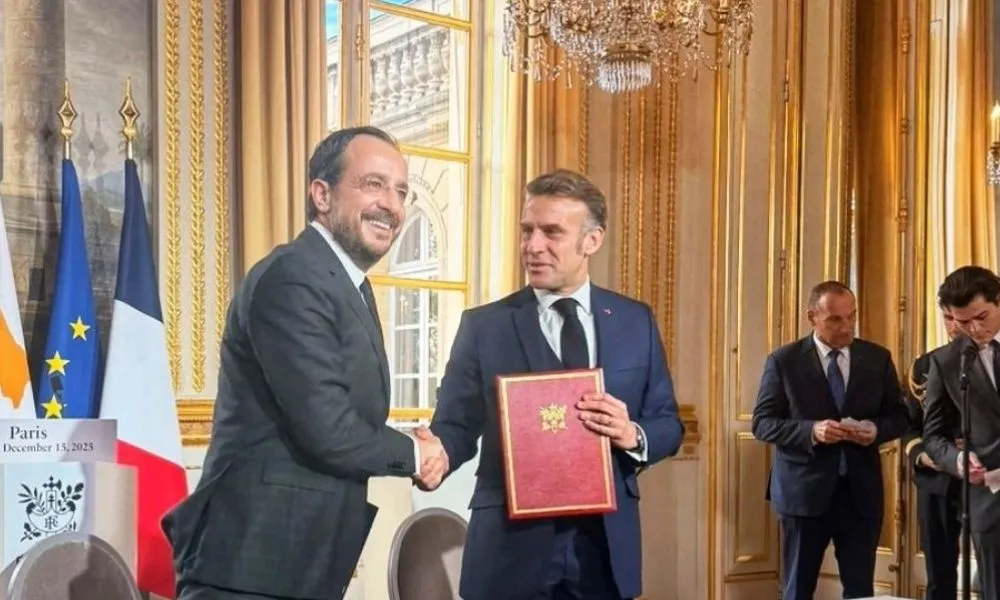

Cyprus and France are signing a Status of Forces Agreement (SOFA) in Nicosia, marking another step in the Republic’s defence upgrade and its effort to integrate more closely into the European security framework.
The agreement governs the legal and practical aspects of the presence, movement and activities of French military personnel on Cypriot territory. It is not a mutual defence pact and does not provide for the establishment of a permanent French base. However, it creates a framework for joint exercises, training, operational cooperation, use of infrastructure and faster response in times of crisis.
A partnership years in the making
The agreement is part of a broader trajectory of defence cooperation between the two countries. Bilateral ties have steadily deepened since a defence cooperation agreement signed in April 2017, which entered into force in August 2020.
The French navy already participates in joint exercises with Cyprus, while France is among the island’s main suppliers of defence equipment.
In 2022, the two sides also agreed on cooperation in evacuation operations from the Middle East via Cyprus, highlighting the island’s strategic location near Lebanon, Israel, Syria and key maritime routes in the Eastern Mediterranean.
What Cyprus gains
For the Republic of Cyprus, the agreement has three main dimensions.
First, it strengthens deterrence. Cyprus remains a small state outside NATO, with part of its territory under occupation and a large Turkish military presence in the north. Closer ties with a major EU power enhance its strategic weight.
Second, it improves access to know-how, training, defence industry cooperation and joint exercises. This comes as the EU expands its defence initiatives, including financing mechanisms to boost preparedness and procurement.
Third, it reinforces Cyprus’s role as a regional security hub. Proximity to conflict zones in the Middle East makes the island a key node for evacuation missions, humanitarian support and coordination during crises.
France’s strategic interest
For France, Cyprus offers EU territory, political stability and strategic access to the Eastern Mediterranean and the Middle East.
French presence on the island facilitates evacuation operations, maritime surveillance, protection of citizens, logistical support for naval units and crisis management. It also strengthens French defence industry interests in the region and complements Paris’s broader strategic partnerships, including with Greece.
The Greek dimension
For Greece, the agreement fits into a wider network of cooperation in the Eastern Mediterranean.
While the Cyprus–France deal does not include a mutual defence clause like the 2021 Greece–France strategic pact, it reinforces France’s growing role in the region.
Athens views the Republic’s security as part of a broader strategic framework, particularly amid Turkish assertiveness and its push for a two-state solution in Cyprus.
European security context
The agreement also has significance for the European Union.
Under Article 42(7) of the EU Treaty, member states are obliged to assist a country that comes under attack. For Cyprus, which is not a NATO member, this provision carries particular weight.
However, its effectiveness depends not only on legal commitments but also on real capabilities – infrastructure, joint exercises, interoperability and political will – which agreements like the one with France help to build.
Turkish reaction
Turkey’s reaction was expected.
The Turkish Cypriot administration has described the agreement as dangerous, arguing it alters the balance of power and ignores Turkish Cypriot rights. Ankara has previously criticised similar moves, claiming the Republic of Cyprus has no authority to conclude such agreements.
This position sits uneasily alongside Turkey’s continued military presence in northern Cyprus since 1974.
In practice, the unease reflects a broader shift: Cyprus is gradually moving away from the image of an isolated and vulnerable state, strengthening its ties with major partners such as France, the United States and Israel, and embedding itself more deeply in the European defence architecture.
Source: protothema.gr