Despite the continued global decline in peace, some countries remain examples of stability and safety. According to the 2026 Global Peace Index, global conditions deteriorated for the 12th consecutive year, with 99 countries recording worse performance compared to the previous year.
The index, compiled by the Institute for Economics and Peace, assesses 163 countries based on 23 criteria, including military expenditure, conflicts, crime rates, homicide levels and citizens’ perception of safety.
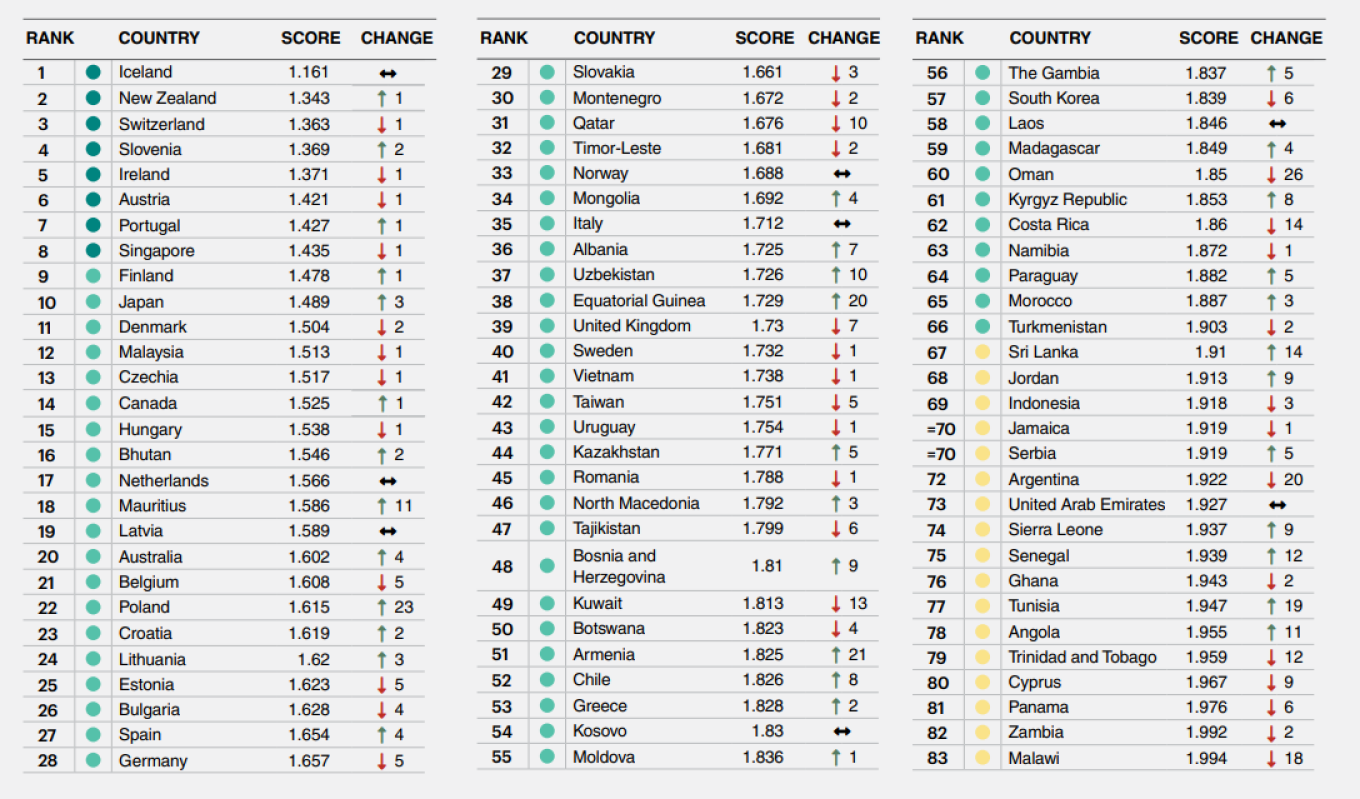
Within this environment, Greece improved its position, ranking 53rd globally with a score of 1.828, climbing two places compared to last year.
As noted by the organisation’s founder and executive chairman, Steve Killelea, although global conditions worsened, the countries at the top of the ranking remained largely unaffected.
Countries that stand out for their safety tend to combine low levels of violence, strong institutions, high social trust, good relations with neighbours and a high quality of life.
Iceland remains at the top
Iceland ranks first for the 19th consecutive year, maintaining its status as the world’s safest country since 2008.
In 2026, it showed a further improvement of 2%, mainly due to a decrease in violent protests. It also continues to record extremely low crime rates, limited militarisation and minimal social tensions.
Residents attribute this to strong local communities, social cohesion, gender equality, effective public services and extensive use of renewable energy.
New Zealand ranks second, rising one place compared to last year and becoming the safest country in the Asia-Pacific region.
Its geographical isolation is seen as a key factor, keeping it away from many global geopolitical tensions. Citizens also describe a relaxed pace of life, high levels of trust and strict gun control rules.
Switzerland ranks third, rising from fifth place in 2025.
It stands out for low crime rates and long-standing military neutrality. Residents describe daily life as based on trust, adherence to rules and compromise among different cultural and linguistic communities.
A striking example of this trust is that lost wallets and credit cards are often returned intact.
Slovenia and Ireland complete the top five
Slovenia ranks fourth, entering the top five for the first time.
The country stands out for low military spending, high safety levels and a strong link between residents and nature. Outdoor activities such as hiking, cycling and skiing are central to daily life, while work-life balance is highly valued.
Ireland completes the top five, scoring highly due to low levels of violence and limited involvement in international conflicts.
Residents attribute their sense of safety to the country’s historical experience, which has fostered tolerance, hospitality and understanding. Its traditional policy of neutrality also contributes to a stable environment.
Despite global uncertainty, these five countries remain examples of societies where safety, trust, stability and quality of life are maintained at very high levels.
Where Cyprus stands
Cyprus ranks 80th in the 2026 Global Peace Index, marking a noticeable decline compared to 2025. With a score of 1.967, the country dropped nine places, recording one of the steepest declines among European states included in the ranking.
Although it remains better positioned than several countries in the Middle East and other regions with heightened geopolitical tensions, Cyprus’s decline reflects challenges across key safety and peace indicators.
Notably, Greece, in contrast, improved its ranking by two positions, widening the gap between the two countries in this year’s assessment.