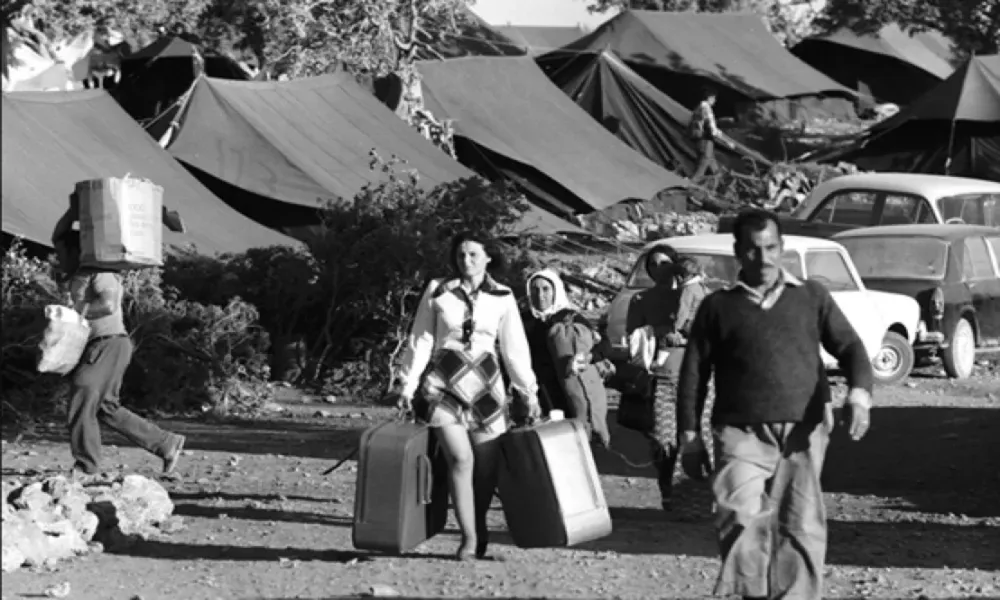

Fifty-two years after the Turkish invasion of 1974, 247,552 displaced Greek Cypriots remain alive, according to 2025 data from the Population Archive of the Interior Ministry obtained by the Cyprus News Agency (CNA).
Four generations of displaced people have now lived with the consequences of the events of July and August 1974, striving to rebuild their lives while maintaining hopes of eventually returning to their homes.
For decades, the physical backdrop to that experience has been Cyprus' network of 69 government refugee housing estates, established after the invasion to accommodate the vast majority of those forced from their homes.
Originally conceived as temporary housing, many of these settlements became permanent homes for the first generation of displaced persons, many of whom died without seeing a return to their places of origin.
Changing communities
After more than five decades, not only have the buildings aged, but the demographic makeup of the settlements has also changed significantly.
The Interior Ministry says it is not possible to determine precisely how many refugees, from the first through to the fourth generation, still live in the housing estates.
Nor does the ministry have complete data on the current population of the settlements.
Officials note that some original beneficiaries now rent out their properties, others have sold them, while some homes remain occupied by the original owners and their families.
A major factor in this evolution was the introduction of property title deeds for displaced persons living in government housing and self-help housing developments from 2006 onwards. Until then, residents occupied the homes under use or rental arrangements.
For many families who lost everything in 1974, ownership of what had initially been intended as temporary accommodation provided long-term security three decades after their displacement.
Living with temporary solutions
The maintenance and suitability of housing in refugee settlements has become an increasingly pressing issue for both residents and the state.
According to the Interior Ministry, major upgrading works have already been carried out through the Reconstruction, Repair and Structural Reinforcement Programme launched in 2000.
The programme targeted eight of the oldest government housing estates, including developments in Pano Lakatamia, Strovolos II, Agios Pavlos and Agios Mamas in Nicosia, Agioi Anargyroi I in Larnaca, and Agios Athanasios, Makarios III and Linopetra in Limassol.
So far, the programme has delivered:
- 47 new apartment blocks
- 187 houses
- Repairs or structural reinforcement of 50 apartment blocks
- Repairs or improvements to 2,200 houses
The programme remains ongoing.
Elevator installations
A separate initiative focused on installing elevators in older apartment buildings within refugee housing estates.
The programme originally covered 368 apartment blocks across Cyprus.
To date:
- Elevators have been installed in 124 existing apartment blocks
- An additional 78 elevators have been installed in newly constructed buildings
- A total of 202 elevators are now operating in refugee housing estates nationwide
The dedicated elevator programme has since been incorporated into the government's ktIZO housing scheme, which provides grants of up to €90,000 per apartment block for elevator installation.
The ktIZO redevelopment scheme
In 2023, the Council of Ministers approved the ktIZO scheme, designed to provide a long-term solution to unsafe and unsuitable apartment buildings in refugee settlements.
The programme covers 358 apartment blocks across Cyprus and is being implemented in three phases.
Phase One
- Includes 43 apartment blocks
- Buildings deemed unsafe and unsuitable
- Properties are being vacated, demolished and rebuilt
Phase Two
- Covers 70 apartment blocks
- Buildings requiring substantial repairs
- State grants of up to €300,000, plus €90,000 for elevator installation
Phase Three
- Covers 245 apartment blocks
- Buildings with less serious defects
- Grants of up to €300,000, plus €90,000 for elevators
New buildings under construction
The first two replacement apartment blocks, located in the Apostolos Andreas housing estate in Latsia and the Kokkines estate in Strovolos, are expected to be handed over within the coming weeks.
Construction is already under way on six additional apartment blocks in Nicosia and Limassol, while work on another two projects in Limassol and Larnaca is due to begin in the autumn.
The second and third phases of the scheme have also been accelerated.
So far, authorities have received expressions of interest from:
- 26 apartment blocks in Phase Two
- 30 apartment blocks in Phase Three
Ongoing maintenance
Alongside the major redevelopment projects, the government continues to maintain refugee housing estates through general maintenance contracts covering the districts of Nicosia, Larnaca-Famagusta, and Limassol-Paphos.
Repair and maintenance works are carried out following requests from eligible refugee residents and are aimed at ensuring safe living conditions.
According to the Interior Ministry, such work has already been undertaken in a large number of housing units across refugee settlements throughout Cyprus.
Source: CNA