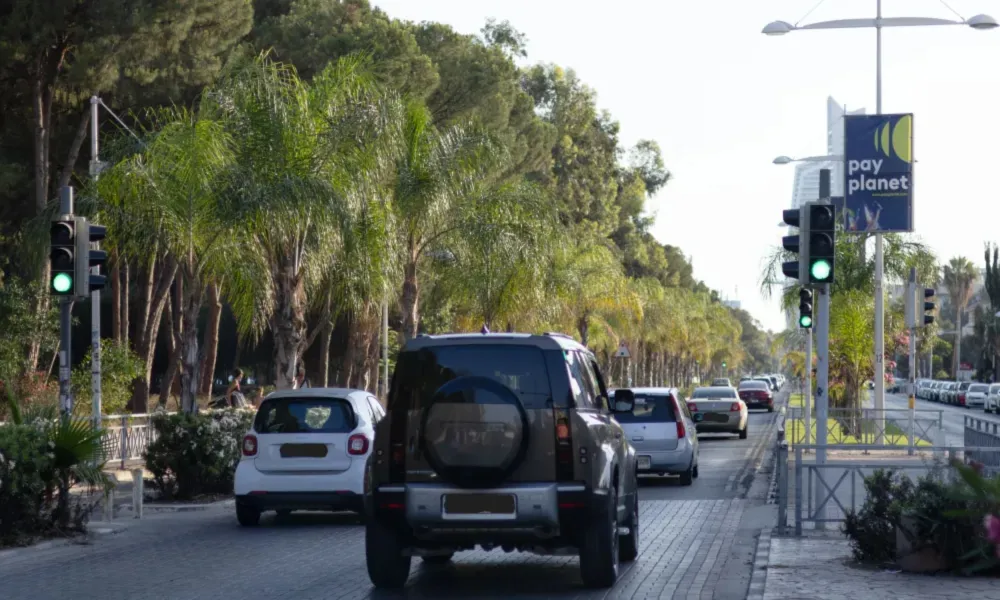

A new initiative by the Public Works Department is expected to ease congestion at key locations in Nicosia and Limassol through the installation of "smart" detectors at 15 signalised junctions.
The detectors will allow traffic lights to adjust their timing according to actual traffic flows, providing additional green-light time where higher traffic demand is recorded.
The move comes as the replacement of the ageing SCOOT traffic management system remains pending due to court proceedings.
It is a smaller and significantly cheaper solution that can be implemented immediately.
The new systems will not form a unified network and will not communicate with one another, but will operate independently at each junction.
Speaking to Politis, Alexis Avgoustis, Executive Engineer at the Public Works Department, stressed that the project should not be confused with the replacement of SCOOT.
SCOOT and the new project are different
According to Avgoustis, the SCOOT traffic management system operated from around 1992-1993 until 2023, but its technology had become obsolete.
A tender for its replacement was launched around two and a half years ago and awarded, but the process was challenged and is currently before the Administrative Court.
The department is awaiting the court's decision before deciding how to proceed.
The key difference, he explained, is that the 15 junctions in the new tender will operate individually.
The detectors will monitor traffic in real time and adjust signal timings, but only at a local level.
Similar systems have already been installed in various locations across Cyprus over the past four to five years, with the Public Works Department describing the results as highly positive.
The Ministry of Transport, Communications and Works will accept bids for the project until 18 September.
Work is scheduled to begin in early October and is expected to take three months to complete.
The estimated cost is €41,900 excluding VAT, funded through national resources.
A total of 25 overhead detectors will be installed, with 11 at seven junctions in Nicosia and 14 at eight junctions in Limassol.
How the traffic lights work
At present, conventional signal-controlled junctions operate according to pre-set programmes that change depending on the time of day.
Different settings apply during the morning period, peak hours and at night.
As Avgoustis explained, even the total signal cycle changes.
A waiting cycle that may reach 120 seconds during the day can be reduced to 50 seconds at night when traffic volumes are lower.
The drawback is that a fixed programme does not know what is happening on the road at any given moment.
As a result, one direction may have 20 vehicles waiting while the opposite direction has none, yet both sides receive time according to the pre-set cycle.
The "black box" above the traffic lights
This is precisely what the new detectors are designed to address.
The devices are installed above or near traffic lights and may resemble small cameras from the outside.
They are not cameras, Avgoustis stressed, but detection systems that can operate using radar technology and identify vehicles within a defined section of road.
Similar technology is already being used around Makarios Avenue and Solomou Square to detect buses and vehicles.
The principle is simple: if there is no vehicle, there is no reason to waste green-light time.
"One direction may have 20 vehicles, while the other has none," Avgoustis said.
In such a case, the new system can reduce the green phase for the empty approach to the minimum required time and allocate the saved seconds to the side with the longer queue.
From 30 seconds to seven
Avgoustis cited the example of another junction in the Engomi area where two detectors have already been installed.
Where there is little or no demand from one direction, the green phase can be reduced from 30 seconds to as little as seven seconds.
The saved time is then added to approaches experiencing higher traffic demand.
"It is demand-based allocation," he said.
He stressed that the system will not eliminate traffic queues.
"It will not eliminate traffic, but it will help with better regulation and distribution."
The difference is that the traffic lights will use available time more efficiently instead of allocating green time to a direction where no vehicles are present.
Much cheaper solution
Cost is another significant factor.
A fully integrated system in which one junction communicates with the next requires sensors, communication systems, control centres, servers or cloud infrastructure and substantially higher investment.
By contrast, the new detectors communicate only with the local traffic-signal controller at each junction.
"Our tender is for 15 traffic-light installations and is worth about €42,000. It is much cheaper," Avgoustis said.
More locations to follow
The Public Works Department does not intend to stop at the initial 15 junctions.
According to Avgoustis, the approach will gradually be extended to other signal-controlled junctions that will not form part of the central traffic management system.
If funding becomes available, the department intends to launch a similar contract next year covering around 10 additional locations, while further needs have also been identified in Larnaca and Paphos.
The technology is not new internationally, he noted.
It has been used abroad for years, while in Cyprus it has been introduced gradually over the past four to five years, initially mainly as part of major private developments generating additional traffic demand.
How much time will motorists save?
For now, the Public Works Department is not providing a specific estimate of how much waiting times will be reduced.
According to Avgoustis, there are some initial results from earlier installations, but not enough data to state confidently that delays fall by a specific percentage.
For that reason, the new tender includes a requirement for measurements before and after installation.
Vehicle queues and traffic conditions at each approach to the junctions will be monitored to assess the impact of the intervention using real data.
The seven junctions in Nicosia
A total of 11 detectors will be installed at the following junctions:
- Kallipoleos - Ipatias - Chalkidonos (2 detectors)
- Limassol Avenue - Tevkrou Anthia (E138) (1 detector)
- Limassol Avenue - Lefkosias Avenue (2 detectors)
- Morphou Avenue - Lykavitou Avenue (2 detectors)
- Iroon Avenue - Lefkotheou Avenue (2 detectors)
- A1 Exit 6 - Chalepianon - Tseriou (E120) (1 detector)
- Kallipoleos - Ipatias - Nikos Mylonas (1 detector)
The eight junctions in Limassol
A total of 14 detectors will be installed at:
- Georgiou A' - Ariadnis (2 detectors)
- Spyrou Kyprianou - Kranou (1 detector)
- Port Road - Agoras (2 detectors)
- Port Road - N. Kavvadia - Tassou A' (3 detectors)
- Nikaias - 22nd Road (2 detectors)
- A. Shoukri - Olympion (1 detector)
- Spyrou Kyprianou - P. Mavromichali (1 detector)
- Spyrou Kyprianou - Christoforou Agroti (2 detectors)