
Certification documents obtained by Politis have raised a series of critical questions about the circumstances under which the FİLO JET departed and conducted its ill-fated voyage from Kyrenia to Taşucu, with particular attention focusing on weather restrictions contained in the vessel's class certificate.
The documents show that the high-speed passenger catamaran was subject to specific operational limits that have taken on added significance following reports of rough sea conditions, accounts from survivors and claims by crew members that waves caused structural damage to the vessel before it sank.
Explicit restriction on wave height
The class certificate issued by Türk Loydu for the vessel, registered under IMO number 8962034 and owned by Filo Denizcilik Şirketi Limited, was issued on 2 June 2026 and remained valid until 3 March 2029, provided class requirements continued to be met.
A key provision contained in the certificate establishes operational limits based on significant wave height.
Under the certificate:
- For waves up to 2 metres, the maximum permitted speed was 32 knots.
- For waves between 2 and 3 metres, the limit was reduced to 27 knots.
- For waves above 3 metres, the crew was instructed to seek shelter while proceeding at low speed.
The certificate also contains a specific instruction:
"The vessel is also not to leave harbour when significant wave heights above 3.0 metres can be expected."
The document further emphasises the need for continuous monitoring of weather and sea conditions.
Weather conditions under scrutiny
The restriction has drawn increased attention because the vessel's scheduled voyage had already been postponed by one day due to adverse weather.
On 28 August, the relevant meteorological service issued warnings forecasting winds of up to force 8 Beaufort in surrounding waters for the following day.
Red flags were raised on beaches in the Kyrenia area, while an orange weather warning was issued for severe conditions.
The FİLO JET had initially been due to sail on 29 August, but the crossing was delayed because of the weather and eventually took place on Sunday.
Investigators must now determine:
- What forecasts were available before departure.
- What information had been provided to the crew.
- What sea conditions actually existed along the route.
- Whether the vessel's operational restrictions were observed.
The captain and crew members have reportedly argued that weather data available at the time did not prohibit the voyage.
Similar statements have been reported by Anadolu Agency, while Turkish Cypriot leader Tufan Erhürman also stated after the sinking that Sunday's conditions had been considered suitable for travel.
Survivor describes powerful impacts
What happened once the vessel entered open waters has become a central focus of the investigation.
Crew members reportedly told a "court" that waves caused damage to the front section of the vessel, resulting in water ingress and an attempted return to Kyrenia.
That account is partially mirrored by survivor testimony obtained by Politis from Şeydi Alay.
According to Alay, the catamaran suffered at least two powerful impacts when it encountered large waves.
"As soon as we met the waves, we felt the first strong impact. After the second impact, water started coming in," he said.
Alay alleged that despite warnings from passengers, the vessel initially continued at speed.
According to his account, only later did the vessel slow down and attempt to turn back.
"When they finally slowed down, they turned the vessel. As soon as they turned it, it listed heavily to one side. A window broke and water started coming inside," he said.
He also claimed that some of the missing passengers may have become trapped in passageways when the vessel developed a severe list, and alleged that there were not enough lifejackets for all passengers aboard.
Was it only the sea state?
One of the key unanswered questions is what caused the initial structural failure and the rapid progression of the disaster.
Investigators have yet to establish whether the damage resulted solely from wave impacts or whether other factors may have contributed, including:
- Structural fatigue.
- The condition of the hull.
- Previous repairs.
- Other possible technical failures.
While accounts of repeated impacts with waves may help explain the sequence of events, they do not in themselves determine the cause of the sinking.
Deep-water investigation planned
Investigators hope the wreck itself may provide answers.
The vessel lies at a depth of approximately 514 metres, making direct examination difficult.
Attention is now focusing on the arrival of the Turkish naval vessel TCG Işın, which carries a remotely operated underwater vehicle capable of operating at depths of up to 3,000 metres.
A detailed visual inspection of the wreck may help determine:
- The exact location of any structural breach.
- The condition of the hull.
- Damage to windows and structural components.
- Any evidence of deformation prior to sinking.
Recently inspected
The documents also show that the vessel underwent inspection relatively recently.
Türk Loydu records annual inspections on:
- 27 May 2025
- 2 June 2026
The most recent inspection took place in Taşucu, Mersin, less than three months before the sinking.
The certificate notes that any outstanding class conditions or technical observations would be listed separately in a Ship Status Report.
Captain held Honduran certification
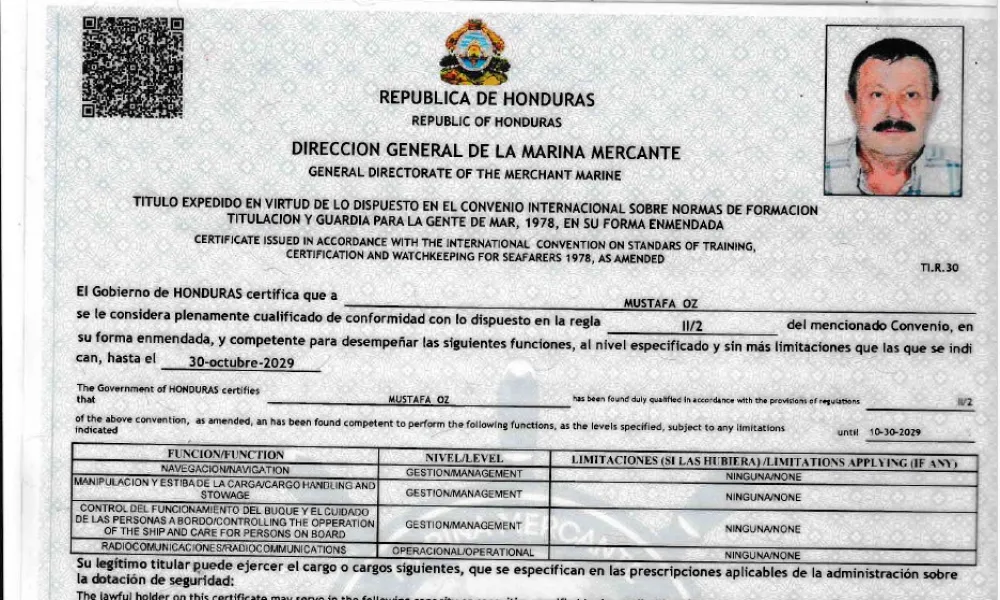
Documents released by the Turkish Cypriot side also shed light on the certification status of the vessel's captain, Mustafa Öz.
According to those records, Öz held a certificate issued by the General Directorate of the Merchant Marine of Honduras, valid until 30 October 2029, authorising him to serve as Master on vessels of 3,000 GT and above.
In September 2025, Turkish Cypriot authorities issued a separate certificate recognising that licence.
That recognition remains valid until 26 September 2026.
The documents therefore indicate that, from a certification standpoint, the captain held the necessary credentials at the time of the disaster.