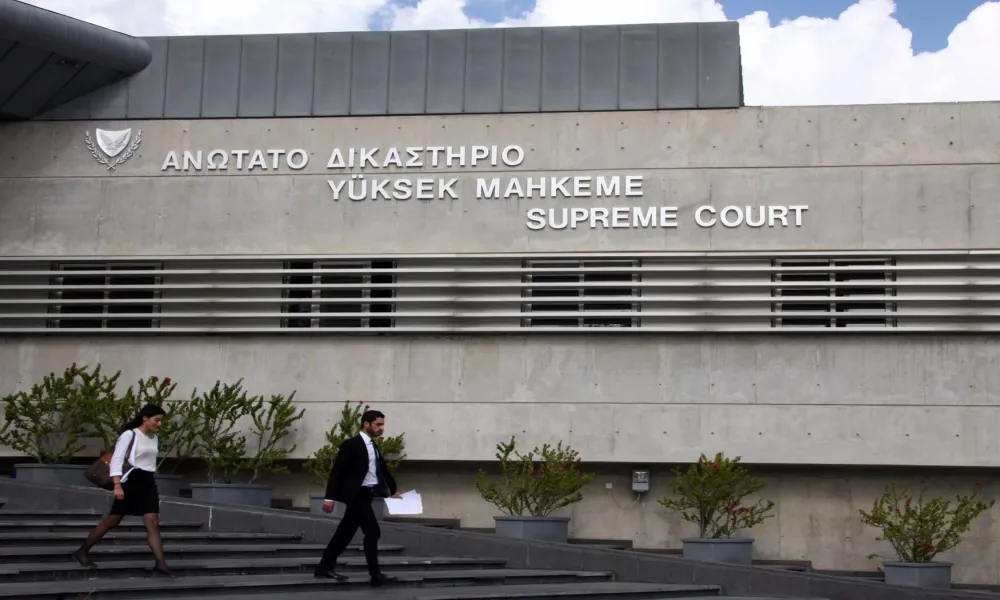

The Supreme Court has ruled that the continued detention of a Lebanese national held for more than a year pending deportation was unlawful, ordering the authorities to release him immediately.
In its decision dated 15 September 2026, the court found that although the Cypriot authorities had continued trying to return the man to Lebanon, the Lebanese authorities’ refusal to accept him and the uncertainty over whether or when his deportation could take place meant his continued detention was no longer justified.
Asylum application and convictions
The applicant, a Lebanese national, arrived in Cyprus through the north and applied for international protection in July 2019. His application was rejected.
In September 2021, he was sentenced by the Paphos Assize Court to 18 months in prison for offences including conspiracy to commit a felony and causing grievous bodily harm.
Detention and deportation orders were issued against him from 2022 and he remained in custody for a considerable period.
In October 2023, following earlier Habeas Corpus proceedings, the Supreme Court issued an order in his favour and he was released.
New detention and deportation order
The man subsequently initiated a new international protection procedure.
In July 2025, he was convicted by Paphos District Court of illegally remaining in the Republic and sentenced to three months in prison.
A new detention and deportation order was issued against him on 6 August 2025.
His detention was subsequently reviewed by the competent authorities and, in January 2026, the Administrative Court upheld the detention and deportation orders.
The man then applied again to the Supreme Court for a Habeas Corpus order.
He argued, among other things, that his detention had exceeded the period reasonably necessary, that there was no longer a realistic prospect of deportation and that the authorities had failed to give sufficient consideration to alternatives to detention.
Authorities continued efforts to deport him
The Supreme Court noted that the Cypriot authorities had not abandoned their efforts to deport the applicant.
Following the Administrative Court’s decision, the deportation order was advanced and arrangements were made for his return to Lebanon.
On 12 August 2026, approval was given for him to be escorted by four members of the Aliens and Immigration Unit.
His forced return was initially scheduled for 31 August and subsequently rescheduled for 10 September.
Lebanon refused to accept him
Those efforts failed after Interpol Beirut responded negatively on 2 September to a request from Interpol Nicosia for Lebanon to accept the applicant.
According to the judgment, no reasons were given for the refusal.
The repatriation operation was consequently postponed and authorities planned to pursue the matter through the Cypriot and Lebanese foreign ministries in an attempt to secure approval from Lebanon.
The Supreme Court, however, noted that there was no indication of how long that procedure would take or whether it would ultimately produce a positive result.
Failure to deport not applicant’s fault
Crucially, the court found that the failure of the most recent attempts to return the man to Lebanon could not be attributed to the applicant.
Given the unsuccessful attempts and the uncertain prospect of any eventual deportation, the court concluded that keeping a person who had already been detained for more than a year was no longer justified.
“With the recent unsuccessful attempts and the uncertainty surrounding any prospect of the applicant’s deportation, who has continued to be detained for more than one year, the continuation of his detention is no longer justified and, consequently, his detention is deemed unlawful,” the court said.
Detention must be as short as possible
The judgment also referred to the requirements of Cyprus’ Aliens and Immigration Law.
Under the legislation, the detention of a third-country national for the purpose of deportation must be for the shortest possible period and may continue only while removal arrangements are progressing with due diligence.
The court stressed that when there is no longer a reasonable prospect of removal for legal or other reasons, continued detention ceases to be justified and the person must be released.
Immediate release ordered
The Supreme Court therefore upheld the application and issued the requested Habeas Corpus order.
It instructed the competent authorities of the Republic of Cyprus to “immediately release the applicant”.
The decision does not rest on a finding that the authorities had failed to pursue deportation. Rather, it turns on the point at which prolonged detention can no longer legally be maintained because there is no sufficiently realistic prospect of carrying out the removal.
Source: CNA