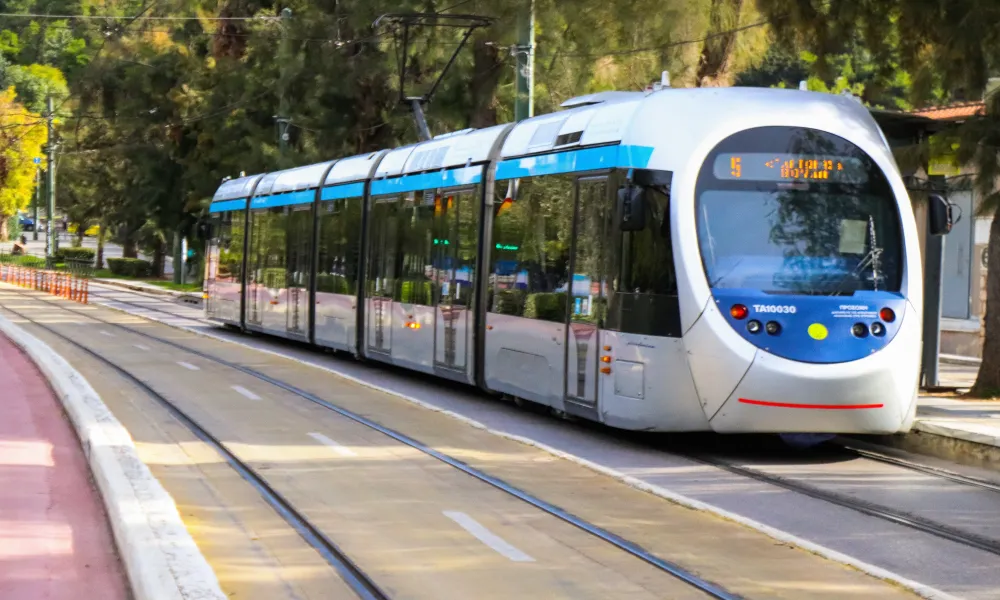

For 26 years, the prospect of a tram system in Nicosia has been presented as a potential solution to the capital's growing traffic problem. Governments have changed, studies have been commissioned, plans have been revised and political support has come and gone. Yet the project remains on paper.
The debate has now returned to the forefront after Nicosia Mayor Charalambos Prountzos called for decisions on a tram network, while Transport Minister Eve Tsolaki announced plans to update a 2015 feasibility study to determine whether such a system could be economically and operationally viable.
The renewed discussion comes as traffic congestion continues to worsen despite road expansions and significant investment in public transport.
Lellos Dimitriades' original vision
The idea first entered public discussion in April 2000, when then mayor Lellos Demetriades proposed a modern tram network after visiting Strasbourg, whose population and urban characteristics he believed were comparable to those of Nicosia.
Demetriades argued that the city could not continue addressing rising traffic through road widening alone. Available space was limited, while growing car ownership was already creating serious congestion and parking problems.
His proposal envisaged two tram lines linking Kaimakli and Lakatamia, alongside improvements to the bus network. He also advocated a broader shift in transport culture, at a time when private-car use was becoming increasingly dominant.
By September 2000, efforts were already under way to secure funding for a dedicated feasibility study, and the proposal soon entered wider government discussions on tackling congestion.
Averof Neophytou backs the concept
The first formal government backing came in October 2002 from then transport minister Averof Neophytou.
Presenting his ministry's plans to the House Finance Committee, Neophytou outlined proposals for a tram network of approximately 40 kilometres, with an estimated construction cost of 300 to 400 million Cyprus pounds.
He highlighted the economic, environmental and social costs of congestion, noting the hours lost daily by commuters.
At the time, officials also pointed to potential European funding opportunities and reported interest from a private company in constructing and operating the network.
Despite the enthusiasm, however, the project never progressed beyond the planning stage.
Sustainable mobility plans revive the project
The proposal re-emerged in 2010 as part of the Nicosia Sustainable Urban Mobility Plan.
Studies examined possible routes connecting the city centre with key urban districts and facilities.
Three years later, in 2013, then mayor Constantinos Yiorkadjis announced a tender for a feasibility study, arguing that building more roads could not by itself solve congestion and that a comprehensive transportation strategy was needed.
The municipality agreed to fund the study because the Transport Ministry lacked the necessary resources, with the study's cost initially estimated at €250,000.
In 2014, then transport minister Marios Demetriades said the study was expected to be completed within months, with particular emphasis placed on determining whether a tram system could complement buses and justify its cost.
In 2018, the plans underwent further evaluation by the European JASPERS advisory body, which examined technical, operational and financial risks.
One of JASPERS' major concerns was Cyprus' low public-transport usage. A tram system would require sufficient passenger demand to justify its substantial construction and operating costs.
The assessment recommended prioritising bus improvements and dedicated transport corridors that could later be adapted for tram services if demand justified the investment.
Again, discussions continued, but no final decision followed.
Significant obstacles remain
Supporters of the project often point out that a tram system offers predictable journey times and could encourage people to switch from their cars.
However, the requirements extend far beyond laying tracks.
A modern tram network would need:
- Dedicated or priority corridors.
- Electrical infrastructure.
- Stations and signalling systems.
- Depots and maintenance facilities.
- Major redesigns of road layouts and junctions.
- Relocation of underground utility networks in some areas.
Construction would inevitably create temporary disruption.
More importantly, experts stress that trams must operate independently from general traffic. If they become trapped in the same congestion as private vehicles, much of their advantage disappears.
Questions therefore go beyond construction costs and focus on whether enough residents would choose to use the service daily.
Supporters argue that younger commuters in particular would be attracted to a modern rail system if it proved reliable and convenient.
Tram must be part of a wider transport strategy
Transport planners stress that a successful tram network cannot operate in isolation.
It would need to be supported by:
- Frequent and reliable bus services.
- Park-and-ride facilities on the edges of the city.
- Efficient transfer points.
- Safe walking and cycling connections.
Without those complementary measures, there is a risk that an expensive infrastructure project would do little to reduce dependence on private cars.
Prountzos pushes for action
The latest push came on 29 September 2026, when Prountzos proposed a tram network of approximately 20 kilometres.
Based on current prices, construction costs are estimated at between €500 million and €600 million, roughly double previous estimates made more than a decade ago.
According to the mayor, a study already exists for a route exceeding 14 kilometres, with the possibility of extending it by a further six kilometres.
Prountzos linked the proposal to the poor performance of public transport, noting that buses account for just 4 to 5 per cent of daily journeys in the capital.
In his view, Nicosia now needs transformative decisions that provide genuine alternatives to driving rather than continuing to rely almost exclusively on road projects.
Government orders a fresh review
The issue has once again reached the Transport Ministry.
On 14 October, Tsolaki announced that the 2015 tram study would be updated in response to interest from both Nicosia and Limassol municipalities.
The aim is to determine whether a tram system could represent a viable and sustainable transport solution for either city.
At the same time, the minister emphasised measures that can be implemented more quickly, including improving bus reliability, revising routes, enhancing passenger information systems and expanding park-and-ride facilities.
She acknowledged that traffic congestion, particularly in Limassol, has reached levels that are no longer acceptable and requires coordinated action from all stakeholders.