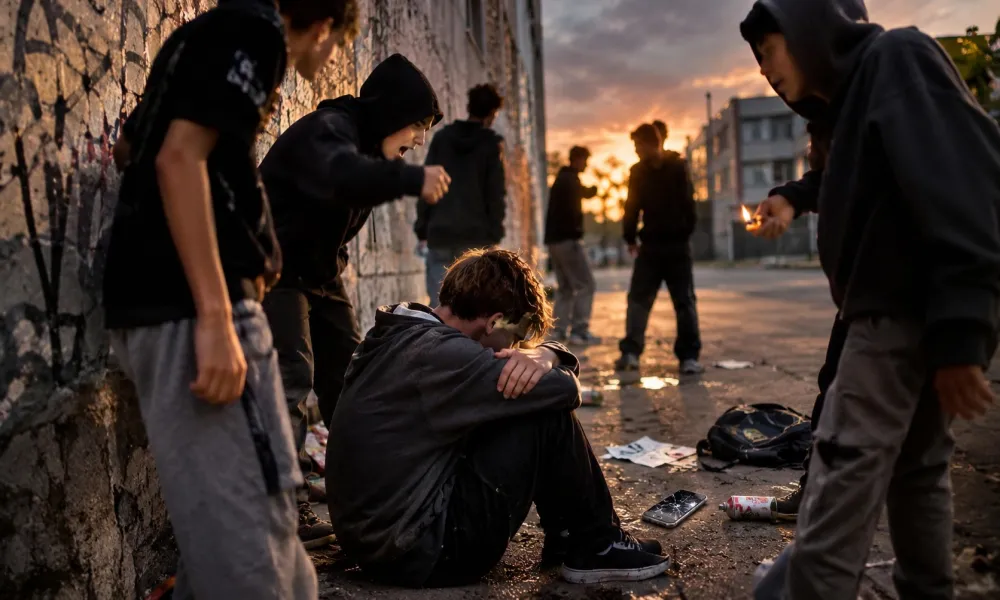

Fires in parks and rubbish bins, vandalism at playgrounds, attacks on peers and violent incidents involving minors. Such scenes are appearing repeatedly across Cyprus, raising concerns about youth delinquency and how it should be tackled.
Behind these incidents, however, lie questions that cannot be answered solely through increased policing or tougher penalties. Why does a teenager reach the point of damaging public property or taking part in an assault? How influential are peer groups? And who intervenes when the first signs of delinquent behaviour emerge?
A string of incidents
Cases recorded in recent weeks highlight different forms of youth offending, ranging from property damage to serious violence.
In Larnaca on 27 October, a police patrol vehicle was attacked with stones near the Church of St John the Baptist, causing extensive damage. Six arrest warrants were issued for minors aged between 14 and 17.
On 3 November, an 11-year-old schoolgirl was allegedly attacked by four classmates at a primary school in Nicosia. The child was taken to hospital for examinations.
In Paphos on 5 November, police announced the arrest of two 15-year-olds in connection with an investigation into motorcycle theft and malicious damage. A few days later, on 11 November, a 17-year-old was arrested in the same district over an investigated case involving conspiracy to commit a felony and causing grievous bodily harm.
Repeated attacks on food delivery drivers have also caused concern. In cases recorded this year in Paphos and Limassol, those arrested included minors as young as 14.
What the numbers show
Statistics support the growing concern.
Cases involving minors aged 14 to 17 have continued to increase. Between 2023 and 2025, recorded cases rose by 20.9%, while the number of minors implicated in offences increased by an even greater 27.2%.
A total of 746 cases were recorded in 2025, compared with 719 in 2024 and 617 in 2023. The number of minors involved rose to 782 in 2025, from 710 in 2024 and 615 in 2023.
While serious crime cases involving teenagers fell by 16.8% from 279 in 2024 to 232 in 2025, the number of minors involved in those cases increased by 10.2%, from 265 to 292.
At the same time, minor offences fell slightly from 191 to 187, while traffic-related offences increased significantly from 249 to 327.
Particular concern surrounds Limassol, where the number of minors implicated in serious offences rose from 53 in 2024 to 86 in 2025, an increase of 62%.
Neighbourhood concerns
Beyond the serious cases appearing in police reports, residents in some areas describe a daily reality shaped by recurring anti-social behaviour.
In Pallouriotissa, around the square of the small church, residents report frequent disturbances, vandalism and fights among young people. Recently, a group of youths set tyres on fire at the playground in the square, while similar damage has been reported at playgrounds in Lakatamia and at the doors of residential homes.
"Incidents of delinquent behaviour in Pallouriotissa are frequent and cause serious concern among residents. There is disorder, damage to public areas such as the square and the playground used by families, while we often witness fights among young people," a local resident told Politis.
The resident said that even when police are called, those involved have often left the area before officers arrive.
"Older people live in the surrounding streets, as well as families with children, and this has now become a serious safety issue," he added, calling for a stronger police presence.
Seeking acceptance
How do young people themselves view such behaviour?
Six secondary school students in Nicosia shared their views with Politis. All agreed that peer pressure can influence a teenager's decisions, leading them to acts they might not otherwise commit.
One student said some young people cause damage because they believe it makes them appear "tough", recalling an incident where a group wrote slogans about football clubs and villages on walls and playground slides.
"Someone may be drawn into it so that friends do not make fun of them or so they can be accepted," another teenager said.
The desire to show off, anger, boredom and a need for attention repeatedly emerged in their responses.
One student stressed personal responsibility, however.
"It doesn't mean that because your friends do something, you have to do it too."
Another pointed to the heavy demands of school and private tutoring, which leave limited time for constructive activities and can lead to less constructive forms of release.
Multiple causes
Dr Koulla Erotokritou, a social worker and lecturer in Social Work at Frederick University, said youth delinquency cannot be attributed to a single factor.
Family circumstances, school failure, bullying, marginalisation, social inequalities and the need for peer acceptance can all interact, increasing a child's vulnerability.
In cases of vandalism and aggressive behaviour in particular, she said the underlying causes may include a search for recognition, difficulty managing anger, frustration or a desire to demonstrate power.
The influence of peer groups plays a major role, as pressure from friends can lead a minor to actions they would not undertake alone.
"Understanding the causes of a delinquent act does not mean justifying it," she said.
Punishment alone is not enough
Erotokritou argues that while public safety is essential, focusing exclusively on policing and harsher penalties does not address the root causes of the problem.
She also rejects the view that responsibility rests solely with parents.
"We cannot expect families to tackle on their own problems that also have social and institutional dimensions," she said.
She stressed the importance of early identification of problematic behaviour, stronger social work services in schools and communities, and meaningful cooperation between families, educators and public services.
Particular emphasis should be placed on adequately staffing social protection services and supporting programmes aimed at helping children who have already become involved in delinquent behaviour.
Social reintegration, she said, does not mean the absence of consequences. Rather, it involves interventions that offer real opportunities for change and reduce the risk of reoffending.
The challenge, therefore, is not only to deal with incidents after they occur, but also to create conditions that make them less likely.
As Erotokritou concluded: "The real challenge for the state is not only to deal effectively with delinquency when it occurs, but to create the conditions so that fewer children end up there."