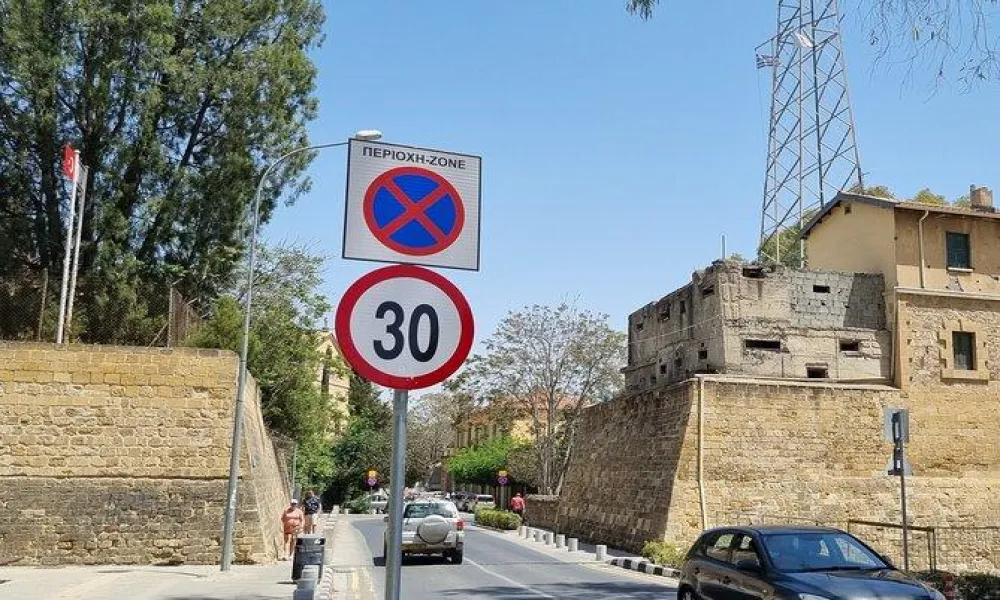

The Municipality of Nicosia is expanding its network of 30km/h low-speed zones after securing €84,925 in funding from the Ministry of Transport, Communications and Works for the introduction of the measure in four additional areas of the capital.
The co-funded project covers areas within the Walled City, Agios Dometios, Engomi and Pallouriotissa. Municipal applications were assessed and approved by the relevant evaluation committee.
The initiative forms part of a broader strategy aimed at reducing vehicle speeds in historic centres and residential districts, with particular emphasis on areas near schools, parks, green spaces and cycle routes.
Areas where the measure is already in force
Nicosia already operates 30km/h zones in the following locations:
- Walled City of Nicosia.
- Historic centre of Kaimakli.
- Omorfita.
- Historic centre of Pallouriotissa.
- Historic centre of Agioi Omologites.
- Area between Makarios III Avenue, Digenis Akritas Avenue, Kallipoleos Avenue and Ethnikis Frouras Street in Lykavitos.
- Historic centre of Engomi.
- Historic centre of Agios Dometios.
- Historic centre of Aglantzia.
Areas next in line
The Municipal Council has also approved additional 30km/h zones that are currently awaiting implementation.
The planned areas include:
- The area west of Demokratias Avenue and north of Grigoris Afxentiou Avenue.
- The area west of Demokratias Avenue, south of Grigoris Afxentiou Avenue and north of Kyriakou Matsi Avenue.
- The area between Iroon Avenue, Ilias Papakyriakou Avenue and Giorgos Seferis Street.
- The area between Iroon Avenue, 28th October Avenue and Ilias Papakyriakou Avenue.
- The area bounded by Prodromou Avenue, Grivas Digenis Avenue, Agiou Prokopiou Avenue, Metochiou Avenue and Sina Street.
- The area between Iroon and Lefkotheou avenues and Lykavittou and Pentelis streets.
According to the municipality, the programme is designed to improve road safety and provide greater protection for residents and visitors.
Following a wider European trend
The introduction of 30km/h zones has become a central feature of road-safety and sustainable-mobility policies across Europe.
Cities including Brussels, Paris, Amsterdam and Helsinki have expanded low-speed zones to improve safety for pedestrians and cyclists, particularly in densely populated neighbourhoods and around schools.
The objective is to reduce both the number and severity of road collisions, lower noise pollution and create safer public spaces.
Among the most notable examples:
- Brussels adopted 30km/h as the default speed limit across most of its road network in January 2021.
- Paris introduced the measure in August 2021.
- Amsterdam reduced speed limits to 30km/h on around 80 per cent of its streets in December 2023.
Similar schemes have also been introduced in Madrid, Barcelona, Helsinki and Lyon as part of broader efforts to make cities safer and more pedestrian-friendly.