

The rise in prices driven by the war in the Middle East is hitting Cyprus hard, with official economic data reflecting the economic squeeze that will further 'tighten' around households and businesses.
According to preliminary data published on Tuesday by Eurostat, inflation in Cyprus reached 3.7% in May, the highest level since September 2023, up from 3% in April and 1.5% in March. In May last year, it stood at just 0.4%.
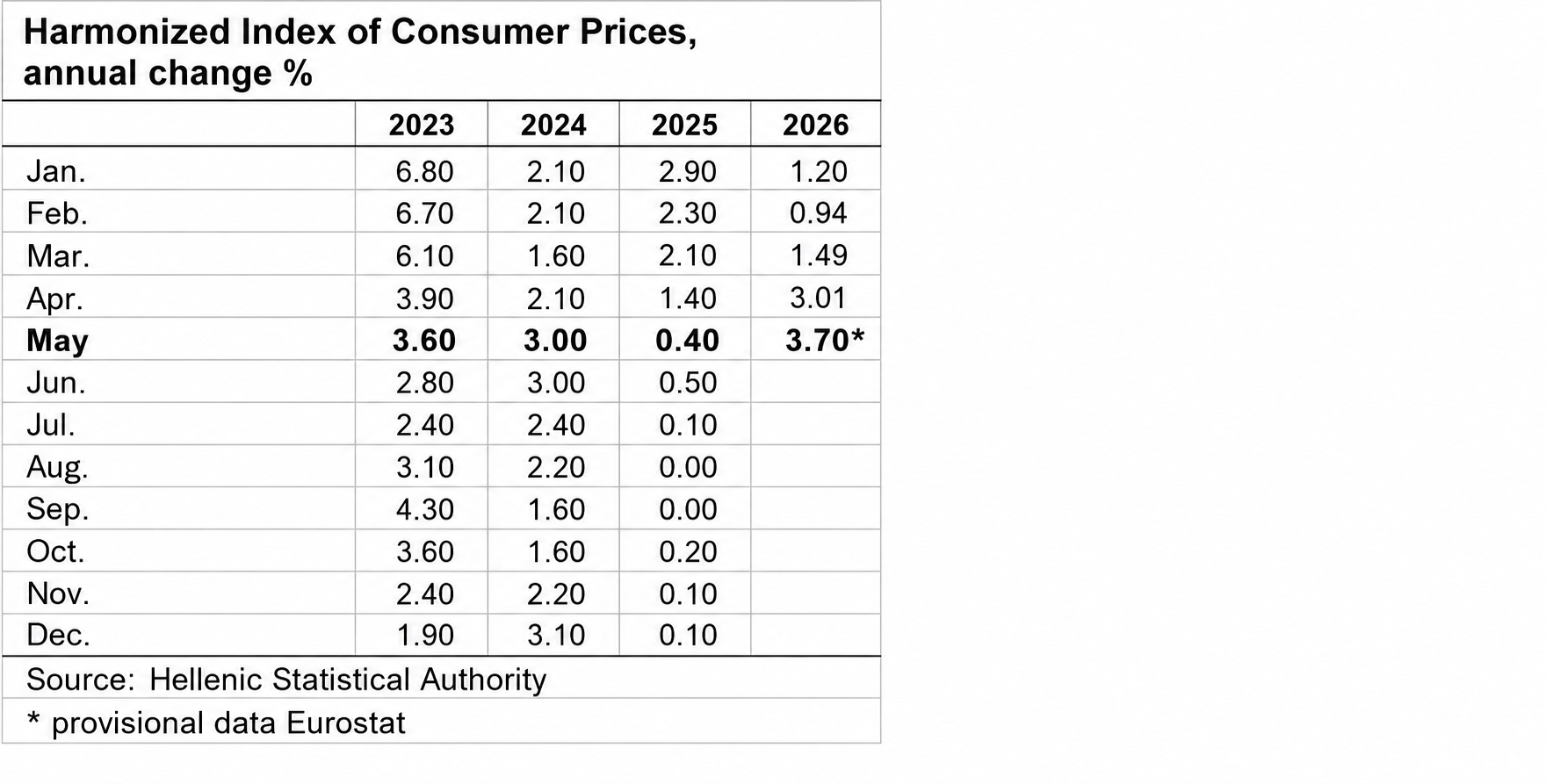 Beyond Cyprus, significant price pressures are also observed in other EU countries. The highest inflation in May, based on the data, was recorded in Bulgaria (6.3%), Lithuania (5.1%) and Greece (5%).
Annual inflation in the eurozone is expected to reach 3.2% in May 2026, up from 3.0% in April, well above the ECB’s target of 2%.
Looking at the main components of inflation in the eurozone, energy is expected to record the highest annual rate in May (10.9%, compared to 10.8% in April), followed by services (3.5%, compared to 3.0% in April), food, alcohol and tobacco (2.0%, compared to 2.4% in April), and non‑energy industrial goods (0.9%, compared to 0.8% in April).
The upward trend in prices is of major concern to trade unions, and a nationwide trade union conference is expected to be convened in the near future.
Price increases are hitting pockets
At the same time, data published by the Cyprus Consumers Association shows that price increases in everyday products continue.
As noted in a statement, during the second half of May a total of 165 price changes were recorded across 34 product categories. Increases ranged from 1% to as high as 9.8%.
The largest increases, from 5.1% to 9.8%, were observed in categories such as sauces and dressings, eggs, soaps, cheeses, yoghurt, tissues and personal hygiene products.
During the same fortnight, 133 price changes were also recorded showing price reductions. The average increase stood at 11.8% and the average decrease at 9.4%.
At the same time, a number of products were observed where prices rose and then dropped again after a short period.
“The big question is why prices increase for some products and decrease for others. General market conditions do not differ much between products that saw price increases and those that saw decreases. Perhaps an in‑depth investigation is needed to determine the causes of these increases,” the Association noted.
It is emphasised that the conclusions were based and documented exclusively on prices recorded on the e‑kalathi platform of the Ministry of Energy, Commerce and Industry and on prices recorded on the free private application smart kalathi.
Retail slowdown
The rise in prices has also begun to affect consumer goods markets. A slowdown in retail trade is reflected in data published by the Statistical Service on Tuesday.
The Retail Trade Turnover Volume Index increased by 2.9% in April this year compared to the same month of the previous year. This is the lowest increase since July 2024. In March, the increase stood at 5.8%.
The Retail Trade Turnover Value Index increased by 5.8% in April 2026 compared to the same month of the previous year. In March, the annual increase was 7.8%.
New pressures
The rise in inflation in the eurozone above the 2% level is expected - for a large number of analysts it is considered a given - to lead the European Central Bank, at its meeting on June 11, to raise interest rates.
According to economist Tasos Iasemidis, the European Central Bank is facing a difficult dilemma: on the one hand it must curb inflation and on the other avoid a deeper economic slowdown.
“The decisions to be taken in the coming months will directly affect the daily lives of millions of European citizens, the labour market, investments and the overall course of the economy,” he notes.
“The intensifying inflationary pressures and the uncertainty caused by the geopolitical crisis in the Middle East are reigniting scenarios for interest rate increases already since last June,” notes Christos N. Christodoulou‑Volos, Professor of Macroeconometrics and Finance and Head of the Department of Economics and Business Administration at Neapolis University Pafos.
According to Mr Volos, the prospect of a new interest rate increase is already creating concern among businesses and households, as higher borrowing costs directly affect housing and business loans, as well as overall economic activity.
“On the other hand, the ECB considers maintaining its credibility in the fight against inflation a priority, even if this entails a slowdown in growth,” he points out.