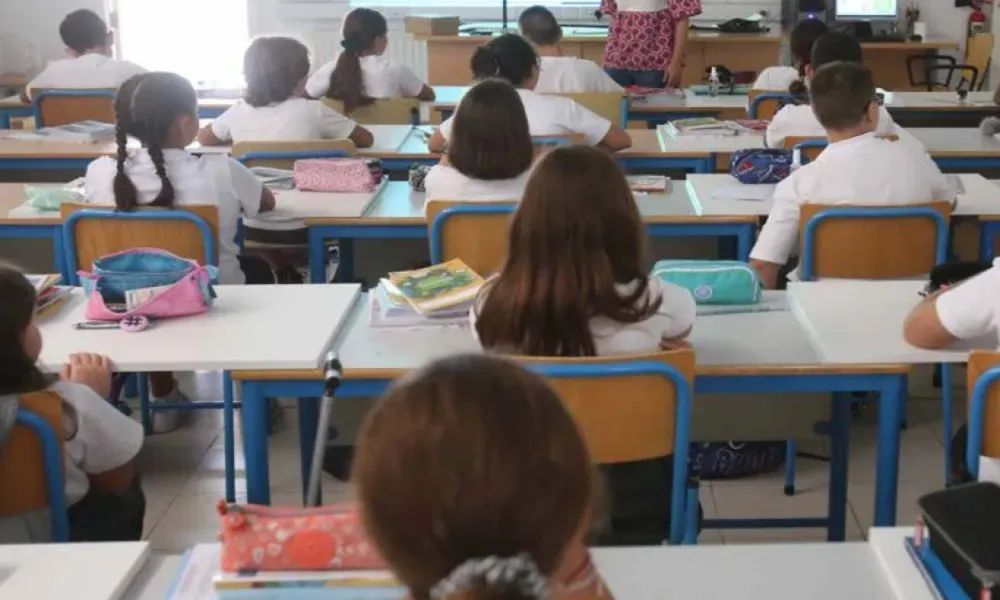



Cyprus spent 13.2% of total public expenditure on education in 2024, the fifth-highest share of any EU country and well above the bloc's average of 9.7%, according to the European Commission's newly published report "Investing in Education 2026." As a share of GDP, that amounted to 5%, or €1.8 billion, and Cyprus recorded the single largest increase in education spending as a share of public expenditure of any EU member state over the past decade, up 2.5 percentage points between 2014 and 2024.
The Commission's breakdown of education budgets by category shows Cyprus channelling the second-highest share of its education spending into staff compensation of any EU country, behind only Belgium.
Where that spending shows up in teachers' pay
According to Eurydice's most recent salary data, compiled with the OECD for the 2023/24 school year, Cypriot teachers start on €26,600 a year, slightly above the European median. After 15 years of service, Cypriot teachers earn €50,576, the third-highest figure among the countries covered by Eurydice, and by the top of the salary scale they reach €66,323, a level exceeded only in Luxembourg, the Netherlands and Switzerland.
The Commission's own analysis, drawn from a separate dataset, places Cyprus among the small group of EU countries with what it terms strong and fast salary progression, and finds that Cypriot teachers' starting salaries can rise by as much as 149% over the course of a career, the largest percentage increase recorded anywhere in the bloc. An earlier Eurydice report put the same figure slightly lower, at 143%.
Where the picture changes
However, the results Cypriot pupils are producing look markedly out of step. In the OECD's PISA 2022 assessment, the most recent available, 15-year-olds in Cyprus scored 418 in mathematics, 381 in reading and 411 in science. The EU averages that year stood at roughly 472 in mathematics, 468 in reading and 480 in science, meaning Cypriot pupils trailed their EU peers by margins of 50 or more points in every subject tested.
Cyprus' scores fell sharply from the previous PISA cycle, down 32 points in mathematics, 43 in reading and 28 in science, according to the OECD's PISA 2022 Volume I report, among the steepest declines recorded by any participating country.
A pattern that resists a simple explanation
Taken together, the figures describe a system that spends more than most of the EU, directs an unusually large share of that spending into staff pay specifically, and rewards long-serving teachers particularly generously, while producing some of the weakest and fastest-deteriorating pupil outcomes in Europe. It is a combination that invites the question of whether Cyprus is getting value for its investment, though the Commission's own report cautions against reading too much into salary levels alone. Its analysis of teacher retention across the EU finds that competitive pay supports recruitment and retention only when it comes alongside supportive working conditions, manageable workloads and a sense among teachers that their profession is valued, and that salary satisfaction alone does little to improve outcomes when those other conditions are absent.
Class sizes, curriculum design, the distribution of resources between well and poorly performing schools, and broader socioeconomic factors all shape PISA outcomes independently of what teachers are paid. What the figures do establish however, is that Cyprus is not underspending or underpaying by regional standards. Whatever is driving its pupils' declining results, a shortage of money directed at teachers does not appear to be the explanation.
Read the report here:
Source: European Commission Directorate-General for Education, Youth, Sport and Culture, Eurydice, OECD