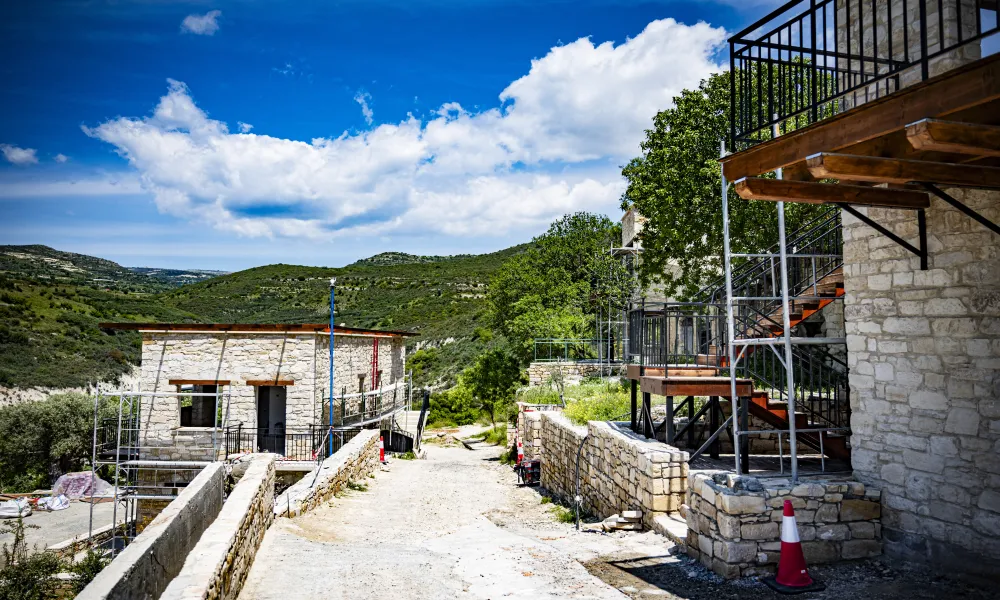

Multiple breaches of environmental legislation and the commencement of works without the permits required by law are reported to have been identified in Trozena, following an on‑site inspection of the village by officials of the Environment Department. One week after the controversy erupted, the competent department visited Trozena yesterday to assess the situation first‑hand and apply the relevant legal provisions. It is recalled that the area forms part of the Natura 2000 network and is considered of exceptional environmental importance.
At first glance, it was found that land clearing, earthworks and preparatory works had been carried out without permits, both within the settlement and in the surrounding area. At the same time, as was already known, corrective works and demolitions of houses had begun, without a planning and building permit being issued by the Limassol District Organisation. For this reason, an inspection by a District Organisation team is scheduled in the coming days to examine building‑related issues, after which the case will be referred to the courts for the issuance of a work suspension order. It must also be clarified whether the corrective works include listed buildings, which appear to be “repaired” without compliance with the provisions imposed by the Management Sector of the Town Planning and Housing Department. Additionally, planting of trees and other vegetation alien to the local flora has been identified, also without permits.
The interventions appear to extend both within the designated development boundary, specifically the Residential Planning Zone (H1), and beyond it, affecting areas falling under the Nature Protection Zones (Z1), Water Protection Zones (Z3), as well as the Water Protection and Protected Landscape Zone (Z3‑PL), which includes the Trozena–Gerovasa Gorge. According to available information, the works and interventions appear to have been carried out from December 2023 to May 2025, that is during the same period when the Special Ecological Assessment Study for the project was being prepared.
Grounds for rejection
Although the requested permits are still under examination, if it is formally established that the works carried out to date have materially altered the natural environment, this alone constitutes grounds for rejecting the project. In such a case, the Environment Department would, by definition, be unable to issue a positive opinion on potential impacts, as those impacts have already begun to occur.
Beyond the above, sources told Politis that the Limassol District Organisation and the Environment Department are now expected to assess the redevelopment and revitalisation of Trozena as a single project, requiring the submission of a masterplan. While there has been an apparent attempt to fragment the overall investment, clear instructions have now been issued for a comprehensive and cumulative study covering all aspects, rather than piecemeal examination of each project separately. The project is therefore expected to be approached as one unified large development, with a masterplan requested for all interventions.
Officials at the Environment Department are particularly concerned about interventions in nature, as well as issues relating to lighting, since the area is a corridor for several rare bird species, including Bonelli’s eagle, peregrine falcon and Cyprus warbler. Additional concerns include electricity supply for the community, the proposed biological treatment plant and underground sewage network, and the overall scale of the development at full operation, as even the campsite does not appear entirely “innocent” or of mild development. A separate issue is Trozena’s water supply, which currently relies on a single water source granted by ministerial approval over a decade ago and is insufficient for the new conditions, necessitating boreholes or connection to the network.
Environmental study published
Meanwhile, following Sunday’s Politis report referring to the non‑publication of the Special Ecological Assessment Study, contrary to usual practice, the study was unexpectedly published yesterday morning on the Environment Department’s website. The department stated briefly that “the Environment Department informs that the Special Ecological Assessment Study for the General Spatial Plan for the Construction and Revitalisation of the Abandoned Settlements of Trozena–Gerovasa, set out below, is under examination”. The study is highly revealing of the investor’s overall plans, as it disclosed further details of the development that had not previously been available.
It should be noted, however, that the Environment Department had been aware of the Trozena development at least since 10 February, when the application was submitted to the Ad Hoc Committee for Special Ecological Assessment. From the outset, members of the committee raised serious concerns, requesting further information and supplementary data for the application under review. From that point, four months ago, until today, despite works continuing in Trozena, it appears that no on‑site inspection was carried out by the competent authorities or, if inspections did occur, no action was taken to address the ongoing illegal works.
Many new houses, few restorations
The study published yesterday is highly revealing of the investor’s actual plans. The overall project comprises 12 separate smaller projects for which individual permits were sought. The applications concern residential development of a total of 48 new houses with a combined coverage area of 1,700 square metres. A further 12 houses are to be built on the basis of existing buildings, with a total area of 232 square metres. One additional listed building will be restored, creating a further four houses. In total, accommodation capacity would reach up to 132 people.
Regarding the winery, it will cover a total of 523 square metres. Part of the building will be new development and part restored. The project also includes a restaurant and reception area of 150 square metres, while elsewhere a gym and wellness area of 157 square metres will be created. On the upper side of the village, a parking area of 707 square metres is planned. The winery’s capacity is set at 40,000 bottles annually and will include a tasting room, cellar and production area.
As for the campsite, which falls partly within Zone Z1, it extends across three different sites with a total area of approximately 800 square metres.
Beyond developments and restorations, the proposal also includes a biological treatment plant and an electricity substation. Finally, access to the winery would be provided via a new road 240 metres in length.