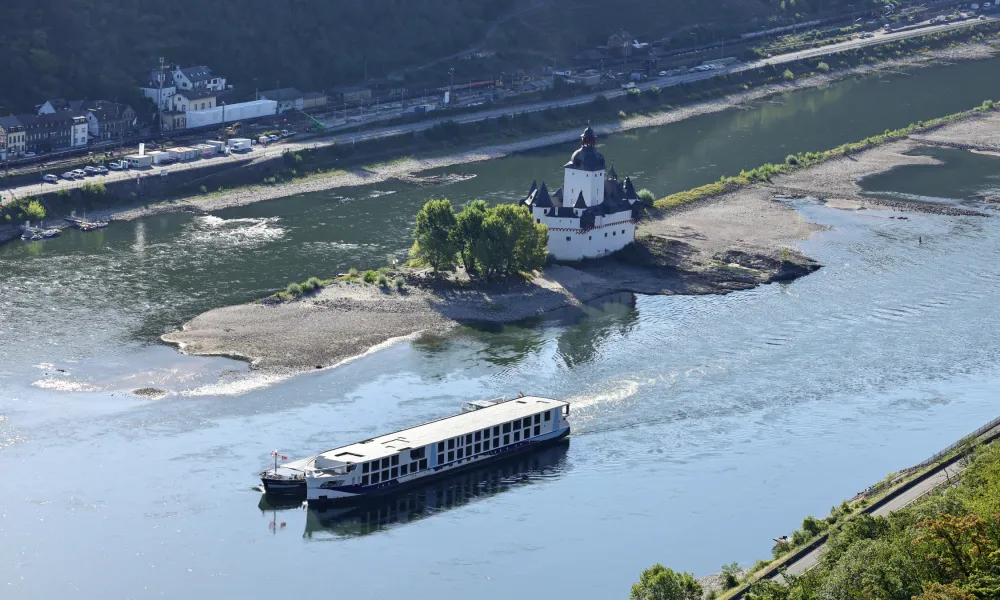

Water levels on Germany's Rhine River have fallen to new lows amid an ongoing heatwave, prompting significant disruption to inland shipping and forcing many cargo operators to suspend services on parts of the river.
En raison de l'évanouissement du #Rhin, il est menacé de "bifurcation", la navigation de bout en bout sera impossible. Cela a été rapporté par le chef de l'Union fédérale des transports fluviaux.#canicule #chaleur #Europe #MacronDémission #Frexit #Eau pic.twitter.com/YtUvMBHidy
— 🇫🇷Allons-y Ensemble🇫🇷 (@Allonsy_France) August 10, 2026
Germany's inland waterways authority, WSV, said navigable water depth at Kaub, a key bottleneck near Koblenz, fell to 15 centimetres on Tuesday, below the previous record low of 25 centimetres recorded in 2018.
"Commercial traffic through Kaub has effectively stopped," a trader said.
The unusually low water levels follow a summer marked by extreme heat and limited rainfall.
💔 The record low water levels on the #Rhine, #Germany pic.twitter.com/6B9vJr2WHq
— ShanghaiEye🚀official (@ShanghaiEye) August 7, 2026
As a result, cargo vessels are able to sail at only around 20 per cent of their normal capacity, substantially increasing transport costs for cargo owners.
To move the same volume of goods, shipments must be distributed across multiple vessels operating with partial loads, further driving up costs throughout the supply chain.
The Rhine is one of Europe's most important commercial waterways, serving as a key transport route for industrial goods, raw materials and fuel between Germany's industrial heartland and major North Sea ports.
VIDEO: 🇩🇪 Germany's #Rhine drops below crucial level, impacting river transport
— AFP News Agency (@AFP) August 14, 2022
The river level has fallen below a key 40-centimetre (15.7-inch) waterline used as a reference for judging its accessibility for shipping after a hot, dry July made worse by climate change pic.twitter.com/PKgvrIdGXL
Source: Reuters/CNA