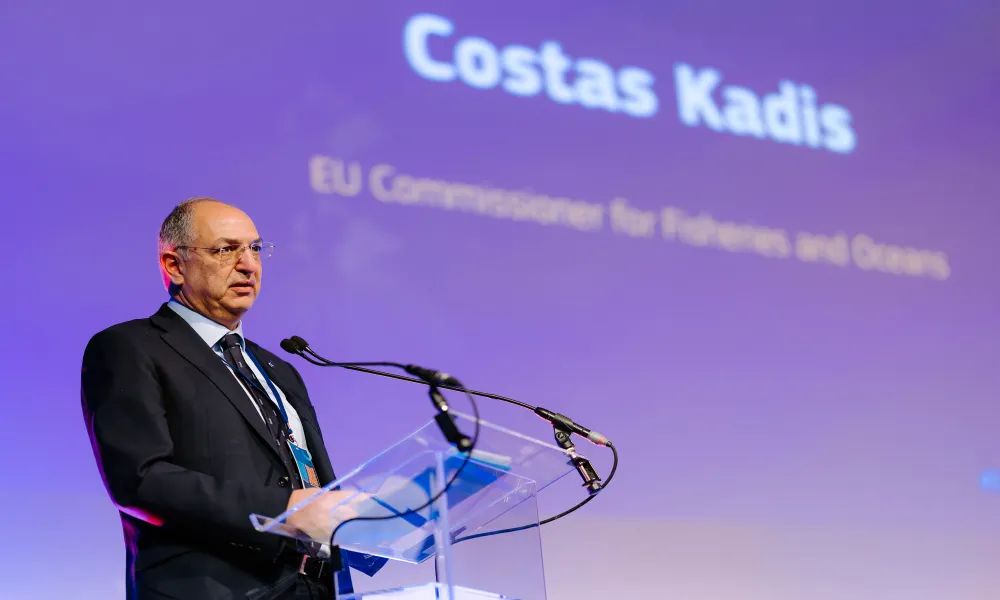

European Commissioner for Fisheries and Oceans Costas Kadis has highlighted the challenges facing the European Union, ranging from security and geopolitics to climate change, energy dependence and food security.
Commenting on European Commission President Ursula von der Leyen’s State of the Union address on Wednesday, Kadis said the speech had outlined the environment in which the EU currently operates and the challenges confronting the bloc.
He specifically referred to the war in Ukraine, developments in the Middle East, rising energy and fuel prices, and the climate crisis.
Reducing external dependencies
Kadis said European policies should aim to make the EU less dependent on external sources, particularly for fuels, food and raw materials.
He also stressed the importance of strengthening the competitiveness of the European economy, including through the completion of the single market.
The Commissioner said von der Leyen’s reference to the defence of European territory was particularly significant for Cyprus.
He also highlighted the need to strengthen the EU’s geopolitical position and referred to relations with Canada, noting the significance of the Canadian Prime Minister’s participation in the discussions.
According to Kadis, closer EU-Canada relations form part of a broader effort to cooperate with partners that share common priorities with the Union.
Oceans and the climate crisis
Kadis linked efforts to tackle the climate crisis with the condition of the world’s oceans, highlighting their crucial role in regulating the climate.
He referred to an initiative that is due to be presented at the United Nations General Assembly in cooperation with Canada, aimed at strengthening the global ocean observation system.
Data collected through such systems, he said, could contribute to more accurate forecasting of extreme weather events and give local communities more time to prepare.
Focus on food security
Kadis also placed particular emphasis on food security, noting that the EU imports more than 70% of its seafood needs.
Reducing this dependence, he said, requires an increase in European production, including through aquaculture.
He also said work was under way to simplify the Common Fisheries Policy, following concerns from fishermen that some existing procedures are overly complex.
For aquaculture, Kadis said a more unified European framework was needed, noting that licensing procedures remain lengthy in some member states.
Potential for aquaculture growth
Kadis described aquaculture as one of the fastest-growing food production sectors globally.
However, he said the sector currently accounts for approximately 10% of related demand in Europe, leaving significant scope for further development.
He said strengthening aquaculture could therefore contribute to the EU’s efforts to improve food security while reducing its dependence on imports.
Source: CNA