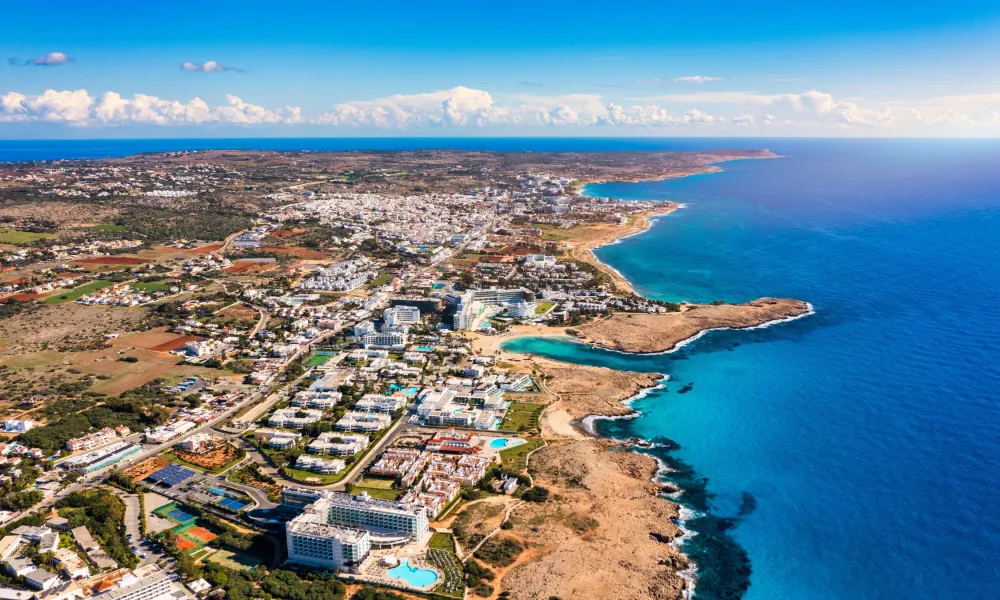

Cyprus' beaches are coming under increasing development and environmental pressure as sections of the coastline gradually disappear behind private developments.
Public concern over the issue intensified in June 2025 when the construction of a restaurant in the sea at Agios Ermogenis beach in Limassol sparked controversy. The justification was that the building stood within the footprint of a previously licensed restaurant, whose foundations had gradually been reached by the sea because of coastal erosion.
Ignoring the protocol
Today, six of the eight Mediterranean EU member states have become contracting parties to the Barcelona Protocol on Integrated Coastal Zone Management in the Mediterranean, a comprehensive international legal instrument that has formed part of EU law since 2011.
Greece has signed the protocol but has not ratified it, while Cyprus remains the only one of those states that has neither signed nor ratified it.
This position has been linked, according to public statements, to a problematic history of coastal licensing.
One example is an earlier public statement by suspended Paphos mayor Phedonas Phedonos, who argued that reluctance to adopt the protocol stemmed from concerns that licences granted to around 15 hotels in Ayia Napa and Protaras could be affected.
Referring to past parliamentary discussions, he said Cyprus had avoided ratification because it could create serious problems for permits issued on state and forest land.
The Audit Office, meanwhile, has highlighted incompatibility between the protocol and the current Beach Protection Law, particularly concerning the extent of areas where development is prohibited.
At the same time, the existing legal framework, namely the Beach Protection Law, which was originally enacted by the British colonial administration nearly a century ago on 7 December 1934, has been described by both the Legal Service and the Audit Office as outdated for modern needs.
Proposed legislation
In an attempt to curb development pressures on beaches, MPs from ALMA recently submitted a bill to Parliament's Interior Committee seeking to amend the Beach Protection Law.
The proposal would establish a uniform minimum coastal protection zone extending 100 metres inland from the highest winter waterline, where, as a general rule, new construction would not be permitted.
The aim is to align Cyprus with Article 8(2)(a) of the Barcelona Protocol.
“The proposal did not emerge theoretically. It arose from the reality of how our beaches have been managed for years and from the need to move from an old, fragmented system to a clear rule of protection,” ALMA MP Litsa Drousiotou told Politis.
Referring to special reports by the Audit Office, she said these had documented significant variations in protection-zone widths, numerous relaxations and shortcomings in addressing illegal interventions.
“For us, the issue has a wider dimension. The proposal reflects the importance we place on environmental protection, particularly of a natural asset so closely linked to citizens' lives.
The coastline cannot be viewed simply as an area for development. Citizens must be able to enjoy free beaches, access to the sea and a coastal environment that we can pass on to future generations.
That is why we propose a clear rule: a uniform 100-metre protection zone from the highest winter waterline, which will apply directly by law and will not depend on whether an administrative authority chooses to issue a new map or notification in the future.”
Protection lines that now lie in the sea
Drousiotou pointed to cases similar to the Agios Ermogenis restaurant as evidence of the problem.
She said perhaps the clearest example identified by the Audit Office involves old protection boundaries which, due to coastal erosion and a failure to update them, are now located in the sea itself.
“All this demonstrates why we need a simple rule that everyone can understand. It is not reasonable for the protection of a beach to depend on relaxations, outdated boundaries or differing administrative decisions.
Citizens are entitled to know there is a minimum level of protection that applies equally to everyone.”
From protection to exploitation?
For his part, Kleitos Papastyllianou, Environmental Policy Officer at Terra Cypria, said the Beach Protection Law was considered relatively progressive when introduced almost a century ago.
However, he noted that the legislation has been amended approximately 45 to 50 times over the past six decades.
“A specialist could argue that it has evolved from the Beach Protection Law into a Beach Exploitation or Development Law,”
he said.
According to Papastyllianou, the legislation in its current form is outdated.
He argued that when compared with the Barcelona Protocol, the law focuses mainly on regulating beach facilities and services for bathers, such as sunbeds, umbrellas and beach-use plans, rather than addressing broader environmental concerns.
Issues such as protected coastal landscapes, climate change, sea-level rise, coastal erosion, extreme weather events and heavy wave activity are largely absent from the law, he said, while they are treated as separate and important subjects within the protocol.
Why Cyprus has not ratified the protocol
Drousiotou said official records provide important insight into Cyprus' long-standing reluctance to sign and ratify the Barcelona Protocol.
According to her, the Legal Service noted as early as 2008 that the protocol's exemptions do not cover projects serving private interests and that this affected powers currently exercised by the Council of Ministers under domestic legislation.
The Audit Office has similarly identified incompatibility between the protocol and the Beach Protection Law as a key factor behind Cyprus' failure to proceed with ratification.
She added that in 2011 the Legal Service warned that EU approval of the protocol created legal obligations for Cyprus, while the Department of Environment later drafted ratification legislation that was sent to the Attorney-General in 2014 for legal review.
The process, however, was never completed.
Drousiotou also pointed to an official government response issued in 2023, which stated that development pressures within coastal zones highlighted the need for ratification as a matter of priority and explicitly recognised the need to amend Chapter 59 of the law to incorporate the 100-metre rule.
“Cyprus has not signed or ratified the protocol independently. That does not mean the obligations arising from it can simply be ignored.
The government itself acknowledged before Parliament in 2023 that compliance with Article 8(2)(a) requires amendment of the Beach Protection Law.
What the government has failed to do for years, effectively serving private interests, we are now attempting to do through our proposal.”
A comprehensive tool is needed
Commenting on the bill, Papastyllianou said environmental organisations welcome the initiative, but argue that Cyprus should seriously consider adopting a comprehensive legal framework for coastal-zone protection.
He noted that Article 8(2)(a) of the Barcelona Protocol sets a minimum protection zone of 100 metres from the highest winter waterline, but also allows for wider protection zones in specially protected areas.
As examples, he highlighted the Lara-Toxeftra Marine Protected Area, Cyprus' only Specially Protected Area of Mediterranean Importance, where protection remains limited to 100 metres despite the protocol permitting distances of up to 500 metres.
He also referred to the Sea Caves of Peyia, where extensive development along the coastal zone has occurred over the past decade, including construction within the current 91-92 metre protection zone, resulting in entire plots effectively bypassing existing restrictions.
According to Papastyllianou, these examples demonstrate why Cyprus needs a more comprehensive and modern approach to coastal management and protection.