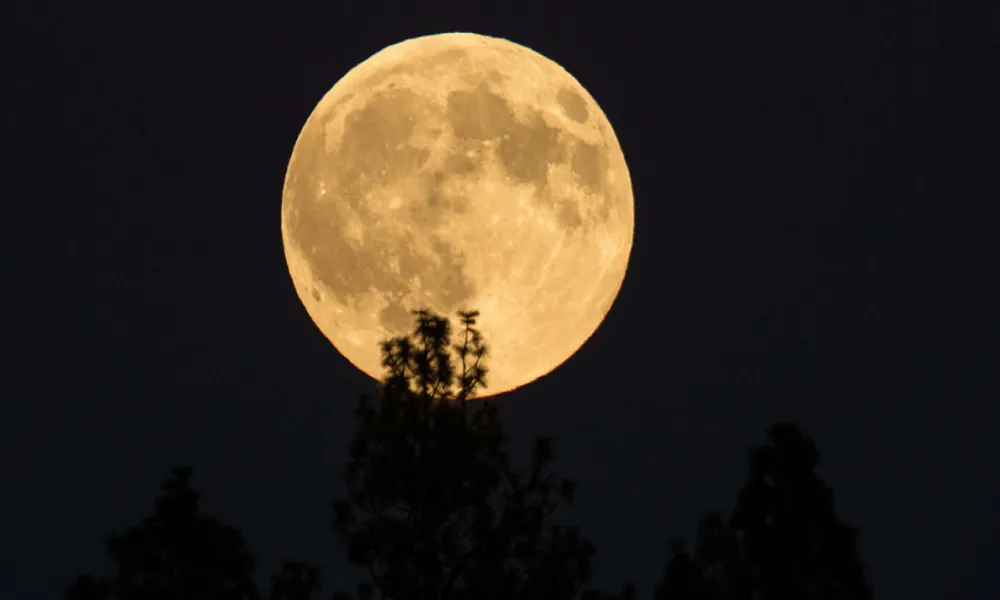

November's full moon appears in the night sky tonight, Tuesday 24 November. It is the second-to-last full moon of the year and is known as the Beaver Moon. This year it is also a supermoon, so it will look larger and brighter than usual.
What to expect tonight
The Beaver Moon will reach its peak on 24 November. As it rises, it is expected to take on an orange hue for around 15 to 20 minutes.
This happens because of the way light scatters: red and orange light travels more easily through the atmosphere, while blue light is absorbed more.
The moon will be visible across Cyprus, weather permitting.
Where the name comes from
The name comes from North America. It is linked to the time of year when beavers built dams before winter.
According to the Old Farmer's Almanac, Native Americans gave the Beaver Moon its name. They often named full moons after natural events or the way animals behaved in that season. In November, beavers begin to retreat to their lodges after gathering food for the winter, which is where the name comes from.
Other names for the November full moon
The November full moon is traditionally known as the Beaver Moon. According to Timeanddate.com, Indigenous peoples of North America also used other names:
- Frost Moon
- Freezing Moon
- Trading Moon
- Oak Moon
- Snow Moon
Celtic traditions also call it the Mourning Moon and the Darkest Depths Moon.
What makes a supermoon
A supermoon happens when a full moon coincides with the Moon being near perigee. Perigee is the point in the Moon's slightly elliptical orbit where it comes closest to Earth. Because the Moon is closer, it looks slightly larger and brighterthan an ordinary full moon, usually by a few percentage points.
The difference in size is small, but supermoons tend to look more impressive as they rise. This is partly due to the "moon illusion": when a full moon is low on the horizon, it looks much larger next to buildings, trees and other features of the landscape.
A run of winter supermoons
This week's Beaver Moon is the first in a series of three supermoons, with December and January also bringing supermoons.
Dates for the coming full moons:
- 24 November 2026: Beaver Moon
- 24 December 2026: Christmas Eve supermoon, the Cold Moon
- 22 January 2027: Wolf Moon
- 20 February 2027: Snow Moon