The establishment of a special tribunal for the crime of aggression against Ukraine marks “a point of no return in the search for justice”, Ukraine’s foreign minister said on Friday.
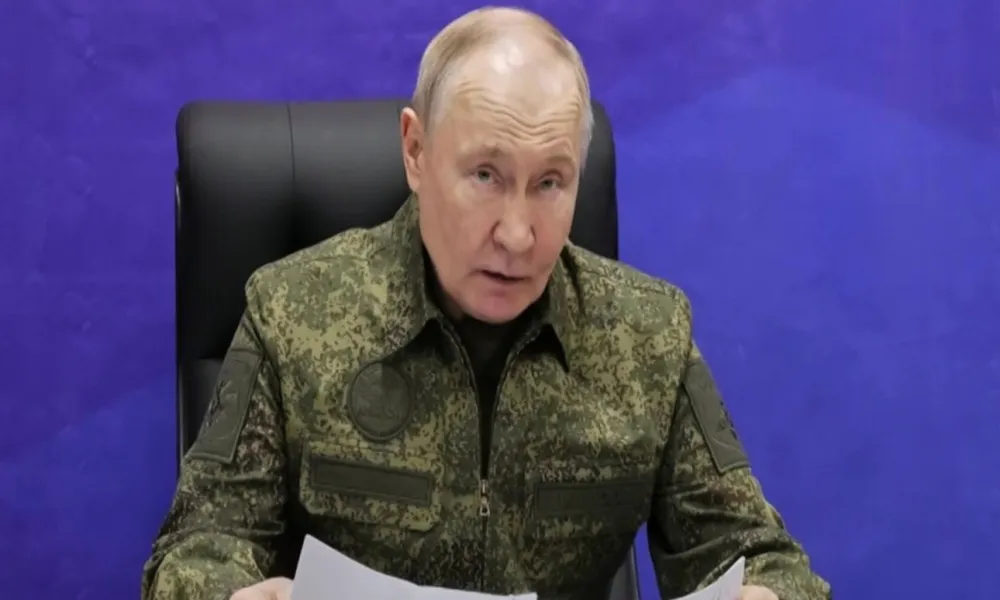
Thirty-six countries, mostly European, have signed up to participate in a dedicated court aimed at prosecuting Russian President Vladimir Putin for the crime of aggression against Ukraine. The tribunal will be based in The Hague in the Netherlands.
The joint commitment was formalised during the annual meeting of foreign ministers of the Council of Europe, which has taken a leading role in addressing the legal gap left by the International Criminal Court.
'Historical turning point'
Ministers approved a resolution setting out the structure and mandate of the tribunal’s governing committee. Its responsibilities will include approving the annual budget, adopting internal rules and electing judges and prosecutors, while participating states commit to safeguarding judicial independence.
Ukrainian Foreign Minister Andrii Sybiha, who attended the ceremony, welcomed the development as a historic turning point in the pursuit of accountability.
“The Special Tribunal is becoming a legal reality. Very few believed this day would come. But it has,” he said on social media, comparing the effort to the post-Second World War Nuremberg trials of Nazi leaders.
“Putin always wanted to go down in history. And this tribunal will help him achieve that. He will go down in history. As a criminal,” he added.
Four EU countries refrain
The resolution was signed by Andorra, Austria, Belgium, Croatia, Cyprus, the Czech Republic, Denmark, Estonia, Finland, France, Germany, Greece, Iceland, Ireland, Italy, Latvia, Liechtenstein, Lithuania, Luxembourg, Moldova, Monaco, Montenegro, the Netherlands, Norway, Poland, Portugal, Romania, San Marino, Slovenia, Spain, Sweden, Switzerland, Ukraine and the United Kingdom.
Australia and Costa Rica were the only non-European countries to join.
The European Union also backed the initiative, although four member states - Bulgaria, Hungary, Malta and Slovakia - did not sign the resolution.
The list remains open for additional countries to join.
Council of Europe Secretary General Alain Berset urged participating states to complete their legislative procedures and provide funding to ensure the tribunal can begin work as soon as possible. The EU has already pledged €10 million in support.
Accountability
Concerns have previously been raised about funding shortfalls due to a lack of commitment from the Donald Trump administration. Trump’s push for a peace deal between Ukraine and Russia has also raised questions over the tribunal’s long-term purpose, including proposals that have floated the idea of broad amnesty for war-related crimes.
Berset said the time for accountability was approaching.
“The time for Russia to be held accountable for its aggression is fast approaching. The road ahead is one of justice and justice must prevail,” he told the meeting.
The tribunal will be complemented by a claims register collecting compensation requests from victims of Russia’s invasion, and a separate international commission that will assess claims and determine appropriate payments.
'Necessary initiative'
The creation of a dedicated tribunal has been a priority for Ukraine and its allies since Russia launched its full-scale invasion in February 2022.
The initiative is seen as necessary because the ICC can only prosecute the crime of aggression when it is committed by a state party, and Russia is not a signatory to the Rome Statute. Moscow can also block Security Council referrals through its veto power.
Unlike war crimes, crimes against humanity and genocide - which focus on individual perpetrators - the crime of aggression is a leadership crime targeting those who control state policy.
Troika of invasion
In practice, it covers what is known as the “troika”: the president, prime minister and foreign minister, as well as senior military commanders involved in directing the invasion of Ukraine’s sovereignty.
Putin, widely regarded as the central figure behind the invasion, remains the primary target, although he is unlikely to face trial in the near term.
Crucially, members of the “troika” cannot be tried in absentia while they remain in office. Prosecutors may still issue indictments, but proceedings would be suspended until the accused leave their posts.
Trials in absentia could still apply to other senior officials, including Russia’s defence leadership, with those convicted later entitled to retrial if they appear in court.
Aides to be targetted too
Senior officials from Belarus and North Korea, which have supported Russia’s war effort, could also face prosecution.
The tribunal will have the power to impose severe penalties, including life imprisonment, asset confiscation and fines to be channelled into the victims’ compensation fund.
EU foreign policy chief Kaja Kallas said there could be no lasting peace without accountability.
“There will be no just and lasting peace in Ukraine without accountability for Russia and the perpetrators of the horrific crimes committed against the Ukrainian people,” she said.
“Russia chose to attack and invade a sovereign country, kill its people, deport its children and steal Ukrainian land. Russia must face justice and pay for what it has done.”