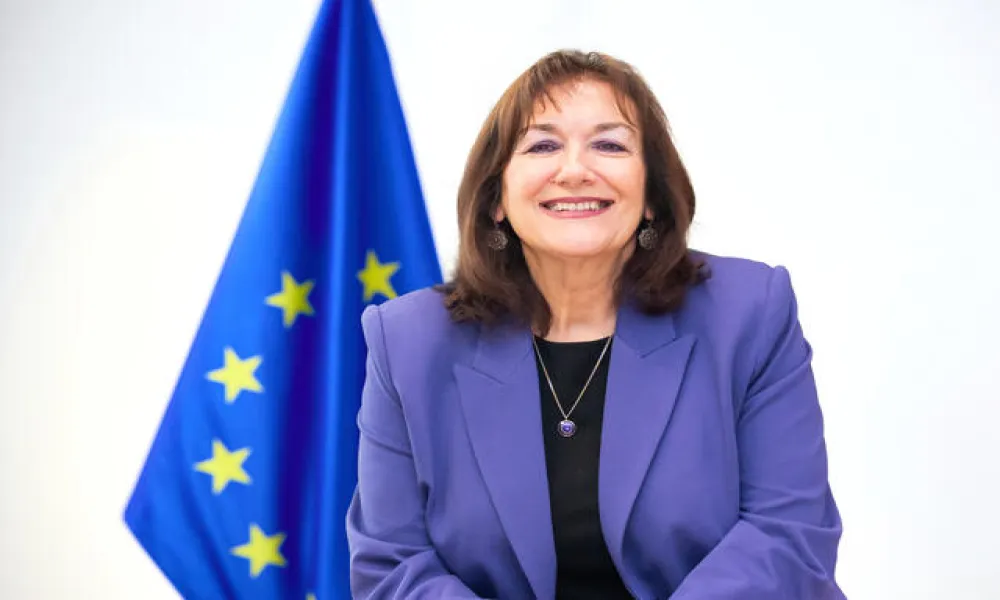

The European Union is ready to support every stage of the process towards a comprehensive settlement of the Cyprus problem, European Commissioner for the Mediterranean Dubravka Šuica has said, days before the expected arrival in Cyprus of UN Secretary-General’s personal envoy María Ángela Holguín.
Speaking to Politis on the sidelines of the informal meeting of EU foreign ministers held in Limassol on Thursday, Šuica said the EU was prepared to play “an active and constructive role” in backing efforts to resume formal negotiations under the auspices of the United Nations.
The EU, she noted, has a direct interest in a stable and secure region, as well as in the development of a cooperative and mutually beneficial relationship with Turkey based on international law.
Her remarks come at a sensitive moment, with Turkey preparing to ratify domestic legislation linked to its so-called “Blue Homeland” doctrine, covering its claims in the Aegean and the eastern Mediterranean.
Turkey, Šuica said, remains an important partner for the EU, particularly on issues of regional stability, security and long-term peace. However, she stressed that cooperation must be rooted in respect for international law, including the maintenance of good relations with all neighbours.
The commissioner also said European Commission President Ursula von der Leyen had raised the Cyprus issue in a recent exchange with Turkish President Recep Tayyip Erdoğan.
“The EU’s position is clear: support for the resumption of formal negotiations, under UN auspices, for a comprehensive settlement,” Šuica said.
Cyprus as a Mediterranean bridge
Šuica underlined Cyprus’ strategic role as a bridge between Europe and the eastern Mediterranean, particularly in relation to energy cooperation, security and regional connectivity.
She said the EU had become increasingly geopolitical in recent years, as crises ranging from Russia’s war against Ukraine to instability in the Middle East and intensifying global competition had highlighted the need for Europe to act more strategically and effectively.
“The EU wants to be an actor and not simply a funder,” she said, adding that this meant a stronger political, economic and strategic presence in the EU’s neighbourhood.
She said this was the thinking behind the Pact for the Mediterranean, which aims to deepen the EU’s relations with its southern Mediterranean partners in areas including energy, migration, economic opportunities and security.
Šuica acknowledged that the EU still needed to act faster, more strategically and with greater unity.
Security and regional stability
Asked how Mediterranean policy connects with EU security, Šuica said Europe’s stability was closely linked to developments in North Africa, the Middle East and the Gulf.
She said one of the core pillars of the Pact for the Mediterranean focuses on security and preparedness, including efforts to tackle organised crime, drug trafficking, disinformation and hybrid threats.
The first action plan under the pact, presented in April, includes initiatives to strengthen cooperation between police and judicial authorities across the region, as well as cooperation on counter-terrorism, prevention of radicalisation and border management.
“The Mediterranean is our shared space,” she said. “Its stability and security are our common responsibility.”
Demographic pressures
Šuica also addressed Europe’s demographic challenges, saying the issue was not limited to one problem but reflected a combination of ageing populations, low birth rates and regional imbalances.
She said the EU’s “demography toolbox”, launched in October 2023, was designed to help member states and regions turn demographic change into an opportunity by supporting families, empowering young people, helping older generations and addressing labour shortages.
She noted that around 10 million young people in the EU are not in education, employment or training, making youth support a key priority.
The commissioner added that the external dimension was also important, as more than half the population in the southern Mediterranean is under the age of 24. The pact therefore places emphasis on youth and people-to-people links, including plans for a youth parliamentary assembly and a network of Mediterranean universities.
Cyprus’ EU presidency
On Cyprus’ EU presidency, Šuica said Nicosia had taken on the role at a critical time for the EU and its cooperation with the Middle East, North Africa and the Gulf.
She praised Cyprus for placing the revitalisation of relations with the region high on the European agenda and for supporting the Pact for the Mediterranean.
She also highlighted Cyprus’ emphasis on connectivity in energy, digital technology and transport, describing these as critical areas for shared prosperity and strategic autonomy.
Šuica said cooperation with Cyprus would continue beyond the end of the presidency, as the country remained a key EU member state for the region.
A major initiative linked to Cyprus under the pact’s action plan is the creation of a European firefighting hub, which she said would strengthen preparedness and rapid response capabilities across the eastern Mediterranean.
The pact, she added, could bring significant benefits to Cyprus in areas such as energy, security and connectivity, while continuing to evolve as a “living” document open to new initiatives.