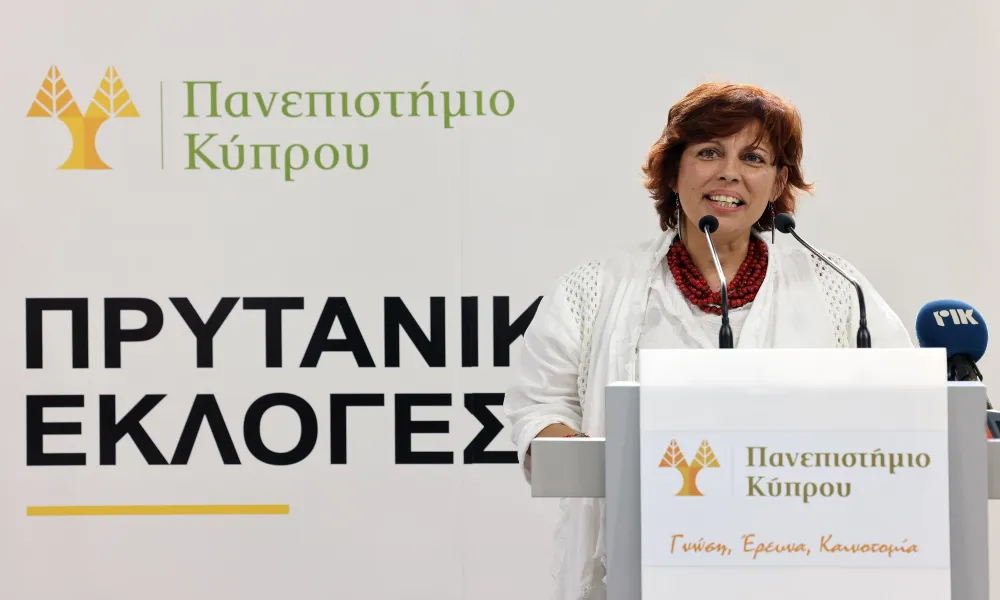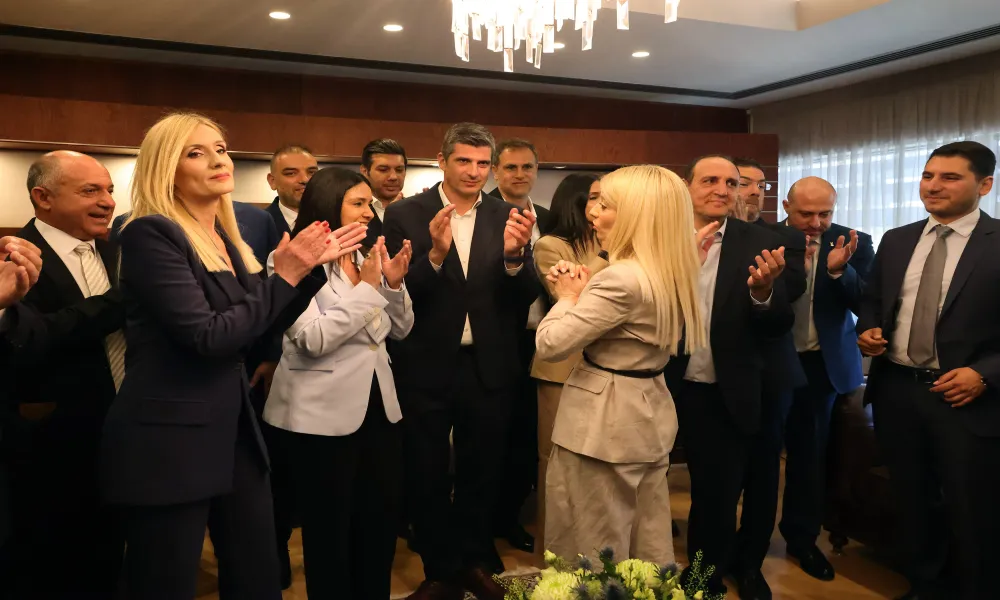

The DISY president won the election in the second round of voting, with the support of DISY, DIKO and the Direct Democracy party. The background of yesterday’s vote was intense and was essentially decided by the decision of the Direct Democracy to support Annita Demetriou from the outset.
The re-election of Annita Demetriou as President of the House of Representatives was not a surprise in terms of the final outcome. However, the process clearly highlighted the political balances, the strategic choices of the parties and the prospects for cooperation that will shape the political landscape up to the presidential elections of 2028.
From the very beginning, that is, once the results of the parliamentary elections were finalised and the discussion on the presidency of the House opened, both DISY and AKEL insisted, throughout their behind-the-scenes contacts with other parties, on keeping their leaders on the table. Despite the various signals exchanged, it was evident that the contest would develop into a pure political confrontation between the two largest parties, which not only survived the elections but, under the circumstances, emerged as the winners.
The result of yesterday’s first round of voting reflected the real strength of the parties within Parliament. Annita Demetriou secured 21 votes, 17 from DISY’s parliamentary strength and four from the Direct Democracy. Stefanos Stefanou gathered 19 votes, coming from AKEL (15) and ALMA (4). Nikolas Papadopoulos received the eight votes of DIKO, while Christos Christou also received the eight votes of ELAM.
The second round confirmed the estimates formed after the first round. DIKO decided to support Annita Demetriou, who thus gathered a total of 29 votes, while Stefanos Stefanou remained at 19. ELAM chose to abstain, maintaining from the start that it would not vote for either Annita Demetriou or Stefanos Stefanou.
The role of a “small” party
The first major political conclusion concerns the role of the Direct Democracy. The party’s four votes proved decisive. Without them, Annita Demetriou would have been limited to the 17 votes of DISY and Stefanos Stefanou would have emerged first in the first round. The decision of the Direct Democracy to support the DISY president appeared to be both a political and tactical victory for DISY, which convinced the newly established party that it was more productive to trust the large parliamentary party than to focus on individual issues of concern.
Indicative is the statement by the party’s leader, Fidias Panayiotou, who during his congratulations to Annita Demetriou noted that the party’s MPs acted based on issues that concern them strongly and were central to their campaign, such as “pensions being aligned with the minimum wage at €1,088,” as well as the understanding shown regarding “the creation of ten thousand homes that we want in order to increase the housing stock, so that rental prices in Cyprus fall.”
ELAM’s stance
The second key factor in yesterday’s result was ELAM’s stance. Despite intense discussions beforehand and scenarios regarding the formation of a broader alliance around Nikolas Papadopoulos, ELAM chose to maintain its own candidacy in the first round. This decision proved decisive, as it deprived DIKO of the possibility of realistically claiming participation in the second round. The party of Christos Christou opted to protect its political autonomy and to avoid a cooperation that could be perceived as a retreat from the positions it maintains based on its own views and approaches.
A third factor was DIKO’s choice not to follow the path of abstention in the second round, as ELAM did, but to shift towards supporting the already emerging winner, Annita Demetriou, thus maintaining bridges for future cooperation between the two parties.
A choice without turning back
Equally important was AKEL’s stance. The party did not accept the possibility of shifting towards Papadopoulos’ candidacy, nor did it appear willing to enter into a multi-party agreement with exchanges. With this choice, AKEL preferred to fight a clear political battle against DISY, even if the numerical balance was ultimately not in its favour.
The party’s stance, based on the data, was a one-way route, but also a consequence of its recovery in the elections. It was not prepared under any circumstances to risk the trust shown by its voters. This stance essentially strengthens the image of a clear confrontation between the two largest political forces of the country, without embellishments or the intervention of other forces.
A failed effort
The election of Annita Demetriou as President of the House appears, in practice, to have overturned an effort by the Presidential Palace, which developed behind the scenes, aiming to form an axis of cooperation among parties maintaining relations with the government of Nicos Christodoulides. Such a scenario could have created new dynamics, both in the functioning of the House and in the implications of these relationships up to the 2028 presidential elections.
Ultimately, however, the differing strategic aims of the parties prevented the creation of a unified front. DIKO and ELAM followed different paths, resulting in the final contest being limited to the two traditional protagonists of the political system, DISY and AKEL.
In essence, from the election of Annita Demetriou for a second consecutive term as President of the House, it emerged that:
- DISY insisted from the beginning on Annita Demetriou’s candidacy and did not engage in scenarios of broader consensus or exchanges.
- AKEL maintained Stefanos Stefanou’s candidacy until the end, rejecting the prospect of supporting Nikolas Papadopoulos within the framework of a broader anti‑DISY alliance.
- Both parties chose to test their strength and engage in a clear political confrontation between them, instead of participating in multi-party formations that would blur the political message.
In essence, yesterday’s process functioned as an early test of balances and intentions ahead of political developments leading up to 2028.