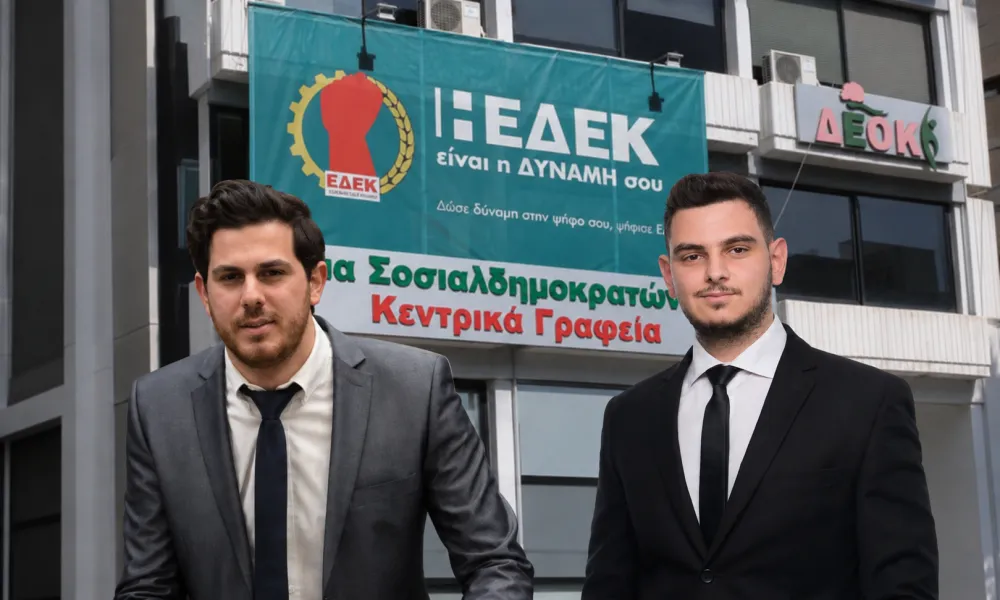

Serious concerns over the conduct of EDEK's leadership election have been raised by two members of the party's Central Electoral Committee (KEE), who allege that unanimous decisions of the committee have either not been implemented or have not been reflected in the final electoral arrangements.
In a joint statement, Yiannis Anastasiou and Michalis Theodoulou said recent developments had left them unable to remain silent and prompted them to publicly distance themselves from the way the process was unfolding.
They stressed that their intervention concerns the institutional operation of the election, respect for the responsibilities of party bodies and the need to safeguard the trust of EDEK members and voters.
Claims of a "parallel process"
The two committee members noted that the KEE has already met twice and that, during its second meeting, it unanimously adopted a series of decisions and recommendations aimed at ensuring a smooth, transparent and impartial election.
According to their statement, those recommendations were submitted in writing to the Political Bureau and were also presented by telephone to all three candidates, with two of the candidates reportedly accepting them.
Among the decisions was a meeting of the Provincial Electoral Committees scheduled for 2 September at Oasis in Choirokoitia for briefing and coordination purposes.
However, Anastasiou and Theodoulou claim that a separate meeting of Provincial Electoral Committee chairpersons was convened by the party's deputy president without prior notification of the KEE.
They argue that this effectively created a "parallel process" dealing with issues that fall within the remit of the electoral procedure and ask: "What is ultimately the role and authority of the Central Electoral Committee?"
Questions over meeting minutes
The two members also raised concerns regarding the minutes of the party's Central Committee.
They said that no minutes relating to election decisions and procedures were presented during the first meeting of the KEE and claimed such records did not exist at that stage.
According to their statement, minutes appeared the following day containing references to election-related decisions.
They further claim that members of the Central Committee subsequently disputed parts of those minutes, reportedly arguing that certain issues had either not been discussed or that different decisions had been taken.
"The fact that there is disagreement regarding the content of minutes relating to the electoral process is serious in itself," they stated.
Disagreement over voting venue in Paphos
The two committee members also devoted significant attention to voting locations, particularly in Paphos.
They said reservations had been expressed by local party officials and members about holding the vote at party offices, citing concerns including accessibility and service for elderly voters.
According to their statement, the Palia Ilektriki venue had been made available free of charge by the Municipality of Paphos and its use was unanimously recommended by the KEE.
However, the party's final announcement selected a different venue.
They contrasted the situation with Larnaca, where they say a unanimous recommendation of the KEE regarding a venue change was accepted.
"If Central Committee decisions are regarded as binding, why was a venue change adopted in Larnaca while the unanimous KEE recommendation regarding Palia Ilektriki in Paphos was not?" they asked.
Questions over Tillyria ballot changes
Another issue concerns the removal of a ballot box from Pyrgos Tillyrias and the addition of one in Pomos.
Anastasiou and Theodoulou said the change was never discussed by the KEE and that the committee never authorised the placement of a ballot box in Pomos.
"Who decided on this change and under what authority?" they asked, describing the issue as significant for the organisation of the election.
Vote transfer arrangement omitted
The two members also expressed concern that a unanimous KEE decision allowing members to transfer their voting rights between districts was omitted from EDEK's official election announcement.
Under the committee's proposal, members wishing to vote in a different district from the one in which they are registered would have been able to submit a request by email until 3 September.
According to the two members, the measure was intended to facilitate participation and maximise voter turnout.
They questioned which unanimous KEE decisions would ultimately be implemented and which would not.
"Is the KEE the competent body or not?"
Anastasiou and Theodoulou acknowledged that each incident might be viewed individually as an organisational disagreement.
Taken together, however, they argue that the overall picture raises serious questions about how decisions are being made.
They cited:
- Disputed meeting minutes.
- Unanimous KEE decisions not reflected in the final arrangements.
- Different treatment of voting venues across districts.
- Changes to ballot locations without discussion.
- The exclusion of vote-transfer provisions.
- Parallel meetings involving Provincial Electoral Committees.
"Who ultimately decides election matters? Is the Central Electoral Committee the competent electoral body or is it being bypassed in practice?" they asked.
They stressed that they do not dispute the institutional role of any party body but are calling for a clear division of responsibilities, institutional consistency and a unified decision-making process.
"It is not enough to say the process is impartial. It must also appear impartial. It is not enough to say there is transparency. The process itself must project transparency," they said.
They will not resign
Despite their concerns, Anastasiou and Theodoulou made clear they do not intend to resign from the KEE.
"We are not leaving because we disagree. We remain because we have a responsibility," they said.
They added that they will continue carrying out their duties "with seriousness, responsibility and without any bias in favour of or against any candidate."
They concluded by arguing that the credibility of the election depends not only on the result but also on the procedures that precede it, the equal application of rules and clarity regarding which body takes each decision.
EDEK: Voting at nine polling centres
Earlier, EDEK announced details of the presidential election process, stating that voting will be conducted in accordance with the unanimous decisions adopted by the party's Central Committee on 30 July 2026.
The announcement, however, made no reference to the Central Electoral Committee or to the document disclosed by Politis on Sunday.
According to EDEK, polling stations will operate across all districts of government-controlled Cyprus, as well as in the wider Tylliria area, at a location designed to serve both local voters and those from the Polis Chrysochous area.
Polling stations will also operate in:
- Athens
- Thessaloniki
- London
Voting will take place from 9:30am to 5:30pm, with different hours to be announced for London because of the time difference.
Polling stations
- Limassol: EDEK Offices, 81 Agias Fylaxeos, 3rd floor.
- Paphos: EDEK Offices, Aristi Court, 34 Nikou Nikolaides Avenue, 2nd floor, Office 202.
- Nicosia: Exormisi Cultural Centre, 12 Thrakis Street, Strovolos.
- Larnaca: Larnaca Municipality Multipurpose Centre, 62 Faneromenis Avenue.
- Famagusta District: Sotira Multipurpose Centre, opposite Sotira Town Hall.
- Pomos: Municipality Hall of Polis Chrysochous, Pomos Municipal District.
- Athens: Cyprus House, 3 Kekropos Street, Plaka.
- Thessaloniki: AGONA Offices, 18 Ioulianou Street.
- London: Greek Cypriot Brotherhood, 2 Britannia Road, London.
Who can vote?
The election will be based on the party membership register covering the period 2015-2025, except in cases where different decisions were adopted by the Extraordinary Pancyprian Congress.
Members wishing to vote must present a party identity card and pay a €10 membership contribution.