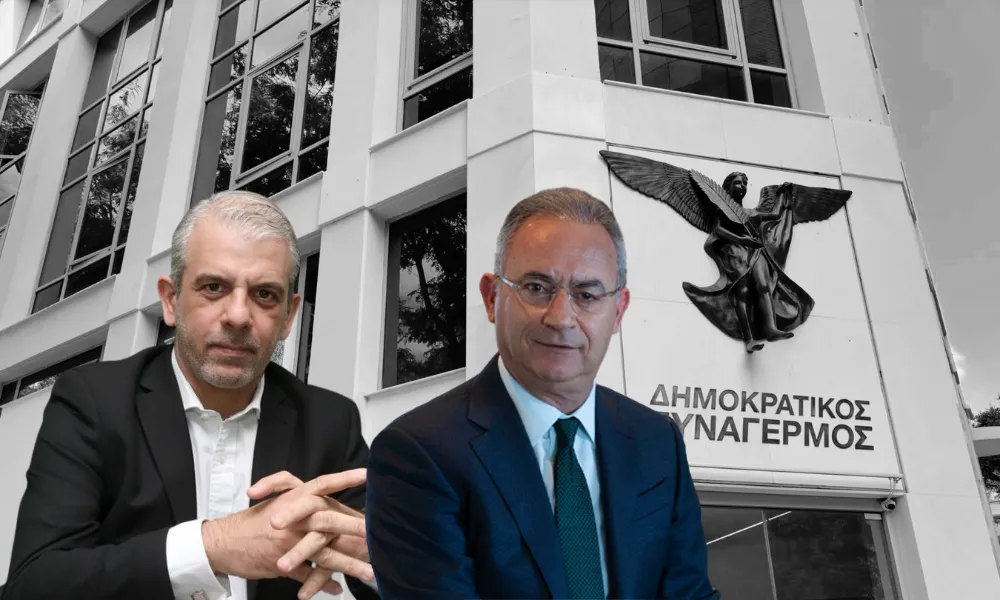

Three days after former DISY leader Averof Neophytou proposed lifting energy sanctions against Russia, the suggestion continues to spark criticism within the party. Shadow cabinet head Michalis Ioannides has challenged his arguments, defending DISY’s position on European sanctions and warning of potential consequences for Cyprus’s strategic interests.
The proposal by former Democratic Rally (DISY) leader Averof Neophytou to lift energy sanctions against Russia continues to generate controversy within the party, three days after his press conference.
On Sunday, DISY shadow cabinet head Michalis Ioannides published a lengthy statement responding point by point to Neophytou’s arguments, as he had indicated he would do on Friday. Ioannides said his intervention was intended to defend the party’s established position.
Four assumptions challenged
Ioannides argued that Neophytou’s proposal rests on four incorrect assumptions.
The first, he said, was that sanctions had driven up diesel prices. Ioannides attributed the increase instead to the war involving Iran and the closure of the Strait of Hormuz from late February.
His second objection concerned the prospect of Russian diesel returning to the market if sanctions were lifted. He argued that Russia had itself been restricting exports since July because of attacks on its refineries. He also cited Eurostat figures which, according to his statement, show that Cyprus has not imported Russian diesel since 2008.
The third assumption concerned the potential benefit to consumers.
Citing an estimate by Goldman Sachs, Ioannides calculated that even a European agreement comparable to the US arrangement would reduce fuel prices by only around one cent per litre.
Finally, he challenged the suggestion that the United States had provided a model for Europe to follow. According to Ioannides, Washington had not lifted sanctions outright but had issued a temporary authorisation covering diesel alone. He added that the European Council had expressed regret over the US decision.
Turkey, the Cronos gas field and Cyprus’ position in Europe
Ioannides also highlighted the approaching expiry of the EU sanctions framework concerning Turkish drilling activities, which is due to expire on 30 November. Renewing the measures requires unanimity among EU member states, he noted, warning that Cyprus could not afford to act as “Europe’s kamikaze”.
Turning to natural gas, he argued that Neophytou’s proposal ran counter to Cyprus’s interests.
In his assessment, Europe’s efforts to reduce dependence on Russian gas would constrain Turkey’s role as a transit country through TurkStream while strengthening Cyprus’s position as a gas producer, particularly through the Cronos gas field.
Ioannides also cited statements made by Neophytou in 2022, when, as DISY leader, he argued that Cyprus had rightly accepted the economic cost of maintaining a principled position.
He compared the latest proposal with positions advocated by Hungarian Prime Minister Viktor Orbán, Slovak Prime Minister Robert Fico and Germany’s Alternative for Germany (AfD) party.
He also recalled a European Parliament vote on ending Russian gas supplies in which AKEL’s MEP and Fidias Panayiotou voted against the measure.
Referring to Cyprus’s accession to the European Union, Ioannides wrote that the country had “joined to sit at the table of the West, not on the menu”.
Targeted support to tackle high fuel prices
As an alternative to lifting sanctions, Ioannides advocated targeted assistance for consumers rather than across-the-board measures.
He also called for greater transparency over fuel prices before taxes are applied and urged the authorities to decide on excise duty before 30 November.
The proposals reflect his argument that the cost-of-living pressures facing households should be addressed through domestic policy measures rather than a change in Cyprus’s position on European sanctions.
DISY distances itself from former leader’s proposal
Ioannides’s intervention follows a statement issued by DISY just hours after Neophytou’s press conference, in which the party distanced itself from his proposal.
DISY said it supported the positions of the European People’s Party (EPP) and the common policy adopted by all 27 EU member states on energy sanctions, “always in full coordination with Greece”.
It described Neophytou’s suggestion as “his personal proposal within the framework of public political debate”.
On the same day, DISY MP Nikos Tornaritis raised questions in an article published by Politis about consistency between Cyprus’s position on Russia and its expectations of European support over Turkey.
The dispute has therefore developed beyond the immediate question of fuel prices, touching on Cyprus’s wider foreign policy and its approach to collective EU decisions.
Dispute unfolds ahead of DISY leadership election
The controversy comes at a sensitive time for DISY, as the party prepares for its internal leadership election.
Ioannides has publicly backed Giorgos Pamboridis for the party’s leadership nomination. Neophytou’s press conference on Friday was his first public intervention since Annita Demetriou withdrew from the contest.
Nominations are due to be submitted on 26 October, while the internal party vote is scheduled for 28 November, less than six weeks away.
The continuing disagreement over Russia sanctions adds another point of tension as the party approaches the leadership contest, with competing views emerging over both economic policy and Cyprus’s strategic position within the European Union.