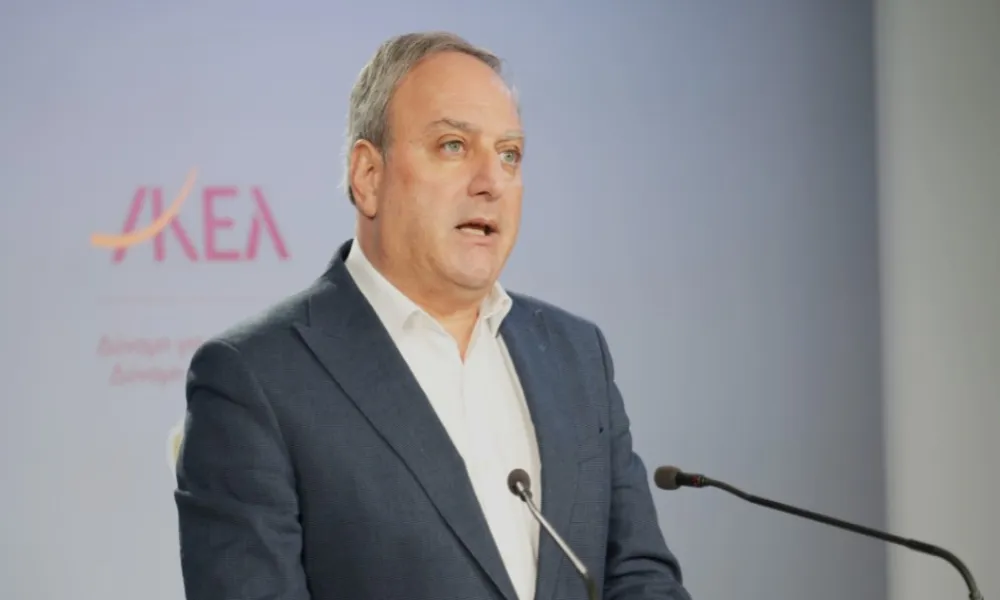

AKEL General Secretary Stefanos Stefanou has called for existing convergences on the Cyprus problem, including those discussed at Crans-Montana, to be preserved, warning that negotiations cannot resume effectively without greater clarity on the positions of both sides.
Stefanou said the agreed framework must be protected before a new round of negotiations begins, expressing concern over how talks could restart without first establishing a clear understanding of the positions of the Greek Cypriot and Turkish Cypriot sides.
Speaking on Politis 107.6 & 97.6 radio’s Proini Epitheorisi programme, hosted by Katerina Iliadi, he said he understood from a briefing to the National Council that President Nikos Christodoulides had conveyed 19 ideas verbally to Turkish Cypriot leader Tufan Erhurman.
According to Stefanou, these included confidence-building measures, proposals on negotiating methodology and substantive issues. He clarified that no written document had been provided to members of the National Council.
Concerns over agreed positions
Stefanou recalled that Greek Cypriot negotiator Menelaos Menelaou had previously stated that a rotating presidency, combined with cross-voting and weighted voting, was an agreed convergence reached during the presidency of Demetris Christofias.
He argued that both the previous and current presidents, as well as their associates, had at times expressed positions that undermined previously agreed convergences, particularly on political equality.
Stefanou also insisted that the negotiating acquis must include the discussions held at Crans-Montana.
At the talks, he explained, the replacement of the existing system of guarantees with a mechanism for implementing a settlement had been discussed. Under that proposed mechanism, the guarantor powers would have an advisory role.
He said preserving the progress already achieved was essential to ensuring that future negotiations could build on existing agreements rather than reopen settled issues.
AKEL proposes a two-stage roadmap
Stefanou expressed concern over comments by UN Secretary-General's Personal Envoy Maria Angela Holguin indicating that the recorded convergences would be given to the two sides when negotiations begin.
He said it remained unclear how far back the UN record extended, questioning how talks could resume without the parties first clarifying their respective positions.
AKEL has therefore proposed a two-stage roadmap to Christodoulides, he said.
Under the first stage, both sides would submit observations on the United Nations' record of convergences, allowing any necessary corrections or additions to be made.
In the second stage, the parties could submit new proposals, provided that any issues on which no new agreement was reached would remain governed by the existing convergences.
The proposal, Stefanou suggested, would help protect the negotiating acquis while allowing discussions to move forward.
Varosha proposals and priority for crossing points
Asked about proposals concerning Varosha, Stefanou declined to disclose details of discussions at the National Council, citing the confidentiality commitment requested by the president.
He nevertheless expressed displeasure over the disclosure of information from the council's meetings, saying AKEL had raised the issue with Christodoulides.
Turning to the substance of the proposals, Stefanou questioned whether large-scale initiatives could be implemented when the sides had not even managed to agree on opening a new crossing point.
He argued that progress on confidence-building measures, particularly the opening of additional crossing points, was necessary but should not come at the expense of substantive negotiations on the Cyprus problem.
Stefanou also recalled that UN Secretary-General António Guterres had acknowledged the failure of efforts to build momentum through confidence-building measures.
With Guterres approaching the end of his term, Stefanou said preserving the existing negotiating acquis should be a priority.
Positive atmosphere at Pyla festival despite political tensions
Commenting on the recent bicommunal festival in Pyla, Stefanou said the atmosphere among Greek Cypriots, Turkish Cypriots and international visitors had been positive.
He also described the interaction between the two leaders during their social meeting as good, while stressing that the event had taken place against an unfavourable political backdrop.
The gathering offered an opportunity for contact between the two communities, he suggested, but the positive atmosphere did not in itself resolve the wider political disagreements.
Holguin's visit expected to focus on confidence-building measures
Stefanou said he did not know why Holguin had not yet visited Cyprus, noting that the United Nations had announced that she was expected to arrive during October.
Her visit is expected to provide an opportunity to pursue the implementation of some confidence-building measures that have already been discussed, he said.
However, he acknowledged that putting those measures into practice would be difficult.
Stefanou's comments underline AKEL's position that efforts to improve relations between the two communities must go hand in hand with preserving previous negotiating progress and establishing a clear basis for the resumption of substantive talks.