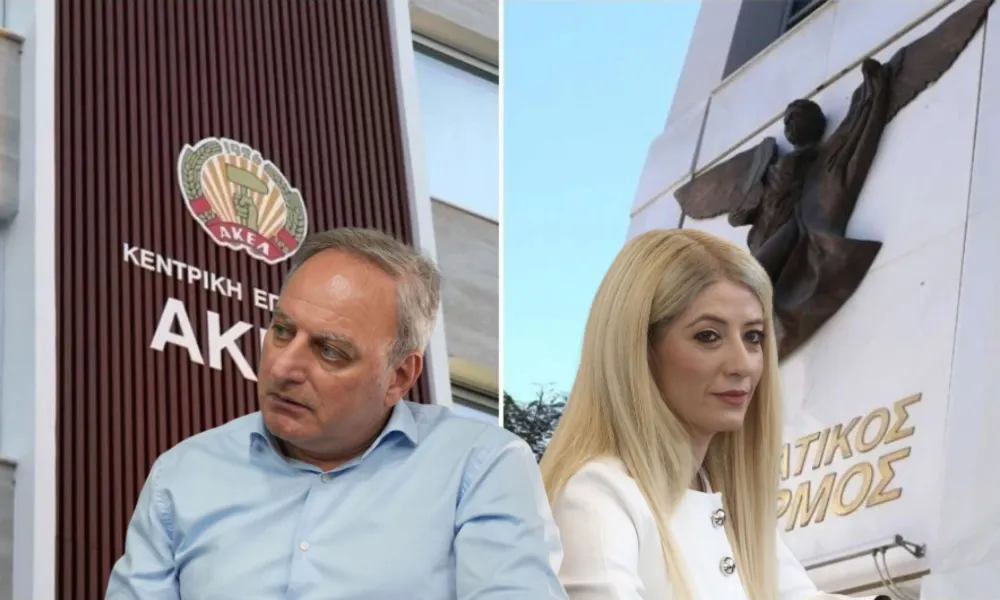

Cyprus' two largest parties, Disy and Akel, together holding 32 of the 56 seats in parliament, are beginning the road to the February 2028 presidential election with unresolved internal issues and no officially chosen candidate.
On Sunday alone, the two parties exchanged four statements within seven hours following a speech by Stefanos Stefanou to Akel's Central Committee.
It marked their first direct political confrontation with an eye on the 2028 presidential contest, but also a clash in which neither side had much to lose. For both parties, the overriding objective is to consolidate support.
Disy once again invoked Akel-era controversies, including Cyprus' loss of access to financial markets, the Dromolaxia scandal and the Mari explosion. Akel responded by pointing to Disy's 13 years in government, the bank bail-in, the collapse of the Cooperative Bank and the "golden passports" programme.
The intended audience was not undecided voters but each party's core supporters.
At the same time, each sought to exploit what it sees as the other's weakness. Disy questioned why Akel is not fielding its own candidate, while Akel accused Disy of resorting to anti-Akel rhetoric to distract from its internal divisions.
United mainly against Akel
Disy's first statement was issued three days after the party's Executive Bureau instructed officials to refrain from public comments on internal matters following Haris Georgiades' letter criticising Averof Neophytou and Annita Demetriou's acknowledgement that party unity was under strain.
Until the party's nomination vote on 28 November, between Neophytou and Giorgos Pamboridis, confrontation with Akel remains one of the few issues on which there is broad agreement within Disy headquarters.
According to an Explorer poll for Phileleftheros, 49% of Disy voters view President Nikos Christodoulides favourably, while Pamboridis has described the party's parliamentary-election support as a "borrowed vote" that is not guaranteed to remain loyal.
For that reason, Disy also used its statement to criticise what it described as the government's lack of decisiveness, positioning itself against both Akel and the president.
Akel's expansion challenge
Akel enters the pre-election period without a candidate of its own.
The party's Central Committee adopted a platform centred on "progressive change" and decided to prioritise discussions on a common programme before selecting a presidential nominee.
Until that process is completed, conflict with Disy offers supporters a clear political opponent.
Akel also faces the challenge of expanding beyond its traditional base. The 48% secured by Andreas Mavroyiannis in the second round of the 2023 presidential election depended in part on support from Disy voters, while prospects for renewed cooperation with Diko appear to be fading.
By linking the Christodoulides administration to Disy and arguing that the two sides are preparing to support one another in a future run-off, Akel is attempting to present itself as the only alternative pole of opposition to both.
The argument stems from former president Nicos Anastasiades' proposal for a pre-election understanding between Disy and Christodoulides.
Those left outside the frame
The renewed two-party confrontation largely ignores the forces that gained ground during the parliamentary elections.
With eight seats, Elam, as well as Alma and Direct Democracy, have little place in a debate centred on which party governed the country more effectively after 2008.
The only significant third figure in the discussion is President Christodoulides, though each party needs him for different reasons.
Akel seeks to identify him with Disy, while Disy is careful not to alienate supporters who continue to view the president positively.
For its cohesion strategy to succeed, Disy must keep its base united after the internal vote on 28 November, while Akel must transform the framework adopted by its Central Committee into political alliances and identify a candidate capable of attracting support beyond the party's traditional electorate.