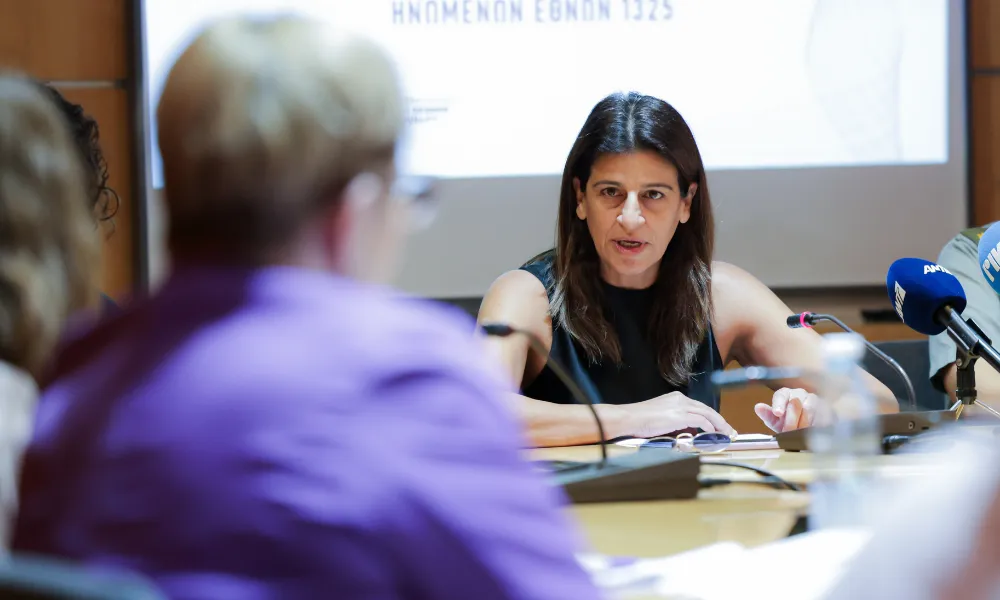



Cyprus remains committed to the principles of international law and the legitimate aspirations of the Palestinian people, Foreign Minister Constantinos Kombos said on Friday during a visit to the Embassy of the State of Palestine in Nicosia. The visit took place in the context of the International Day of Solidarity with the Palestinian People.
Kombos spoke for about 20 minutes with the Palestinian Ambassador to Cyprus, Abdullah Attari. In a message in the Embassy’s visitors’ book, he said the day serves as a reminder of the shared responsibility to work towards a just and comprehensive peace in the Middle East.
As he noted, peace can be achieved only through a two-state solution, in accordance with the relevant UN Security Council resolutions. A unified and territorially contiguous Palestinian state, linking Gaza and the West Bank and with East Jerusalem as its capital, would benefit the Palestinians and strengthen the security of the region as a whole.
The Minister recalled that the Republic of Cyprus was among the first countries to recognise the State of Palestine, in 1988. He added that President Abbas’s visit to Cyprus in October 2026 was clear evidence of the close ties between the two peoples.
Expressing serious concern over the deteriorating situation in the West Bank, Mr Kombos strongly condemned the continuing and escalating violence by settlers against Palestinian civilians. He also reiterated that settlements are illegal under international law and constitute an obstacle to peace.
'Worrying' situation in Gaza
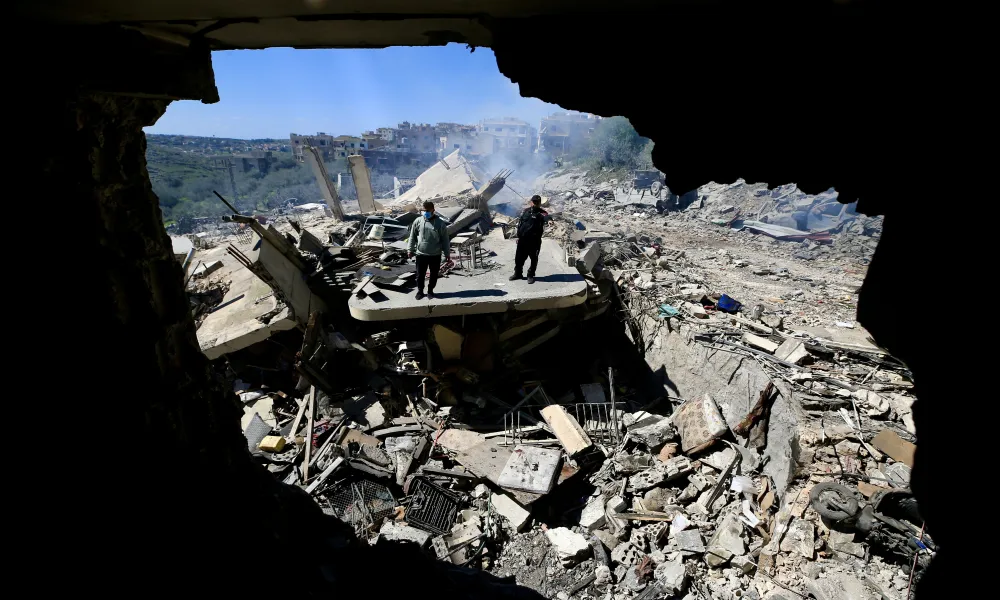
On Gaza, he said the humanitarian situation remains worrying, particularly with winter approaching. He said immediate and unhindered access and the sustained delivery of humanitarian aid on a large scale were essential, including use of the Amalthea maritime corridor as a complement to land routes. He also stressed that the protection of civilians must be ensured at all times.
Cyprus, as the EU member state closest to the region, will continue to contribute actively to stabilisation efforts under the Comprehensive Plan to End the Conflict in Gaza, adopted through UN Security Council Resolution 2803, he said. He also underlined that the Republic of Cyprus remains committed to the stability and prosperity of the region.
Attari said that, at the beginning of what he called the genocide in Gaza, he had personally warned the Cypriot media that “the most dangerous thing would be to become accustomed to what we are seeing”, adding that, unfortunately, he had been proven right.
'Accustomed to the genocide'
The Ambassador said that, in his words, people had become accustomed to the continuation of the genocide in Gaza, ethnic cleansing in the West Bank and settler attacks there, which he described as barbaric, dangerous and criminal. He alleged that the attacks were carried out in cooperation with the army and following political decisions by various ministers in the Netanyahu government.
Referring to the expected change of government in Israel, he urged journalists to be careful, follow developments in Gaza and the West Bank, and not be carried away by the change. He argued that the policy of Israeli governments had remained the same since 1948 and linked the continuation of actions by the Israeli army to the Nakba. He called on people not to become accustomed to what, he said, was happening in Gaza, the West Bank and East Jerusalem.
On the International Day of Solidarity with the Palestinian People, Attari said it was established by UN General Assembly Resolution 181 in 1977, exactly 30 years after the Assembly’s decision to partition Palestine into two states. He said one of the states had become a regional superpower and possessed nuclear weapons, referring to Israel. He added that, in his assessment, Israel’s expansionist policy had reduced the share envisaged by Resolution 181 from 50% to 22%, which, he said, was under occupation.
Stefanou: Our thoughts are with the Palestinian people every day
AKEL Secretary-General Stefanos Stefanou also visited the Embassy. He said that although they were there every year, their thoughts, hearts and struggles were with the Palestinian people every day, as well as with every people fighting for freedom, justice, dignity and solidarity. As he said, all these things were concentrated in the struggle of the Palestinian people.
Stefanou said that in a world increasingly afflicted, in his words, by wars, invasions and occupations, the struggle for freedom in Palestine needed to be intensified and Israel’s policies that violate international law and agreements needed to end.
He added that this was doubly necessary for Cypriots, since, as he said, Cyprus and the Cypriot people were victims of invasion, occupation, settlement and an attempt at ethnic cleansing. He said they joined their voices with that of the Palestinian people, demanding justice in Palestine, Cyprus and throughout the world. “It is our duty, it is our belief,” he said, adding that they would be there every year.
Among those at the Embassy were ambassadors and representatives of diplomatic missions from Armenia, Austria, Brazil, China, Cuba, Egypt, Finland, Greece, the Holy See, Hungary, India, Iran, Ireland, Italy, Japan, Jordan, Kuwait, Lebanon, Libya, Malta, the Netherlands, Oman, Poland, Portugal, Qatar, Romania, Russia, Saudi Arabia, Serbia, Slovakia, Spain, Sweden, Switzerland, Syria, the United Arab Emirates, the United Kingdom and the Maldives.
Also present were Greek Cypriot negotiator Menelaos Menelaou; AKEL MP Marina Nikolaou; Direct Democracy MP Diana Constantinidou; representative of the Armenian religious group in Parliament Vartkes Mahtesian; Cyprus Journalists’ Union President George Fragkos; delegations from PEO and POGO; a Police representative; members of the public; and students.
Source: CNA