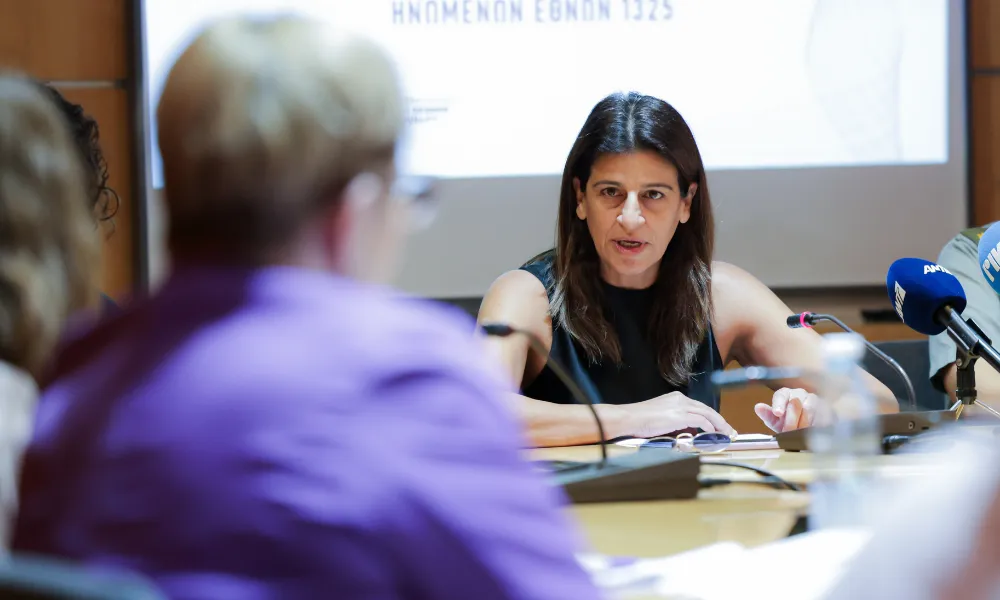

On the third day of the series, Commissioner for Gender Equality Josie Christodoulou addresses the myths that still surround violence against women. She explains how they shift the blame onto women and why the narrative needs to change.
Day 3: What myths about violence against women still persist, such as "she provoked him" or "if she stays, it can't be that serious"?
Josie Christodoulou: "A number of deeply rooted myths and misconceptions about violence against women continue to exist in our society, contributing to victim-blaming, the normalisation of abuse and the silence that often surrounds it.
Expressions such as 'she provoked him', 'she must have done something to deserve it' or 'if it were really that serious, she would have left' shift responsibility from the perpetrator to the victim. These assumptions are not only harmful but also fundamentally wrong. No behaviour, clothing, attitude or decision can justify violence.
Another common misconception is that violence is a private family matter and should remain behind closed doors. Violence against women is not a private issue; it is a violation of human rights and a matter of public concern. So, it is a social problem.
There is also the belief that violence is limited to physical abuse, or that it only occurs in certain social or economic groups. In reality, women of all ages and backgrounds can experience physical, psychological, sexual, economic or online violence.
We must also understand that leaving an abusive relationship is not always simple. Fear, threats, financial dependence, emotional manipulation, concern for children and the risk of retaliation can make leaving extremely difficult and, in some cases, particularly dangerous.
We therefore need to change the narrative: instead of asking why a woman did not leave or what she did to provoke the violence, we must ask why the perpetrator felt entitled to cause harm, and how we can best support the survivor."
What the 16 Days of Activism are
The 16 Days of Activism against Gender-Based Violence is an international campaign that runs every year from 25 November to 10 December.
It begins on the International Day for the Elimination of Violence against Women and ends on Human Rights Day. The dates frame violence against women as a human rights issue.
The theme for 2026, set by the United Nations UNiTE campaign, is "UNiTE to End Violence Against Women and Girls: Ensure justice, protect survivors, end impunity".
Why the series matters
Gender-based violence is the most extreme form of inequality. Preventing it is not only a matter for the justice system and the police. It also requires changes in attitudes, education and institutions.
The series will cover four main themes:
- The roots of violence: stereotypes, unequal power relations and control
- Prevention: the role of education, the workplace and the media
- Justice for survivors: the barriers to reporting abuse and accessing justice
- Equality policies: the National Strategy for Gender Equality
The Commissioner's role
In Cyprus, policy on violence against women is coordinated by the National Coordinating Body for the Prevention and Combating of Violence against Women at the Ministry of Justice and Public Order.
The Commissioner for Gender Equality focuses on what lies behind the violence: unequal power relations and the gender stereotypes that allow it to happen.
Her role is set out in the Commissioner for Gender Equality and Related Matters Law of 2024. Under this law, the Commissioner designs the National Strategy for Gender Equality and coordinates how it is put into practice.
About Josie Christodoulou
Josie Christodoulou was appointed Commissioner for Gender Equality on 1 March 2023. She coordinates and monitors the National Strategy for Gender Equality, working with all ministries and deputy ministries.
She chairs the National Machinery for Women's Rights and founded the Civil Society Platform, which aims to strengthen social dialogue on gender equality.
She previously worked as Policy Coordinator at the Mediterranean Institute of Gender Studies (MIGS). She also served as Adviser to the Minister of Foreign Affairs on including a gender perspective in foreign policy.
She holds a degree in Psychology from the University of Indianapolis in the United States and a master's degree in Gender Studies from Middlesex University in the United Kingdom.
This article is part of a series published by Politis to the Point in collaboration with the Commissioner for Gender Equality for the 16 Days of Activism against Gender-Based Violence. The next question will be published tomorrow.