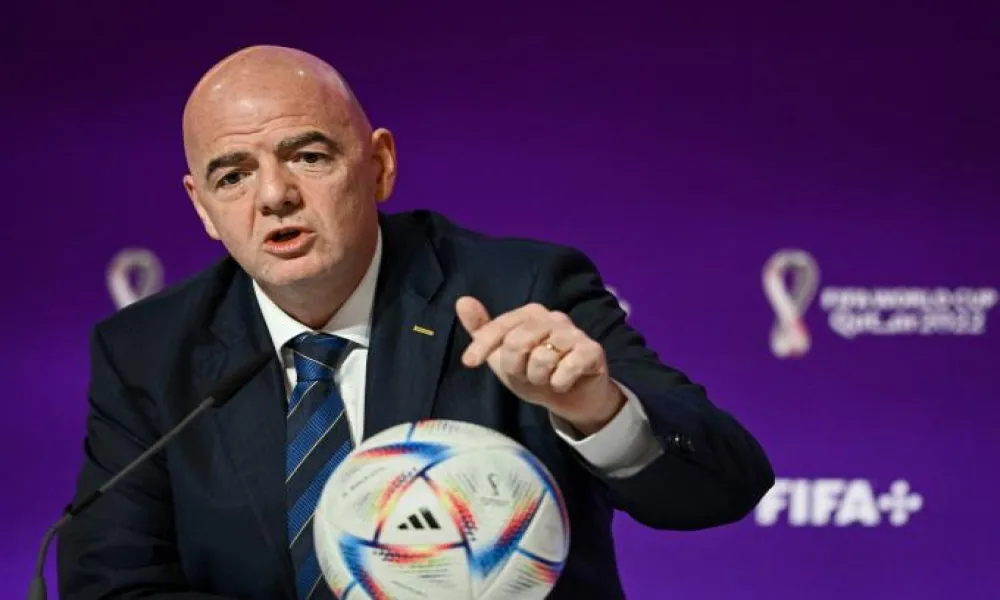

World football has seen dramatic developments over the past 24 hours, following FIFA president Gianni Infantino's statement in the early hours of last Saturday that he was withdrawing his proposal to sell a 20% stake in the World Cup's participation and commercial rights to private investors, in a deal worth $4.2 billion.
International outrage and fierce reaction from the majority of football's confederations and figures forced the powerful head of world football's governing body into a retreat, though even after abandoning the plan, he continues to face harsh daily criticism.
Even former associates have spoken in recent days of "secret" processes they themselves knew nothing about, while major confederations such as UEFA have launched an all-out attack on the Italian-Swiss football executive, describing the process as opaque and saying they have completely lost trust in him.
Infantino now faces a difficult battle ahead of his bid for re-election in March 2027, after national federations including England, Wales, Sweden and Serbia formally withdrew their support for him, joined on Tuesday by the Hellenic Football Federation. Beyond limited remaining support from African federations, Infantino's popularity has collapsed over the past ten days.
The international football world already considers it likely that Infantino, after a decade in the presidency, will be forced to resign soon, potentially even before the next FIFA presidential election, scheduled for 18 March in Morocco.
Discussion has already begun over who might succeed Infantino at the head of world football's governing body. Reuters has produced a detailed early analysis naming five figures who could contest the FIFA presidency in the coming months.
Victor Montagliani (CONCACAF president)
According to a report last Friday, the Canadian businessman and head of the North and Central American football confederation, Victor Montagliani, is seriously considering a bid for the FIFA presidency. CONCACAF rejected Infantino's proposal for private investment funds in the World Cup, though it stopped short of calling for a full boycott, as UEFA did. The 2026 World Cup was the first tournament hosted on CONCACAF territory since 1994.
Aleksander Čeferin (UEFA president)
The Slovenian president of UEFA, Aleksander Čeferin, stayed away from last month's World Cup final following a series of disagreements between UEFA and FIFA. The European confederation has emerged as one of Infantino's most vocal critics during what has been an especially difficult week for the FIFA president.
Sheikh Salman bin Ebrahim Al Khalifa (AFC president)
The president of Asia's football confederation and senior vice-president of the FIFA Council, Sheikh Salman bin Ebrahim Al Khalifa of Bahrain, is among those who have opposed expanding the World Cup to 64 teams. The AFC also criticised Infantino's private investment proposal, saying the plan exposed fundamental weaknesses in FIFA's consultation and decision-making processes that now need to be addressed.
Nasser Al-Khelaifi (Paris Saint-Germain president)
According to a Politico report last week, figures in European football are beginning to rally around the Qatari sports executive and Paris Saint-Germain president, Nasser Al-Khelaifi, as one of the leading potential contenders for the FIFA presidency.
Lise Klaveness (Norwegian Football Federation president)
Lise Klaveness, president of the Norwegian football federation and one of the most prominent women in world football, with considerable influence across Europe and beyond, was among the most vocal leaders of the opposition to Infantino's World Cup stake sale plan.
Norway had also considered filing an ethics complaint with FIFA after the governing body lifted a suspension imposed on US forward Folarin Balogun during the World Cup, following an intervention by US President Donald Trump. That episode reignited questions over the nature of Infantino's relationship with the American president.