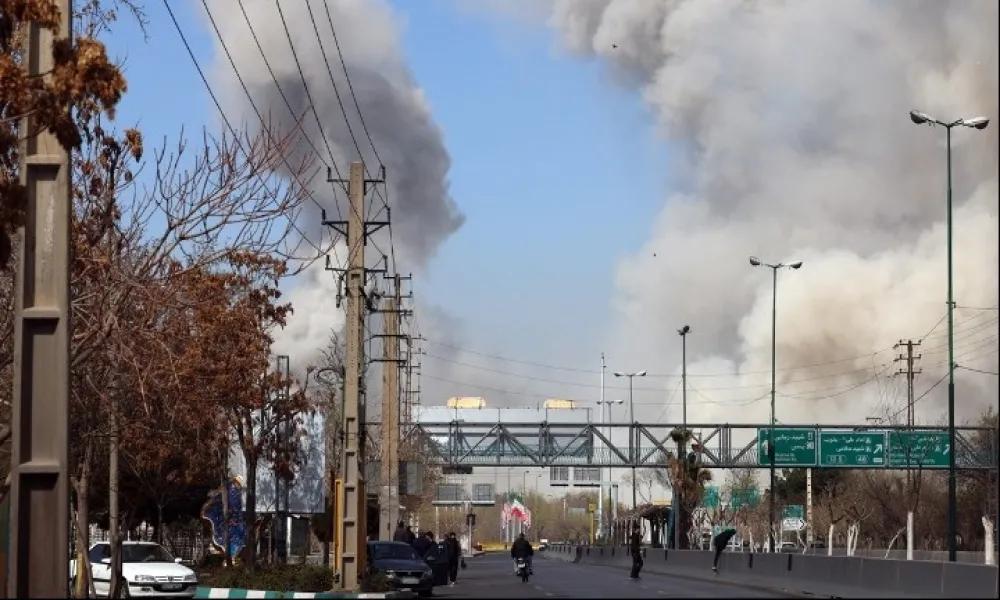

Fresh US military strikes on Iranian targets on Tuesday cast doubt over the prospects of an imminent end to the three-month-old conflict, even as American and Iranian negotiators continued to discuss a framework for a ceasefire and the reopening of the Strait of Hormuz.
US Central Command said it had carried out the strikes to "protect our troops from threats posed by Iranian forces," targeting boats attempting to lay mines and missile launch sites. Secretary of State Marco Rubio, speaking from New Delhi where he was attending a meeting of the Quad grouping, said the Strait of Hormuz must open "one way or the other," and that finalising a deal with Iran could "take a few days." Iran said on Monday it had shot down a "hostile" stealth drone using a new air defence system, without specifying its origin.
The diplomatic picture grew more complicated on several fronts. Iranian Supreme Leader Ayatollah Mojtaba Khamenei said on Tuesday that Gulf powers would no longer serve as a shield for US bases in the region, warning that Washington would have "no safe haven" in the area. Tehran has also demanded a halt to Israeli strikes in Lebanon as a condition of any broader agreement, but Israeli Prime Minister Benjamin Netanyahu said on Monday that Israel would escalate its campaign against Hezbollah, despite an April ceasefire that was meant to contain the conflict's spillover.
The Hormuz framework
On the framework being discussed, Nikkei reported, citing a Middle East diplomatic source, that Iran and the US were working on a plan that would see the strait reopened approximately 30 days after a deal is reached, with Iran clearing mines during that window. Ships from all countries would then be able to navigate freely and Iran would cease collecting transit fees. Under the reported plan, the current ceasefire would be extended by 60 days, during which talks on Iran's nuclear programme would take place.
Trump further complicated negotiations on Monday by calling on Saudi Arabia, Qatar, Pakistan, Turkey, Egypt and Jordan to join the Abraham Accords and normalise relations with Israel en masse, framing the move as part of any agreement to end the war with Iran. Pakistan rejected the proposal outright. None of the other countries named has publicly responded. A positive response is considered unlikely given deep public opposition to Israel in those countries, particularly over the scale of its military operations in Gaza. Saudi Arabia has long maintained it will not normalise relations with Israel without a credible path toward the creation of a Palestinian state, a position the current Israeli government rejects.
Markets and the Quad
Oil prices responded to the renewed uncertainty. Brent crude futures rose more than 2% in Asian trade on Tuesday to $98.21 a barrel, reversing some of Monday's sharp decline. Gold slipped 0.9% to $4,529.50 per ounce, as higher oil prices stoked inflation concerns and the prospect of sustained elevated interest rates. "We keep being told there's a deal that's near, but what does the deal look like? That's what's really important," said Joseph Capurso, strategist at Commonwealth Bank of Australia. "When's the Strait of Hormuz going to open? There's a lot we don't know."
On the sidelines of the conflict, the Quad foreign ministers, Australia's Penny Wong, India's S. Jaishankar, Japan's Toshimitsu Motegi and Rubio, met in New Delhi and agreed to jointly build a port in Fiji, launch an Indo-Pacific Energy Security initiative, and sign a critical minerals framework aimed at strengthening supply chains across mining, processing and recycling.
Source: Reuters