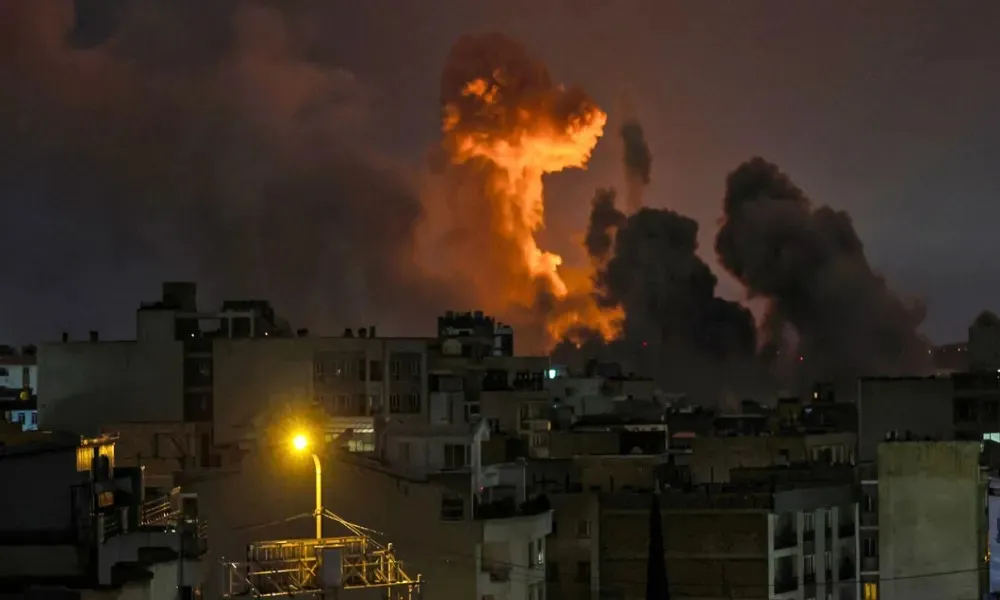
The United States has carried out new military strikes in Iran, according to a US official, as negotiations continue to end the three‑month war in the Middle East. The strikes targeted a military facility considered a threat to US forces and commercial shipping in the Strait of Hormuz.
According to the official, who spoke on condition of anonymity, US forces intercepted and shot down multiple Iranian drones deemed threatening to military units and commercial vessels in the area.
Two US officials said Iran had launched four one‑way attack drones earlier in the day against American and commercial ships.
US fighter jets, including F/A‑18 Hornets, F‑16 Fighting Falcons and F‑35 Lightning IIs, brought down the drones. Subsequently, US F/A‑18 aircraft struck a drone control station near the port city of Bandar Abbas before it could launch a fifth unmanned aircraft. US officials described the operations as limited and defensive, adding that they did not constitute an escalation that would derail the fragile ceasefire. No casualties were reported.
Earlier, Iran’s Fars news agency reported three explosions east of Bandar Abbas at around 01:30 local time. According to the report, air defence systems were activated for several minutes, while authorities launched an investigation into the origin of the blasts.
Bandar Abbas, the capital of Hormozgan province, is considered one of Iran’s key operational centres in the Gulf. At the start of the week, Iranian media also reported explosions in the area, describing exchanges of fire with US forces. Tehran accused Washington of violating the ceasefire in place since early April.
Escalation amid ongoing talks
The latest strikes come as efforts continue to reach an agreement between Washington and Tehran to end the war, which began on 28 February following US and Israeli attacks on Iran.
The conflict has caused thousands of deaths and significant disruption to global energy markets, particularly due to developments around the Strait of Hormuz.
The US also carried out what it described as “defensive strikes” on Monday, which Tehran condemned as a breach of the ceasefire. According to US Central Command, those operations targeted vessels allegedly laying mines and missile installations seen as a threat to US forces.
Trump: “We are not satisfied”
Donald Trump said the United States is not yet satisfied with the terms of the agreement under discussion with Iran.
Speaking during a cabinet meeting at the White House, he said Tehran is seeking a deal but added that “so far they have not reached where we want them.”
“They very much want a deal. I don’t think they have another choice,” he said, adding that the Iranians are “negotiating with their last strength.”
.@POTUS on Iran: "They want very much to make a deal. So far, they haven't gotten there. We're not satisfied with it, but we will be — either that or we'll have to just finish the job... They're negotiating on fumes, but we'll see what happens." pic.twitter.com/eZDKq4RLHO
— Rapid Response 47 (@RapidResponse47) May 27, 2026
Pointing to Defence Secretary Pete Hegseth, he added: “If they don’t give us what we need, then the man to my left will finish them.”
The US president also reiterated that Washington is ready to resume military operations if negotiations fail.
Strait of Hormuz at centre of dispute
Trump also rejected reports from Iranian state media suggesting that Iran and Oman would jointly manage shipping in the Strait of Hormuz under a peace deal.
“The Strait of Hormuz will be open to everyone and the United States will oversee it,” he said, making clear that “no one” will control the waterway.
.@POTUS on Iran: "They're starting to give us the things that they have to give us — and if they do, that's great, and if they won't, then the man on my left is going to finish them off." pic.twitter.com/MzouOlXy2E
— Rapid Response 47 (@RapidResponse47) May 27, 2026
The comments came after Iranian state television reported that a preliminary memorandum of understanding between Washington and Tehran was under negotiation, suggesting that the US would lift the naval blockade of Iranian ports while Iran would restore navigation in the strait to pre‑war levels within a month.
The report also claimed that shipping management would be jointly handled by Iran and Oman.
The White House dismissed these claims outright, describing them as “a complete fabrication.”
US Secretary of State Marco Rubio said there had been “some progress and interest” in the negotiations, without specifying which issues remain unresolved.