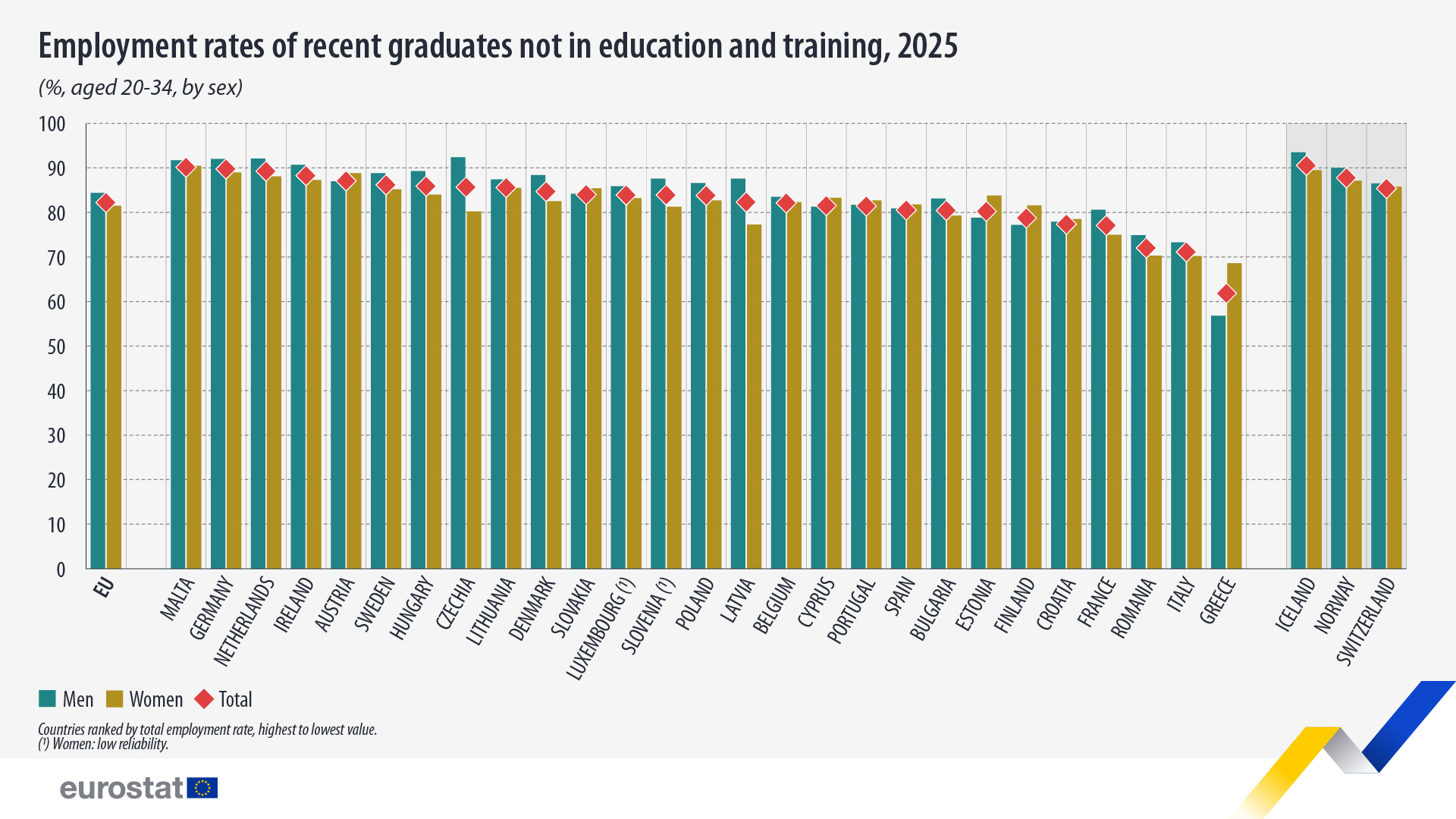

The move from education into work appears to be becoming smoother for young people across the EU, with more than eight in ten recent graduates in employment last year, according to new Eurostat figures.
In 2025, the employment rate for young adults aged 20 to 34 who had recently completed upper secondary or tertiary education reached 83.0%, up from 82.3% in 2024. The longer-term picture also points to steady improvement, with the rate rising by 7.5 percentage points over the past 11 years.
The figures underline the advantage of higher education in the labour market. Recent graduates with tertiary qualifications had an employment rate of 87.0%, almost 10 percentage points higher than the 77.2% recorded among those with medium-level education.
Malta recorded the strongest performance in the EU, with 91.0% of recent graduates in work, followed by Germany at 90.6% and the Netherlands at 90.1%. Cyprus stood at 82.3%, slightly below the EU average but well above the countries at the lower end of the table. Greece had the lowest rate, at 62.4%, followed by Italy at 71.8% and Romania at 72.7%.
Gender gap remains visible
The data also show that men continue to enter employment at a higher rate than women after graduation. Across the EU, 84.4% of recent male graduates were employed in 2025, compared with 81.5% of women.
Among men, the highest rates were recorded in Czechia, at 92.4%, followed by the Netherlands at 92.1% and Germany at 92.0%. Greece, Italy and Romania recorded the lowest rates. For women, Malta led the EU with 90.5%, ahead of Germany at 89.0% and Austria at 88.8%, while the lowest rates were again found in Greece, Italy and Romania.
In 18 EU countries, recent male graduates were more likely to be employed than women. The widest gaps were seen in Czechia, Latvia and Slovenia. In the countries where women recorded higher employment rates than men, the largest differences were in Greece, Estonia and Finland.