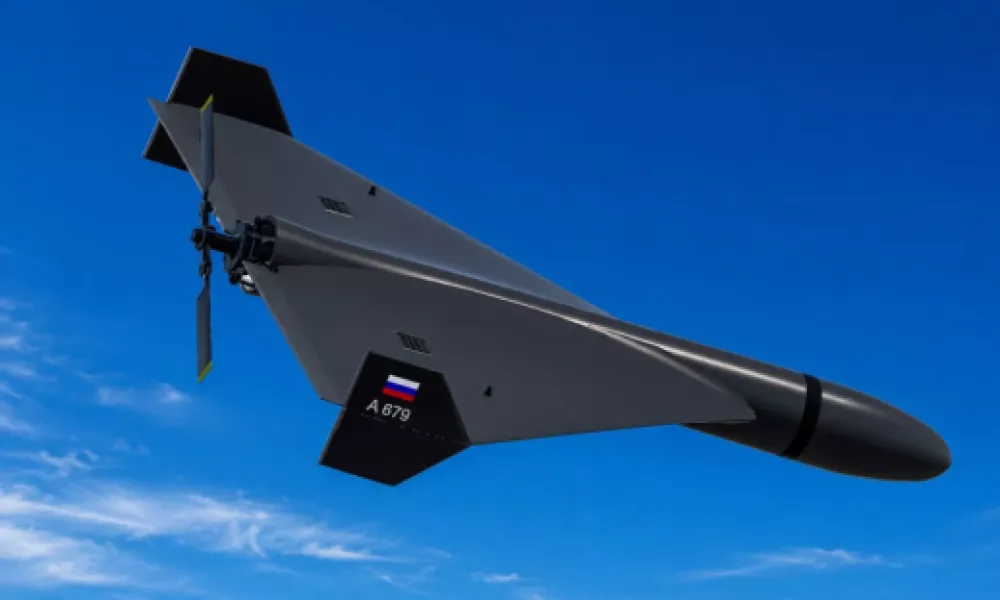

A Russian drone that crashed into a ten-storey apartment building in Galați, Romania, far from the Ukrainian front, has underlined one of Europe’s most uncomfortable security realities: the drone war does not stop at national borders.
The incident has drawn renewed attention to Russia’s use of Shahed-type attack drones, the low-cost weapons that have become central to Moscow’s campaign against Ukraine since the full-scale invasion began in February 2022.
The Weapon That Sounds Like A Lawnmower
Shahed-type drones are now among Russia’s most widely used weapons in the war. They are launched in large numbers, often hundreds in a single night, against military targets, residential areas, energy facilities and civilian infrastructure.
Their purpose is not only destruction. It is also exhaustion. By sending waves of relatively cheap drones, Russia forces defenders to use expensive air defence missiles, gradually draining ammunition stocks and stretching response systems.
In Ukraine, the drones are often nicknamed “mopeds” because of their deep, distinctive engine noise, often compared to a lawnmower. It is a sound that residents of Kyiv, Odesa and now Galați have learned to fear.
Shahed-136 Or Geran-2?
The Geran-2 is Russia’s domestically produced version of Iran’s Shahed-136. It is a long-range, single-use attack drone, commonly described as a kamikaze drone because it flies to its target and explodes on impact.
Moscow began domestic assembly in 2023 at a factory in Tatarstan, a year after the start of the war. Once production moved inside Russia, the scale of attacks increased sharply, with more drones launched in a single night than were previously used over entire months.
The specifications explain why the tactic has proved effective. The Geran-2 is relatively slow, flying at around 180 kilometres per hour, but it can reach distances of up to 2,000 kilometres and carry roughly 50 kilograms of explosives.
Compared with ballistic and cruise missiles, it is slower and less powerful. But at an estimated cost of €25,000 to €40,000, it is far cheaper than missiles worth millions. In a war of attrition, that cost ratio matters.
Western Components In Russian Wreckage
One of the most difficult aspects of the drone campaign for Europe is the continued presence of Western-made components in Russian systems.
Despite European Union sanctions banning direct exports to Russia, hundreds of parts made by Western companies continue to appear in Russian drones. Ukrainian military intelligence has mapped the structure of downed Geran-2 drones by analysing wreckage recovered after attacks.
According to a joint journalistic investigation published in February, only a small share of the hundreds of components identified were of Russian origin. Many were produced in the United States and China, while more than 100 were made by around 20 European companies, including microchips, receivers, transistors, diodes, antennas and fuel pumps.
Trade data cited in the investigation showed 672 shipments of sanctioned components from European companies to Russia between January 2024 and March 2025, routed through 178 intermediary firms, mainly in China and Hong Kong.
Geran-5 And The Next Phase
Russia has also continued to upgrade the Geran line. Since securing domestic production, Moscow has worked on greater flight altitude, better resistance to electronic interference and heavier warheads.
In May, the Geran-5 was presented as a significant step forward. It is a jet-powered attack drone, around six metres long, with a wingspan of up to 5.5 metres. Its size brings it closer to a small cruise missile than to the original Shahed design.
It reportedly uses a Chinese-made Telefly engine, carries a 90-kilogram warhead and has an operational range of around 1,000 kilometres. Its cruising speed is estimated at 450 to 600 kilometres per hour, around three times faster than its predecessor, while carrying nearly twice the payload.
Ukrainian military information suggests the Geran-5 can also be launched from aircraft, including Su-25 attack jets. It may also be able to carry R-73 infrared-guided air-to-air missiles in addition to its main warhead. Reports indicate that this version also relies on Western microelectronics, including chips from countries such as Germany and the United States.
357 Nights Of Attacks In One Year
The scale of Russia’s drone campaign is difficult to overstate. In 2025, Moscow attacked Ukrainian cities on 357 of the year’s 365 nights. Ukraine had only eight nights without an air raid alert.
As attacks have become larger and deadlier, Kyiv has continued to strengthen its air defences and develop systems specifically designed to counter Geran-type drones.
The results show that Ukraine’s defences can still respond effectively. On 23 May, during one of the largest attacks of the war, Russia launched 600 drones, 36 ballistic missiles, Kinzhal and Zircon hypersonic weapons, and Oreshnik medium-range ballistic missiles.
Ukrainian forces intercepted the overwhelming majority of them, with the reported shoot-down rate for Shahed-type drones exceeding 91%. The challenge is no longer only interception. It is cost and endurance. When 600 drones are launched in one night, even the small percentage that gets through can cause serious damage.
Galați And The NATO Alarm
The night of 28 to 29 May 2026 brought the war beyond Ukraine’s immediate battlefield. A Russian drone, identified by Romanian authorities as a Geran-2, entered Romanian airspace and struck a ten-storey apartment building in Galați, near the Ukrainian border on the Danube.
The warhead exploded, a fire broke out and two residents were lightly injured. It was the first time since the start of Russia’s full-scale invasion that a Russian drone had hit a residential building on Romanian territory.
Two Romanian F-16s took off from the Fetești air base and were ordered to engage, but did not shoot the drone down over a populated area in order to avoid triggering an explosion in an urban zone. The drone remained in Romanian airspace for about four minutes before crashing.
Romania’s interim prime minister, Ilie Bolojan, acknowledged that the country’s air defence response was limited by the equipment available, a rare public admission of vulnerability.
Bucharest summoned the Russian ambassador and described the incident as a “serious and irresponsible escalation”. NATO Secretary-General Mark Rutte said the alliance would defend “every inch” of allied territory and warned that the consequences of the war “do not stop at the border”.
According to Romania’s Ministry of Defence, debris from Russian drones has been found on Romanian territory at least 47 times since the start of the war, including 12 times in 2026 alone. The Galați strike was not an isolated accident. It was the culmination of a growing pattern.
Source: newsauto.gr