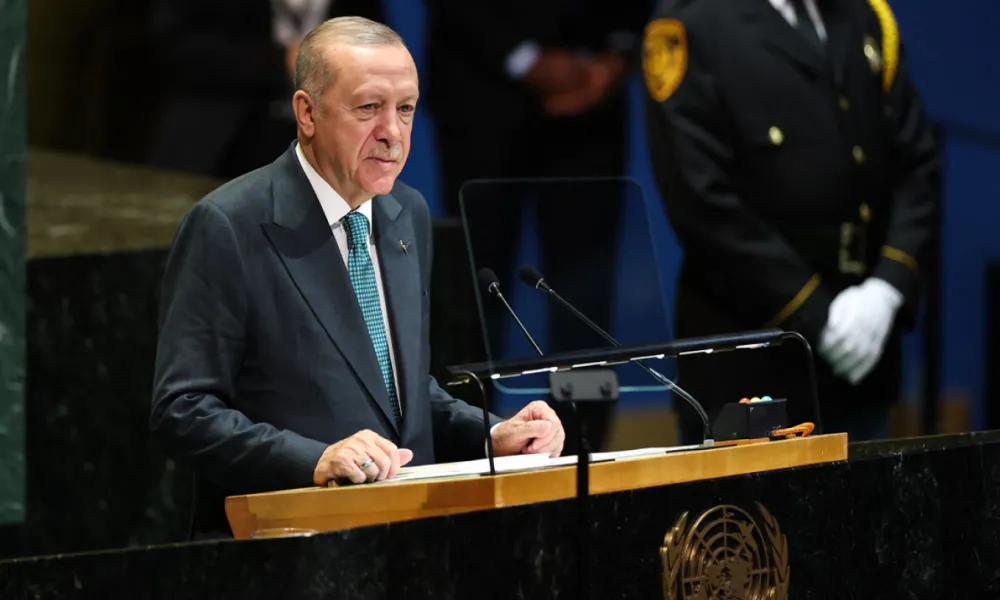
“The job is easy for us as long as this gentleman remains at the head of the CHP.” That was how Recep Tayyip Erdogan described Kemal Kilicdaroglu when he took over Turkey’s main opposition party in 2012.
After a three-year break, Kilicdaroglu is now returning to the leadership of the Republican People’s Party, known as the CHP, with the help of his old adversary. The move points to a more inventive form of authoritarian rule, one that preserves the appearance of democratic politics while reshaping the opposition from within.
On 21 May 2026, Turkish courts annulled the CHP’s 2023 congress, citing allegations of vote-buying among delegates. That congress had brought Ozgur Ozel to the leadership of the party, replacing Kilicdaroglu.
The judges suspended the party leadership, effectively removing Ozel and ordering Kilicdaroglu’s reinstatement. Unprecedented scenes followed, with police forcibly removing the party leadership from CHP headquarters.
Turkey has a long history of dissolving parties and eliminating political rivals. Istanbul Mayor Ekrem Imamoglu was arrested in March 2025, while Selahattin Demirtas, the then co-chair of the pro-Kurdish Peoples’ Democratic Party, or HDP, was jailed in 2016.
The Turkish state has previously used the courts to shut down political parties, from Necmettin Erbakan’s Welfare Party, banned in 1998, to a long list of Kurdish parties, including the People’s Labour Party, the Democracy Party, the People’s Democratic Party, the Democratic Society Party and the HDP.
What changed on 21 May
Turkey’s authoritarian slide has passed through several milestones over the past decade, according to Salim Cevik, a Turkey analyst at the Arab Center in Washington DC, writing in Foreign Policy.
Those milestones involved the repression of opposition figures, the removal of individuals, restrictions on institutions and the shrinking of the space in which the opposition could operate.
But Cevik argues that the 21 May decision goes further. The target is no longer an individual, a mayor or a municipality, he writes, but the party itself, the institutional vehicle through which any future challenge to Erdogan would be expected to emerge.
In that sense, the court ruling does not merely weaken or intimidate the opposition. It seeks to redesign it.
By leaving the main opposition party intact while changing the person who controls it, Erdogan avoids the political costs of banning the CHP outright. Under Kilicdaroglu, the CHP would probably continue contesting elections, holding parliamentary seats and offering visible proof of political pluralism. It would provide the image of competition without its substance.
Had Erdogan moved to dissolve the CHP, he risked turning his opponents into victims and possibly strengthening them. Instead, the party remains in place, but under a leadership more convenient to the authorities.
In April 2026, Erdogan said Turkish democracy would soon have “the kind of main opposition it deserves”. One month later, the court delivered it. A similar pattern was visible in 2016, when Erdogan helped block an extraordinary congress of the far-right Nationalist Movement Party, which could have threatened the position of Devlet Bahceli, later his political ally.
There is no known agreement between Erdogan and Kilicdaroglu. Even so, Kilicdaroglu’s request for police to clear the party headquarters by force is being read as a sign of the approach he is likely to take.
Can Ozel form a new party?
For Ozel, forming a new party remains a difficult option. According to Cevik, the first obstacles would be funding, organisation and the creation of a network of local branches. These challenges might be overcome in normal circumstances.
What makes them far more difficult today is the scale of state pressure on private actors who would need to support such an effort. Even landlords could hesitate to rent office space to a new opposition movement for fear of government retaliation.
New parties rarely succeed in Turkey even under normal conditions. Current conditions are anything but normal.
Ozel also faces an additional risk. A parliamentary file seeking the lifting of his immunity is already pending, meaning that leaving the CHP could expose him to prosecution without the political protection his position still provides.
For now, a breakaway party remains a last resort.
Source: in.gr